Sermorelin
$59.95
- Buy 5+ of each and save 5%
- Buy 10+ of each and save 8%
- Product is sold in powder form, needs reconstitution before use. Please read more on our FAQ page.
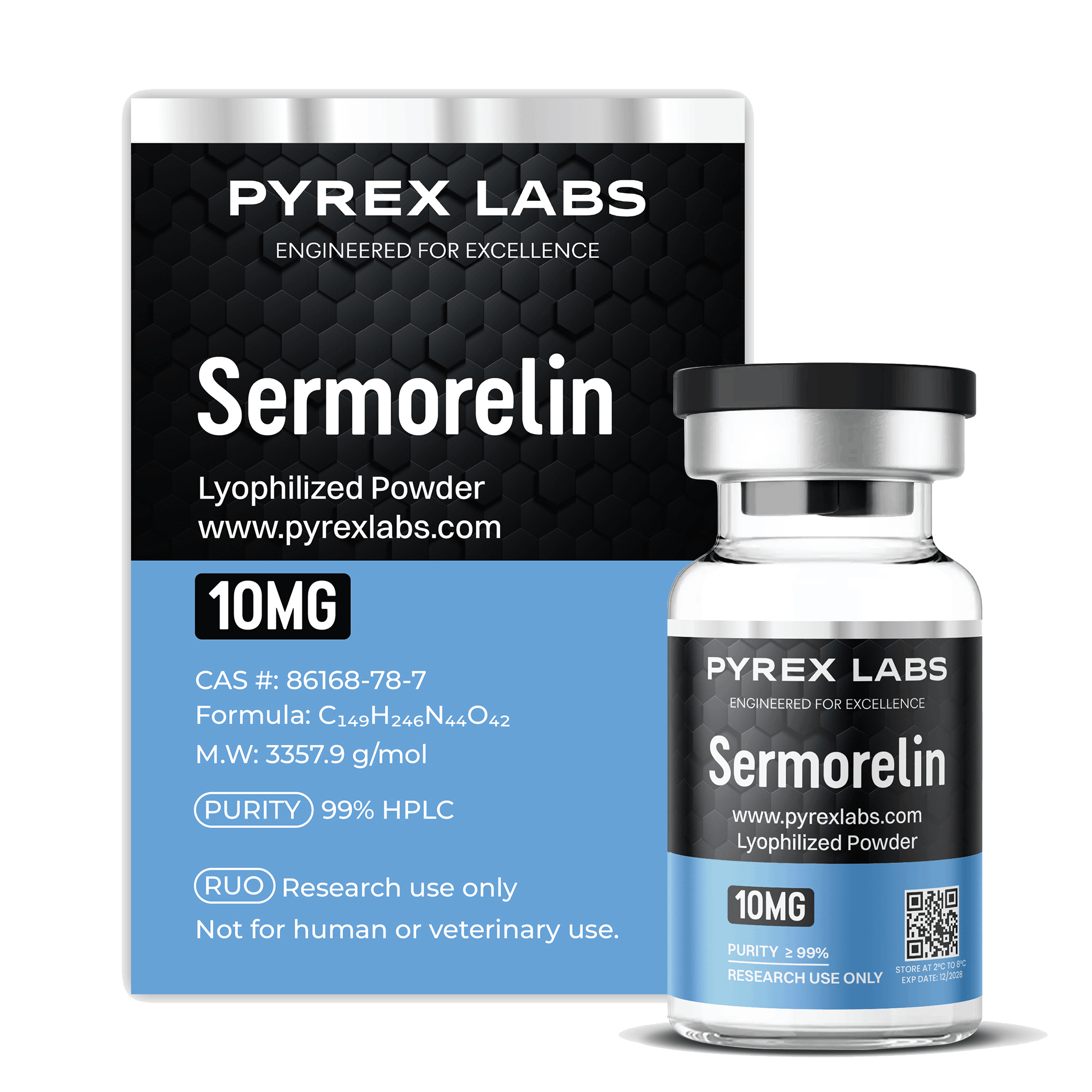
Sermorelin (GRF 1-29 amide) is a synthetic analogue of Growth Hormone-Releasing Hormone (GHRH) from Pyrex Labs. It contains the first 29 amino acid residues of the naturally occurring 44-amino acid GHRH — the minimum sequence required for complete biological activity.
The peptide binds specifically to GHRH receptors on somatotropic cells in the anterior pituitary, stimulating pulsatile release of endogenous growth hormone. With a short half-life of approximately 11-12 minutes, it is well-characterized as a diagnostic challenge test agent for assessing pituitary GH reserve. Research applications include pituitary function studies, growth hormone deficiency diagnostics, comparative endocrinology, and GHRH-GH-IGF-1 axis investigations.
Each 5mg vial contains lyophilized powder tested to ≥98% purity by HPLC, with sequence confirmed by mass spectrometry.
Available on backorder
SHARE:
SHARE:
- Products sold on our website are designed for in vitro testing and lab experimentation exclusively.
- All the products you see on the website are being sold in a lyophilized powder state (freeze-dried), in a sealed sterile vial; and should be reconstituted.
- The product’s label clearly states the amount of product a vial contains; some products are offered in different variations.
- The products we are selling come in a sealed vial but require additional lab equipment for proper testing.
AVAILABILITY:
- Ships today if you order and pay by 12 PM CST
- Some product may take up to 72 hours to ship
- Backordered items will ship in 3-5 days
Sermorelin (also known as GRF 1-29 amide) is a synthetic analogue of Growth Hormone-Releasing Hormone (GHRH) from Pyrex Labs. It contains the first 29 amino acid residues of the naturally occurring 44-amino acid GHRH — the minimum sequence required for complete biological activity . This shorter fragment retains full efficacy in stimulating growth hormone release from the anterior pituitary gland, making it a well-established tool in endocrine research .
Unlike full-length GHRH or other GH secretagogues, Sermorelin represents the biologically active fragment of the native hormone. Its sequence is identical across several mammalian species, including human, pig, and cattle, which has contributed to its widespread use in comparative endocrinology studies . Each 5mg vial contains lyophilized powder tested to ≥98% purity by HPLC, with sequence confirmed by mass spectrometry.
Best for: Pituitary function research, growth hormone deficiency diagnostics, comparative endocrinology studies, and investigations of the GHRH-GH-IGF-1 axis.
Key Research Applications
-
Diagnostic Testing: Historically used as a challenge test for growth hormone deficiency — administration of Sermorelin (1 μg/kg IV) stimulates GH release, allowing researchers to assess pituitary reserve capacity and somatotroph function
-
Pediatric Growth Research: Investigated in prepubertal children with idiopathic GH deficiency, with once-daily subcutaneous administration (30 μg/kg) shown to promote growth in research models
-
GHRH Receptor Studies: Binds specifically to GHRH receptors on somatotropic cells in the anterior pituitary, activating Gs protein-coupled signaling and stimulating GH synthesis and pulsatile release
-
IGF-1 Axis Research: The resulting GH elevation stimulates hepatic production of Insulin-like Growth Factor-1 (IGF-1), providing a tool for studying the complete GHRH-GH-IGF-1 endocrine axis
-
Anti-Aging Research Models: Sermorelin is one of several GHRH analogues studied for potential applications in age-related decline in GH secretion, alongside related compounds like tesamorelin and CJC-1295
Mechanism of Action
Sermorelin exerts its biological effects through specific, targeted activation of the GHRH receptor pathway:
Receptor Binding & Signaling: Sermorelin binds to the GHRH binding site on somatotropic cells in the anterior pituitary gland. This binding activates Gs protein-coupled receptors, stimulating adenylyl cyclase activity and increasing intracellular cAMP levels. The downstream signaling cascade leads to GH synthesis and release .
Pharmacological Equivalence: Research demonstrates that Sermorelin is as effective as natural forms of GHRH (including GHRH 1-40 and GHRH 1-44) in stimulating GH release, with similar molar efficacy .
Pulsatile GH Release: Unlike exogenous GH administration which produces sustained, non-physiological GH levels, Sermorelin — like other GHRH analogues — stimulates pulsatile GH release that more closely mimics natural secretory patterns. This pulsatile profile is associated with a lower side effect profile compared to continuous GH elevation .
Pharmacokinetics:
| Parameter | Value |
|---|---|
| Half-Life | 11-12 minutes |
| Route of Administration | Subcutaneous or intravenous |
| Molecular Formula | C₁₄₉H₂₄₆N₄₄O₄₂S |
| Molecular Weight | 3357.88 Da |
Specifications
| Specification | Detail |
|---|---|
| Product | Sermorelin (GRF 1-29 amide) |
| Also Known As | Geref, GHRH 1-29 amide, Groliberin |
| Sequence (Full) | H-Tyr-Ala-Asp-Ala-Ile-Phe-Thr-Asn-Ser-Tyr-Arg-Lys-Val-Leu-Gly-Gln-Leu-Ser-Ala-Arg-Lys-Leu-Leu-Gln-Asp-Ile-Met-Ser-Arg-NH₂ |
| Sequence (Short) | YADAIFTNSYRKVLGQLSARKLLQDIMSR-NH₂ |
| Molecular Formula | C₁₄₉H₂₄₆N₄₄O₄₂S |
| Molecular Weight | ~3357.9 Da |
| Amino Acids | 29 residues |
| CAS Number | 86168-78-7 |
| Form | Lyophilized white powder, sealed glass vial |
| Purity | ≥98% (HPLC) |
| Solubility | Water / Bacteriostatic water |
| Half-Life | 11-12 minutes |
| Origin | Synthesized in the USA |
| Storage (lyo) | −20°C, desiccated, protected from light |
| Storage (reconstituted) | 2–8°C short term; aliquot at −20°C for long term |
| Intended use | Laboratory and in-vitro research only |
Comparison: Sermorelin vs. Other GHRH Analogues
| Feature | Sermorelin | CJC-1295 (No DAC) | CJC-1295 (with DAC) | Tesamorelin |
|---|---|---|---|---|
| Length | 29 amino acids | 29 amino acids + linker | 30 amino acids + DAC | 44 amino acids |
| Half-Life | ~11-12 minutes | ~30 minutes | ~6-8 days | Extended |
| Receptor Target | GHRH receptor (specific) | GHRH receptor | GHRH receptor | GHRH receptor |
| Key Distinction | Shortest fully functional fragment | No DAC modification | Long-acting with DAC | Stabilized full-length |
| Primary Research Use | Diagnostic testing, short-term studies | Pulsatile GH studies | Sustained GH exposure studies | Lipodystrophy research |
Important Research Notes
FDA Status & Historical Context: Sermorelin received FDA approval in 1997 as a diagnostic agent for growth hormone deficiency. However, it was subsequently withdrawn from the market by the manufacturer for commercial reasons (rather than safety or efficacy concerns) . It remains a well-characterized reference compound for GHRH receptor research.
Regulatory & Anti-Doping Status: Sermorelin is classified as a prohibited substance by the World Anti-Doping Agency (WADA) due to its potential to enhance athletic performance through GH-mediated effects on muscle and skeletal tissue . Researchers should be aware of this classification when working with the compound.
Pulsatile Release Advantage: A key research advantage of Sermorelin (and other GHRH analogues) over direct GH administration is the induction of pulsatile GH release, which more closely mimics physiological secretion patterns. This pulsatile profile is associated with a reduced side effect profile compared to the sustained GH elevation produced by exogenous GH administration .
Diagnostic Application: In clinical research settings, Sermorelin administration (1 μg/kg as a single IV injection) has been used as a standardized challenge test for assessing pituitary GH reserve capacity in suspected GH deficiency .
Growth Research: Limited research data suggests that once-daily subcutaneous administration of 30 μg/kg of GHRH analogues may promote growth in certain prepubertal populations with idiopathic GH deficiency, though responses were variable and dependent on individual patient factors .
Reconstitution Guidance
Reconstitute Sermorelin with sterile water or bacteriostatic water (0.9% benzyl alcohol) for research use. Direct diluent gently down the inner wall of the vial rather than onto the lyophilized cake. Swirl slowly until fully dissolved — do not shake.
Given its short half-life (11-12 minutes), Sermorelin is typically used in protocols requiring precise timing of GH stimulation, such as diagnostic challenge tests or acute signaling studies. Many investigators reconstitute at 0.5-2 mL per vial to achieve desired concentrations and use immediately or within a short window to maintain activity.
For best results, aliquot the reconstituted solution into single-use tubes immediately to avoid repeated freeze-thaw cycles.
Storage & Stability
Before Reconstitution: Store the unopened, lyophilized vial at −20°C in a desiccated, light-protected environment. Stable under these conditions for the shelf-life indicated on the certificate of analysis.
After Reconstitution: Store working solutions at 2–8°C for short-term use (up to 7-14 days). For long-term storage, prepare single-use aliquots and freeze at −20°C. Avoid repeated freeze-thaw cycles, which significantly degrade peptide activity.
Quality Assurance
Every lot of Sermorelin undergoes comprehensive release testing against internal specifications, including:
-
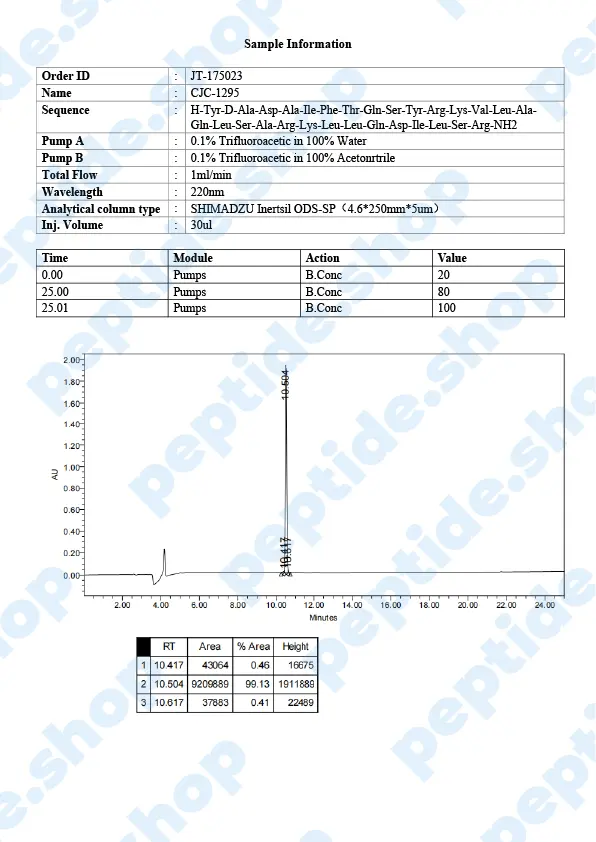
HPLC for purity confirmation (≥98%)
-
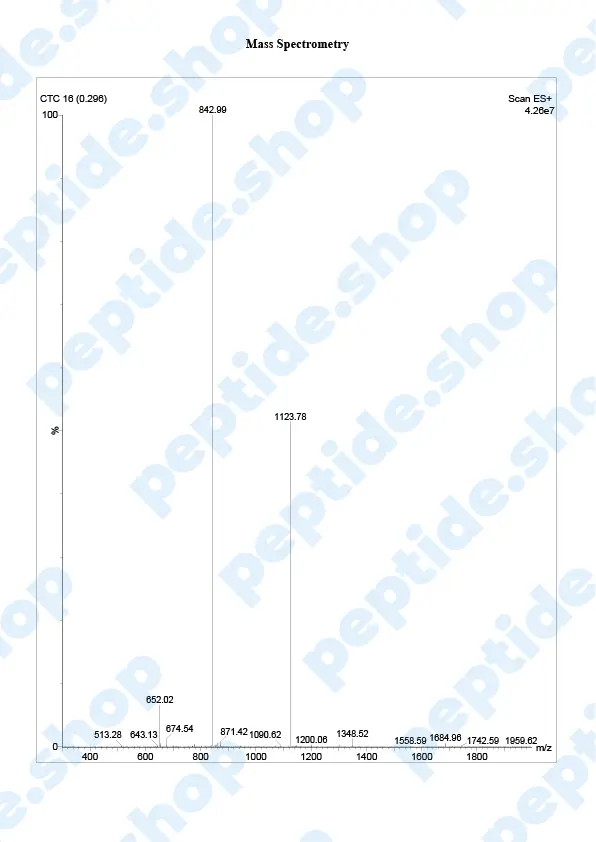
Mass spectrometry for identity verification
-
Visual inspection of vial integrity
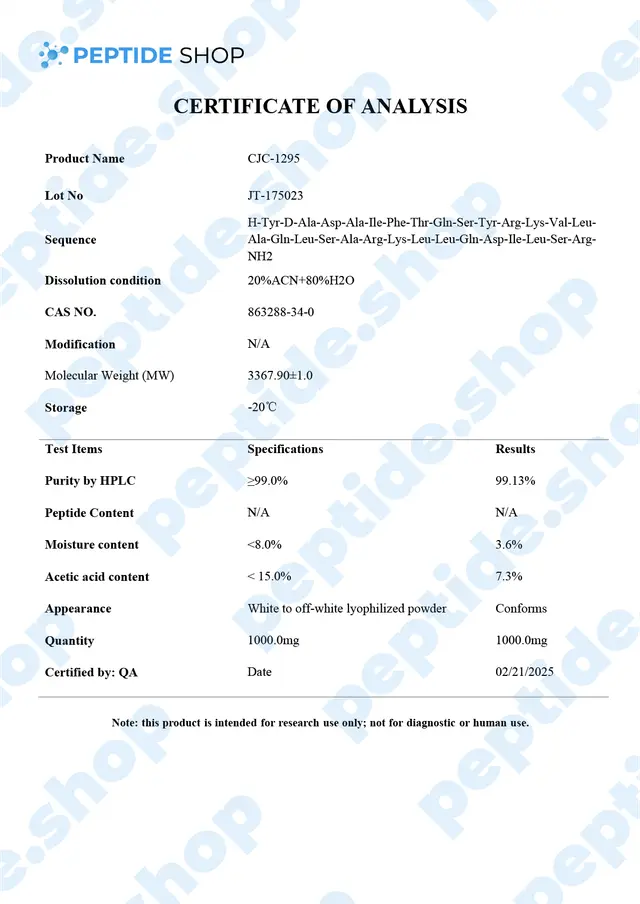
Each vial is coded with a lot number that links directly to release testing documentation. A lot-specific Certificate of Analysis (COA) is available upon request.
Related Products from Pyrex Labs
Researchers who order Sermorelin frequently also purchase:
-
CJC-1295 (No DAC) – Shorter half-life GHRH analogue for pulsatile studies
-
CJC-1295 with DAC – Long-acting GHRH analogue for sustained exposure studies
-
Tesamorelin – Full-length stabilized GHRH analogue
-
Ipamorelin – Selective GH secretagogue for combination studies
-
MOD GRF 1-29 – Research-grade GHRH analogue similar to Sermorelin
Frequently Asked Questions
What is Sermorelin? Sermorelin is a synthetic 29-amino acid peptide corresponding to the biologically active fragment of natural Growth Hormone-Releasing Hormone (GHRH). It is the shortest fully functional fragment of GHRH .
How does Sermorelin work? Sermorelin binds specifically to GHRH receptors on somatotropic cells in the anterior pituitary gland, stimulating the synthesis and pulsatile release of endogenous growth hormone .
What is the half-life of Sermorelin? Sermorelin has a short half-life of approximately 11-12 minutes . This makes it suitable for diagnostic challenge tests and acute stimulation studies.
How is Sermorelin different from CJC-1295? Sermorelin is the 29-amino acid fragment of GHRH with a half-life of approximately 11-12 minutes. CJC-1295 is a modified GHRH analogue with modifications that extend its half-life to approximately 30 minutes (No DAC) or 6-8 days (with DAC). Sermorelin is better characterized in the literature as a diagnostic agent .
Is Sermorelin approved for human use? No. This product is for research purposes only and is not FDA-approved for human consumption, medical treatment, or veterinary applications. While Sermorelin was historically FDA-approved as a diagnostic agent, it has been withdrawn from the market for commercial reasons .
Do you provide a Certificate of Analysis? Yes. A lot-specific COA is available upon request for every vial shipped.