Glutathione
$59.95
- Buy 5+ of each and save 5%
- Buy 10+ of each and save 8%
- Product is sold in powder form, needs reconstitution before use. Please read more on our FAQ page.
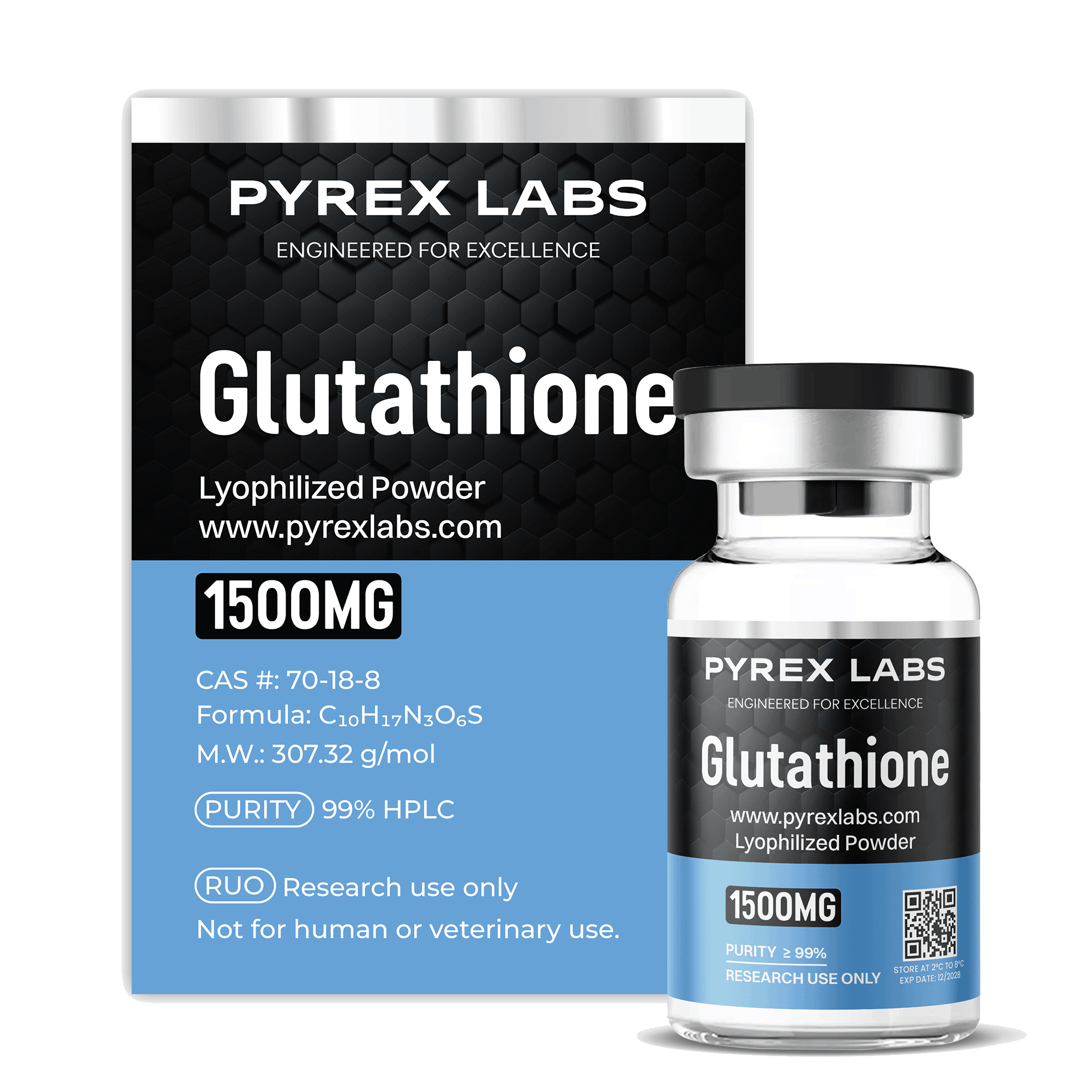
Glutathione (γ-L-Glutamyl-L-cysteinylglycine) is the body’s primary intracellular antioxidant and redox buffer from Pyrex Labs. This ubiquitous tripeptide (glutamic acid, cysteine, glycine) exists in reduced (GSH) and oxidized (GSSG) forms, with the GSH/GSSG ratio serving as a critical biomarker for cellular redox status.
GSH protects cells from reactive oxygen, nitrogen, and sulfur species, participates in Phase II detoxification pathways, and has been studied in cancer biology, neurodegenerative diseases (Parkinson’s, Alzheimer’s), and immune function. Cancer cells often exhibit significantly elevated GSH levels — at least 4-fold higher than normal cells.
Each vial contains lyophilized powder tested to ≥98% purity by HPLC.
SHARE:
SHARE:
- Products sold on our website are designed for in vitro testing and lab experimentation exclusively.
- All the products you see on the website are being sold in a lyophilized powder state (freeze-dried), in a sealed sterile vial; and should be reconstituted.
- The product’s label clearly states the amount of product a vial contains; some products are offered in different variations.
- The products we are selling come in a sealed vial but require additional lab equipment for proper testing.
AVAILABILITY:
- Ships today if you order and pay by 12 PM CST
- Some product may take up to 72 hours to ship
- Backordered items will ship in 3-5 days
Glutathione (γ-L-Glutamyl-L-cysteinylglycine) is a ubiquitous tripeptide composed of glutamic acid, cysteine, and glycine that serves as the body’s primary intracellular antioxidant and redox buffer . As the most abundant low-molecular-weight thiol in cells, it is found in concentrations ranging from 1–10 mM across mammalian tissues, with the highest levels in the liver (up to 10 mM) .
The molecule’s two key structural features—the nucleophilic sulfur atom on the cysteinyl residue and the γ-glutamyl isopeptide bond—enable its diverse biological functions . The γ-glutamyl bond protects GSH from degradation by normal proteases, allowing it to translocate throughout the systemic circulation . Glutathione exists primarily in two forms: reduced GSH and oxidized glutathione (GSSG), with the GSH/GSSG ratio serving as a critical biomarker for assessing cellular redox status .
Each vial contains lyophilized powder tested to ≥98% purity by HPLC, with identity confirmed by mass spectrometry.
Best for: Cellular metabolism research, oxidative stress studies, detoxification pathway investigations, and redox regulation models.
Key Research Applications
-
Redox Homeostasis Research: GSH maintains cellular redox balance through dynamic interconversion between reduced (GSH) and oxidized (GSSG) forms, protecting cells from reactive oxygen, nitrogen, and sulfur species
-
Detoxification Studies: Participates in Phase II detoxification pathways by neutralizing exogenous toxins and reactive electrophiles, facilitating their elimination
-
Cancer Biology Research: Cancer cells often exhibit significantly elevated GSH levels (at least 4-fold higher than normal cells), positioning GSH as a target for therapeutic intervention and drug delivery systems
-
Disease Model Investigations: Decreased GSH/GSSG ratio has been correlated with aging and pathological conditions including renal failure, diabetes, neurodegenerative diseases (Parkinson’s, Alzheimer’s), and cataracts
-
Mitochondrial Research: GSH transport into mitochondria involves coordination between the citric acid cycle and oxidative phosphorylation, with mitochondrial GSH playing a critical role in protection against oxidants and mitochondrial toxicants
-
Immunology Research: GSH regulates immune function and has been studied in managing liver diseases, oxidative stress, and immune dysfunction
Specifications
| Specification | Detail |
|---|---|
| Product | Glutathione (Reduced GSH) |
| Synonyms | L-γ-Glutamyl-L-cysteinyl-glycine; Reduced glutathione; Glutathion |
| CAS Number | 70-18-8 |
| Molecular Formula | C₁₀H₁₇N₃O₆S |
| Molecular Weight | 307.32 Da |
| Structure | Tripeptide (Glu-Cys-Gly) |
| Form | Lyophilized white to off-white powder, sealed glass vial |
| Purity | ≥98% (HPLC) |
| Solubility | Water, DMSO (slightly), Aqueous Base |
| Storage (lyo) | −20°C, desiccated, protected from light, inert atmosphere |
| Intended use | Laboratory and in-vitro research only |
Reconstitution Guidance
Reconstitute Glutathione with sterile water or appropriate research buffer. The peptide is soluble in water up to 100 mM . Direct diluent gently down the inner wall of the vial rather than onto the lyophilized powder. Swirl slowly until fully dissolved.
For best results, prepare fresh solutions for immediate use or aliquot into single-use tubes and freeze. GSH is susceptible to oxidation in solution; avoid multiple freeze-thaw cycles.
Storage & Stability
Before Reconstitution: Store the unopened, lyophilized vial at −20°C under inert atmosphere, desiccated and protected from light. Stable under these conditions for the shelf-life indicated on the certificate of analysis.
After Reconstitution: Store working solutions at 2–8°C for short-term use. For long-term storage, prepare single-use aliquots and freeze at −20°C. Avoid repeated freeze-thaw cycles.
Important Research Notes
Research Consideration — Oral Bioavailability: Oral glutathione supplementation faces significant bioavailability challenges. Glutathione cannot enter cells intact—it must be metabolized to L-cystine before cellular uptake . While absorption into the bloodstream is possible, increasing intracellular glutathione is more efficiently achieved through precursors like N-Acetylcysteine (NAC) .
GSH in Kidney Research: The kidneys extract approximately 80% of plasma GSH, making them the primary site for GSH turnover and metabolism . Studies on exogenous GSH have shown protective effects in pathological states including hypoxia, diabetic nephropathy, and renal injury .
Biomarker Applications: The GSH/GSSG ratio serves as a universal biomarker for oxidative stress assessment, with proper balance essential for improving health and treating age-related disorders .
Related Products from Pyrex Labs
Researchers who order Glutathione frequently also purchase:
-
N-Acetylcysteine (NAC) – For GSH precursor studies
-
NAD+ – For cellular energy and metabolic research
-
MOTS-c – For mitochondrial research
-
TB-500 – For tissue repair research
Disclaimer
⚠️ FOR RESEARCH PURPOSES ONLY. NOT FOR HUMAN USE.
Not approved by the FDA. Not intended for diagnostic, therapeutic, or medical applications in humans or animals. For in-vitro laboratory research exclusively. Pyrex Labs products are intended solely for scientific investigation and research purposes by qualified professionals.
This product description is ready to copy and paste as plain text. Would you like me to create a shorter version, add WordPress tags, or adjust the format for a specific platform?