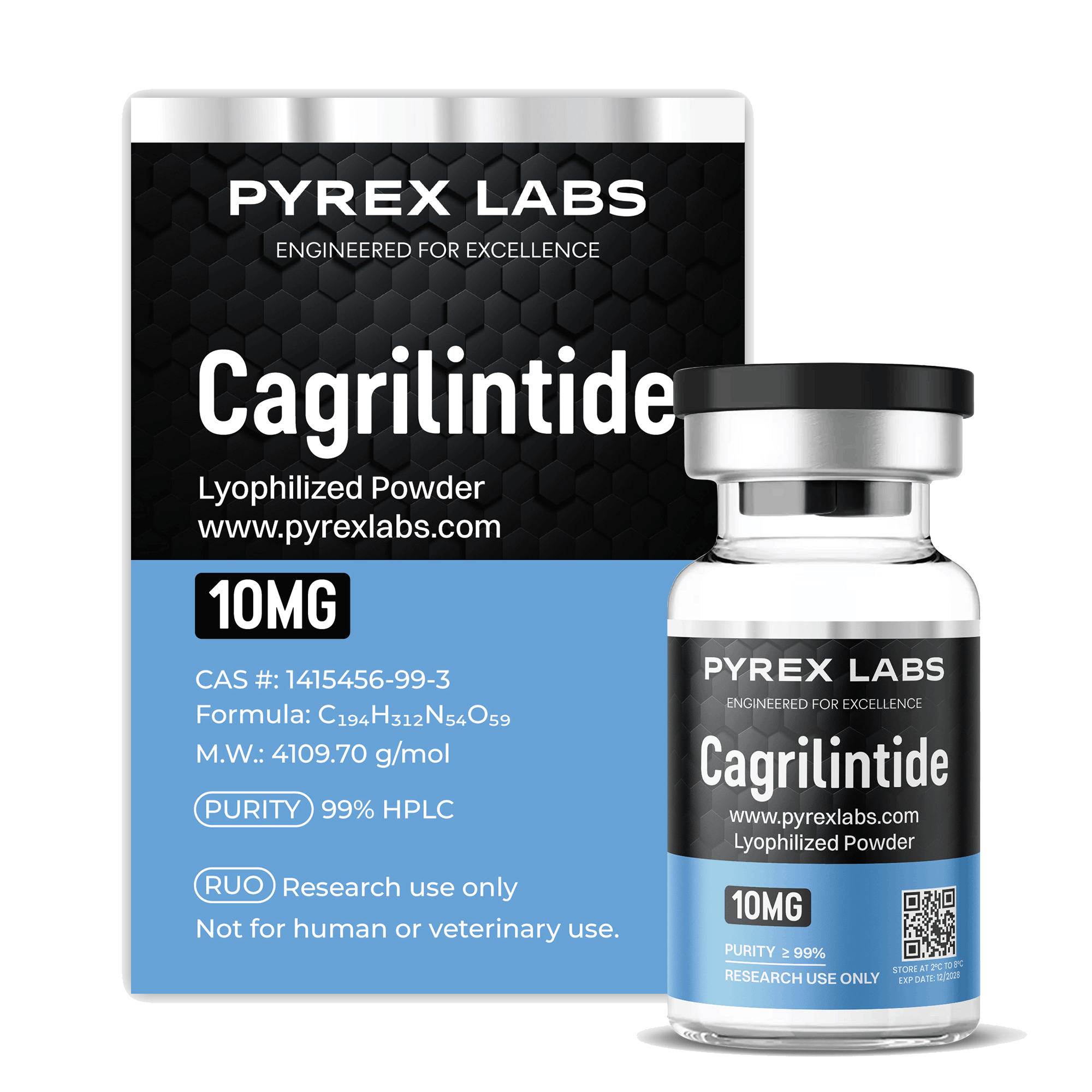
Cagrilintide
$69.95
- Buy 5+ of each and save 5%
- Buy 10+ of each and save 8%
- Product is sold in powder form, needs reconstitution before use. Please read more on our FAQ page.
Cagrilintide (AM833) is a long-acting, acylated amylin analogue from Pyrex Labs. It functions as a dual agonist at amylin receptors (AMYRs) and the calcitonin receptor (CTR) — a class known as DACRAs (Dual Amylin and Calcitonin Receptor Agonists).
Mechanism: Activates satiety pathways in the brainstem, suppresses postprandial glucagon, and slows gastric emptying. Phase 3 trials demonstrate approximately 11.8% weight loss as monotherapy and up to 22.7% when combined with semaglutide.
Best for: Obesity research, metabolic disease models, satiety pathway studies, and combination therapy investigations with GLP-1 receptor agonists.
FOR RESEARCH ONLY. NOT FOR HUMAN USE.
SHARE:
SHARE:
- Products sold on our website are designed for in vitro testing and lab experimentation exclusively.
- All the products you see on the website are being sold in a lyophilized powder state (freeze-dried), in a sealed sterile vial; and should be reconstituted.
- The product’s label clearly states the amount of product a vial contains; some products are offered in different variations.
- The products we are selling come in a sealed vial but require additional lab equipment for proper testing.
AVAILABILITY:
- Ships today if you order and pay by 12 PM CST
- Some product may take up to 72 hours to ship
- Backordered items will ship in 3-5 days
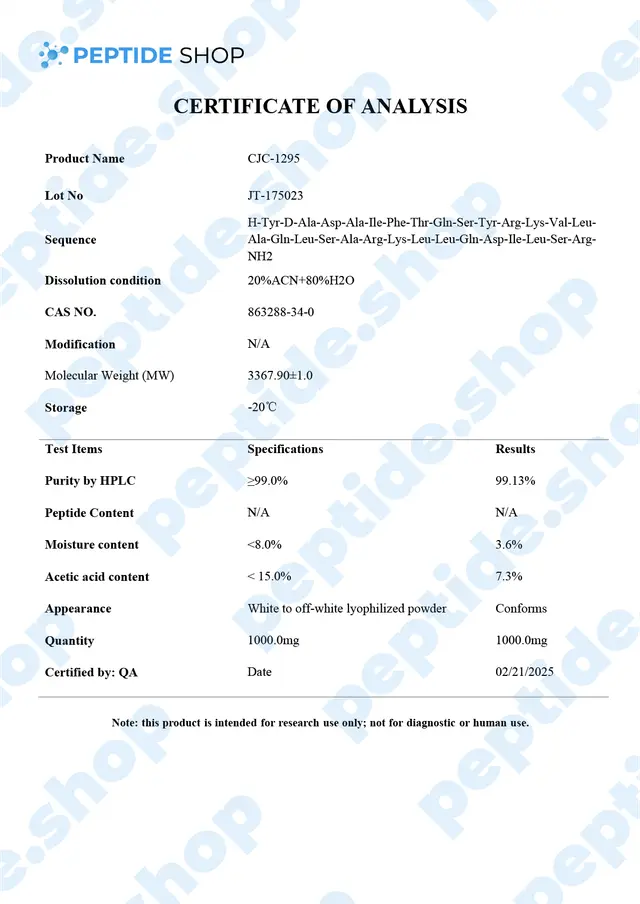
Cagrilintide (also known as AM833) is a long-acting, acylated amylin analogue being developed by Novo Nordisk as a once-weekly subcutaneous treatment for obesity and type 2 diabetes . It is a 37-amino acid peptide modified with a C20 fatty diacid moiety for albumin binding, extending its half-life to support once-weekly dosing .
Structurally, cagrilintide is a human amylin analogue with helix-stabilizing mutations (N14E, V17R) to counteract amyloid fibril formation — a known issue with native human amylin — and a C-terminal proline substitution at position 37 (P37Cagri) . Its molecular formula is C₁₉₄H₃₁₂O₅₈N₅₄S₂ with a molecular weight of approximately 4409 Da .
Best for: Obesity research, metabolic disease models, satiety pathway studies, and combination therapy investigations with GLP-1 receptor agonists.
Mechanism of Action
Cagrilintide functions as a dual agonist at amylin receptors (AMYRs) and the calcitonin receptor (CTR) — referred to as a DACRA (Dual Amylin and Calcitonin Receptor Agonist) .
Primary Mechanism: Amylin is a satiety hormone co-secreted with insulin from pancreatic beta cells in response to meals. It acts upon sub-cortical homeostatic and hedonic brain regions, slows gastric emptying, and suppresses post-prandial glucagon responses .
Receptor Binding: Cagrilintide binds to the calcitonin receptor (CTR) and amylin receptors (AMY1R, AMY2R, AMY3R) — heterodimers formed by CTR with receptor activity-modifying proteins (RAMPs) . Cryo-EM structural studies reveal that cagrilintide adopts a conserved “bypass” binding mode at both receptor types, anchored by key interactions including F23Cagri at the transmembrane bundle level and an intramolecular salt bridge (E14-R17) that stabilizes the N-terminal helix .
Central Nervous System Effects: Cagrilintide acts on neurons in the dorsal vagal complex (DVC) of the brainstem. Long-term treatment activates calcitonin receptor-expressing neurons in the nucleus of the solitary tract (NTS) and upregulates prolactin-releasing hormone (Prlh) expression — a mechanism critical for sustained weight loss effects in rats . Notably, this long-term transcriptional response is species-specific and is observed in rats but not in mice .
Key Research Findings
Phase 3 REDEFINE 1 Trial (Obesity, No Diabetes): In a 68-week phase 3 trial of 3,417 adults with obesity or overweight (without type 2 diabetes), cagrilintide 2.4 mg monotherapy produced clinically meaningful weight loss :
| Endpoint | Cagrilintide 2.4 mg | Placebo |
|---|---|---|
| Mean Weight Loss (adherence-adjusted) | -11.8% | -2.3% |
| Mean Weight Loss (regardless of adherence) | -11.5% | -3.0% |
| ≥15% Weight Loss (adherence-adjusted) | 31.6% | 4.7% |
| ≥15% Weight Loss (regardless of adherence) | 31.0% | 5.2% |
Phase 3 Trial with Type 2 Diabetes (CagriSema): A phase 3a trial of 1,206 adults with type 2 diabetes and BMI ≥27 evaluated the combination of cagrilintide 2.4 mg with semaglutide 2.4 mg (CagriSema) versus placebo over 68 weeks :
| Endpoint | CagriSema | Placebo |
|---|---|---|
| Mean Change in Body Weight | -13.7% | -3.4% |
| ≥5% Weight Loss | 83.6% | 30.8% |
| GI Adverse Events | 72.5% | 34.4% |
Cagrilintide + Semaglutide (CagriSema): In the REDEFINE 1 trial, the CagriSema combination produced 22.7% weight loss at 68 weeks, compared to 16.1% for semaglutide alone .
Renal Mechanism Studies: Preclinical research indicates cagrilintide increases intracellular cAMP in cortical tubules of diabetic rats, with potential effects on kidney physiology including phosphorylation of ion transporters (NKCC2, NCC) in the thick ascending limb and distal convoluted tubule .
Receptor Potency Profile
Cagrilintide is a potent agonist at amylin and calcitonin receptors across species:
| Receptor | Species | EC50 (Mean) |
|---|---|---|
| AMY3(a)R | Mouse | 1.49 x 10⁻¹¹ M |
| AMY3(a)R | Rat | 1.86 x 10⁻¹² M |
| CTR(a) | Mouse | 7.96 x 10⁻¹² M |
| CTR(a) | Rat | 5.89 x 10⁻¹² M |
Data from in vitro cAMP potency assays in BHK cells
Species Difference: Cagrilintide is significantly more potent at human amylin receptors than at mouse receptors, which may explain species-specific responses in preclinical models .
Safety Profile
Most Common Adverse Events (REDEFINE 1):
-
Gastrointestinal effects (nausea, vomiting, diarrhoea, constipation) — the most common side effects, typically mild to moderate and temporary
-
Nausea led to permanent discontinuation in 1.0% of participants on cagrilintide, compared with 0.1% on placebo
GI Tolerability Comparison: Preclinical studies suggest that non-selective amylin analogues like cagrilintide may be associated with higher GI tolerability challenges compared to more selective compounds . However, cagrilintide demonstrated a favourable discontinuation rate in phase 3 trials .
Investigational Status: Cagrilintide is an investigational compound that does not yet have regulatory approval. A dedicated phase 3 RENEW programme is scheduled to begin in Q4 2025 to further investigate cagrilintide monotherapy for obesity and overweight .
Comparison: Cagrilintide vs. Other Obesity Therapies
| Feature | Cagrilintide | Semaglutide | Tirzepatide |
|---|---|---|---|
| Mechanism | Amylin/CTR dual agonist | GLP-1R agonist | GIP/GLP-1 dual agonist |
| Route of Action | Satiety (brainstem) | Appetite (hypothalamus) | Appetite + insulin |
| Weight Loss (Phase 3) | ~11.8% (monotherapy) | ~15% (monotherapy) | ~21% (monotherapy) |
| GI Side Effects | Moderate | Moderate-High | High |
| WADA Status | Investigational | Investigational | Investigational |
Related Compounds
Eloralintide (LY3841136): A selective amylin mimetic from Eli Lilly in preclinical development, designed to retain weight loss efficacy with improved GI tolerability compared to non-selective amylin analogues like cagrilintide .
Pramlintide: An approved synthetic amylin analogue for type 2 diabetes, administered via injection with meals. Cagrilintide is a next-generation long-acting version requiring only once-weekly dosing .
Disclaimer
⚠️ FOR RESEARCH PURPOSES ONLY. NOT FOR HUMAN USE.
Not approved by the FDA. Not intended for diagnostic, therapeutic, or medical applications in humans or animals. Cagrilintide is an investigational compound and is not available for clinical use outside of regulated clinical trials. Pyrex Labs products are intended solely for scientific investigation and research purposes by qualified professionals.