IGF1-LR3
$99.95
- Buy 5+ of each and save 5%
- Buy 10+ of each and save 8%
- Product is sold in powder form, needs reconstitution before use. Please read more on our FAQ page.
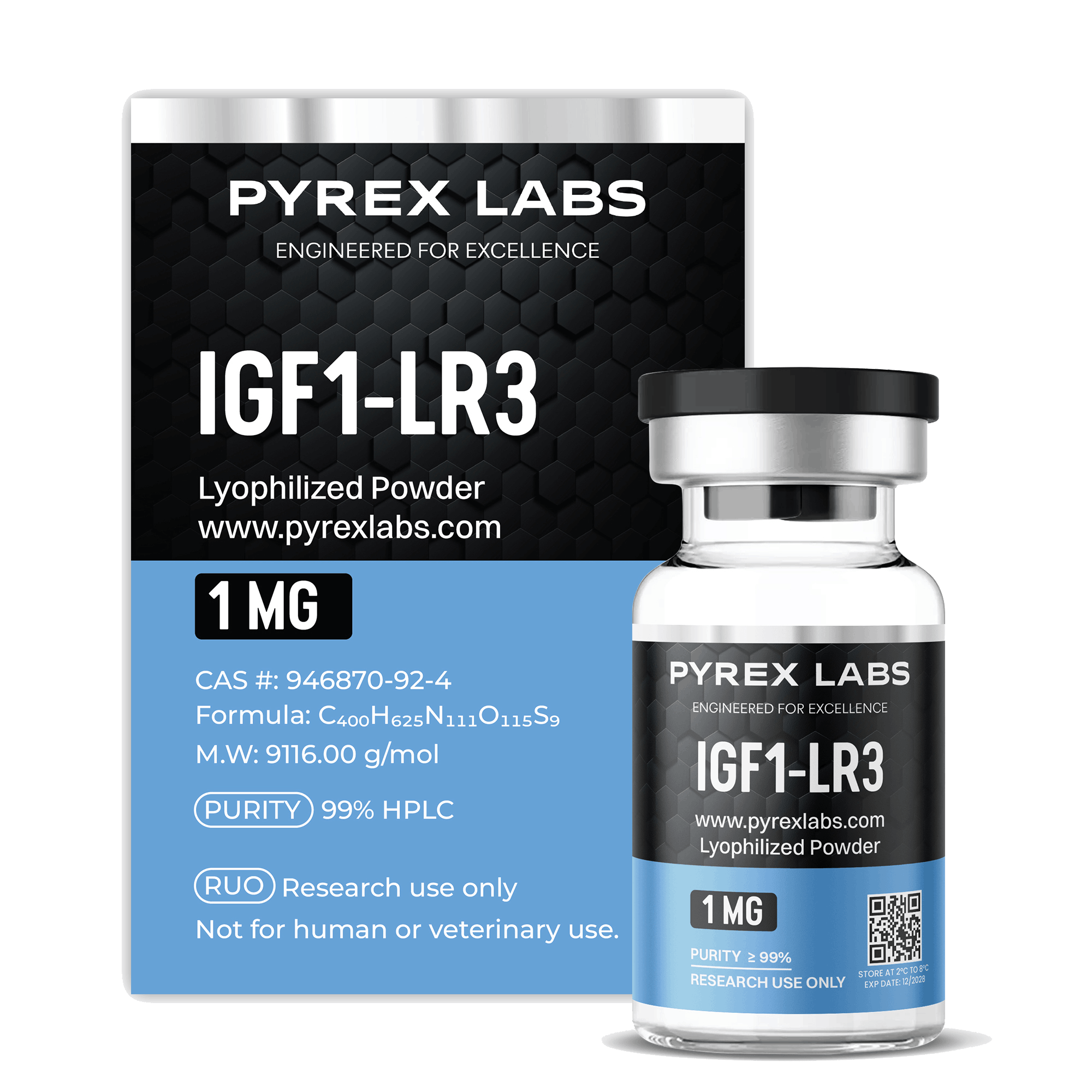
IGF-1 LR3 (Long Arginine 3-Insulin-like Growth Factor-1) is a synthetic, bio-engineered analog of natural IGF-1 from Pyrex Labs. The LR3 modifications — an Arginine substitution and a 13-amino acid N-terminal extension — reduce binding to IGF-binding proteins (IGFBPs) by over 100-fold, resulting in significantly higher bioavailability and biological potency than natural IGF-1.
This growth factor is widely investigated for serum-free cell culture, stem cell proliferation, AKT signaling studies, and developmental biology models. Each 1mg vial contains lyophilized powder tested to ≥95% purity by SDS-PAGE and HPLC, with identity confirmed by mass spectrometry.
Available on backorder
SHARE:
SHARE:
- Products sold on our website are designed for in vitro testing and lab experimentation exclusively.
- All the products you see on the website are being sold in a lyophilized powder state (freeze-dried), in a sealed sterile vial; and should be reconstituted.
- The product’s label clearly states the amount of product a vial contains; some products are offered in different variations.
- The products we are selling come in a sealed vial but require additional lab equipment for proper testing.
AVAILABILITY:
- Ships today if you order and pay by 12 PM CST
- Some product may take up to 72 hours to ship
- Backordered items will ship in 3-5 days
IGF-1 LR3 (Long Arginine 3-Insulin-like Growth Factor-1) is a synthetic, bio-engineered analog of natural Insulin-like Growth Factor-1 from Pyrex Labs. Designed for researchers requiring enhanced potency and stability in cell culture models, this 1mg vial features two critical modifications that distinguish it from natural IGF-1.
The LR3 modification includes an Arginine substitution at position 3 and a 13-amino acid N-terminal extension. These changes dramatically reduce the molecule’s affinity for IGF-binding proteins (IGFBPs) — over 100-fold lower than natural IGF-1 — while preserving full activity at the IGF-1 receptor. The result is significantly higher bioavailability and biological potency in experimental systems.
Each vial contains lyophilized powder with a molecular weight of approximately 9.1 kDa, tested to confirm ≥95% purity by SDS-PAGE and HPLC. Every batch undergoes rigorous quality control to ensure consistent performance in your research protocols.
Key Research Applications
-
Serum-Free Cell Culture: Investigated as a supplement to promote proliferation and maintenance of various cell types, including stem cells, without serum interference
-
Growth Factor Signaling Studies: Examines the AKT signaling pathway and downstream effects on cell growth, proliferation, and apoptosis inhibition
-
Developmental Biology Models: Studied in contexts such as fetal growth restriction to evaluate growth-promoting potential
-
Neurodegenerative Disease Research: Explored in Alzheimer’s disease models for its effects on amyloid plaque remodeling and neuronal health
Distinguishing Features vs. Natural IGF-1
| Feature | IGF-1 LR3 | Natural IGF-1 |
|---|---|---|
| IGFBP Affinity | >100-fold lower (minimal binding) | High (significant binding) |
| Bioavailability | High (remains free and active) | Reduced (bound to binding proteins) |
| Half-Life | Extended due to modifications | Short |
| Biological Potency | Significantly higher | Standard |
| Best For | Serum-free culture, high-activity needs | Traditional IGF-1 pathways |
Specifications
| Specification | Detail |
|---|---|
| Product | IGF-1 LR3 (Long Arginine 3-IGF-1) |
| Vial size | 1mg |
| Amino Acid Residues | 83 |
| Molecular Weight | ~9.1 kDa |
| Form | Lyophilized white powder, sealed glass vial |
| Purity | ≥95% (SDS-PAGE / HPLC) |
| Origin | Synthesized and lyophilized in the USA |
| Storage (lyo) | −20°C, desiccated, protected from light |
| Storage (reconstituted) | 2–8°C short term; aliquot and freeze at −20°C for long term |
| Intended use | Laboratory and in-vitro research only |
Reconstitution Guidance
Reconstitute IGF-1 LR3 with sterile 10 mM acetic acid or sterile water, depending on your experimental protocol. Many researchers reconstitute at 0.1-1 mg/mL in 10 mM acetic acid, then further dilute into cell culture media or assay buffers as needed.
Direct diluent gently down the inner wall of the vial rather than onto the lyophilized cake. Swirl slowly until fully dissolved — do not shake. For best results, aliquot the reconstituted solution into single-use tubes immediately to avoid repeated freeze-thaw cycles, which is the primary cause of activity loss in growth factor preparations.
Storage & Stability
Before Reconstitution: Store the unopened, lyophilized vial at −20°C in a desiccated, light-protected environment. Pyrex Labs lyophilized cakes remain stable under these conditions for the shelf-life indicated on the certificate of analysis.
After Reconstitution: Store working solutions at 2–8°C for short-term use (up to 7-14 days). For long-term storage, prepare single-use aliquots and freeze at −20°C. Avoid repeated freeze-thaw cycles, which significantly degrade activity.
Quality Assurance
Every lot of IGF-1 LR3 undergoes comprehensive release testing against internal specifications, including:
-
SDS-PAGE and/or HPLC for purity confirmation (≥95%)
-
Mass spectrometry for identity verification
-
Visual inspection of vial integrity
Each vial is coded with a lot number that links directly to release testing documentation. A lot-specific Certificate of Analysis (COA) is available upon request.
Important Research Notes
Mechanism of Action: IGF-1 LR3 exerts its effects primarily through the IGF-1 receptor, activating the AKT signaling pathway. This pathway regulates cell growth, proliferation, and survival (inhibition of apoptosis). The LR3 modifications ensure that the molecule remains biologically active in the presence of IGF-binding proteins, which would otherwise sequester natural IGF-1.
Published Research Contexts: Peer-reviewed studies have investigated IGF-1 LR3 in:
-
Fetal growth restriction models to evaluate growth-promoting potential
-
Alzheimer’s disease models for amyloid plaque remodeling
-
Stem cell culture maintenance under serum-free conditions
-
Muscle cell hypertrophy and differentiation studies
Researchers should consult primary literature (PubMed, Google Scholar) before designing studies and validate dose ranges, vehicle compatibility, and analytical methodology against original published methods.
Related Products from Pyrex Labs
Researchers who order IGF-1 LR3 frequently also purchase:
-
IGF-1 (Natural) – for comparative binding studies
-
MGF (Mechano Growth Factor) – for muscle cell research
-
Ipamorelin (5mg) – for GH secretagogue studies
-
CJC-1295 with DAC (5mg) – for sustained GHRH research
-
Fragment 176-191 (5mg) – for metabolic research
Frequently Asked Questions
What does LR3 stand for? LR3 stands for Long Arginine 3. It refers to two modifications: an Arginine substitution at position 3, and a 13-amino acid N-terminal extension (“Long”) that enhances stability.
Why is IGF-1 LR3 more potent than natural IGF-1? Natural IGF-1 binds strongly to IGF-binding proteins (IGFBPs) in culture media, reducing its availability to cells. IGF-1 LR3 has over 100-fold lower affinity for these binding proteins, so more of the molecule remains free and active at the IGF-1 receptor.
What is the typical reconcentration for cell culture? Many researchers reconstitute at 0.1-1 mg/mL in 10 mM acetic acid as a stock solution, then dilute to working concentrations ranging from 10-100 ng/mL in cell culture media. Always validate concentrations against your specific experimental model.
Is IGF-1 LR3 approved for human use? No. This product is for research purposes only and is not FDA-approved for human consumption, medical treatment, or veterinary applications.
Do you provide a Certificate of Analysis? Yes. A lot-specific COA is available upon request for every vial shipped.