The Tesamorelin, Modified GRF 1-29, and Ipamorelin peptide blend is a research-grade formulation composed of three structurally distinct synthetic peptides that each interact with the growth hormone (GH) regulatory axis through separate pharmacological receptor mechanisms.
Two components — Tesamorelin and Modified GRF 1-29 — primarily target the growth hormone-releasing hormone receptor (GHRH-R), a Class B G protein-coupled receptor (GPCR) located on anterior pituitary somatotroph cells.[1][2][4] In contrast, Ipamorelin functions as a selective agonist of the ghrelin receptor subtype GHS-R1a.[3][7]
Because these peptides engage distinct but physiologically interconnected signaling systems, the blend may provide a useful framework for investigating both convergent and divergent intracellular pathways involved in somatotroph activity, pulsatile GH regulation, and broader GH-axis physiology. The dual GHRH-receptor stimulation alongside selective GHS-R1a activation may also support research into receptor synergy, second-messenger signaling dynamics, and downstream endocrine responses associated with growth hormone secretion.
Tesamorelin, Modified GRF 1-29, and Ipamorelin: Historical Development
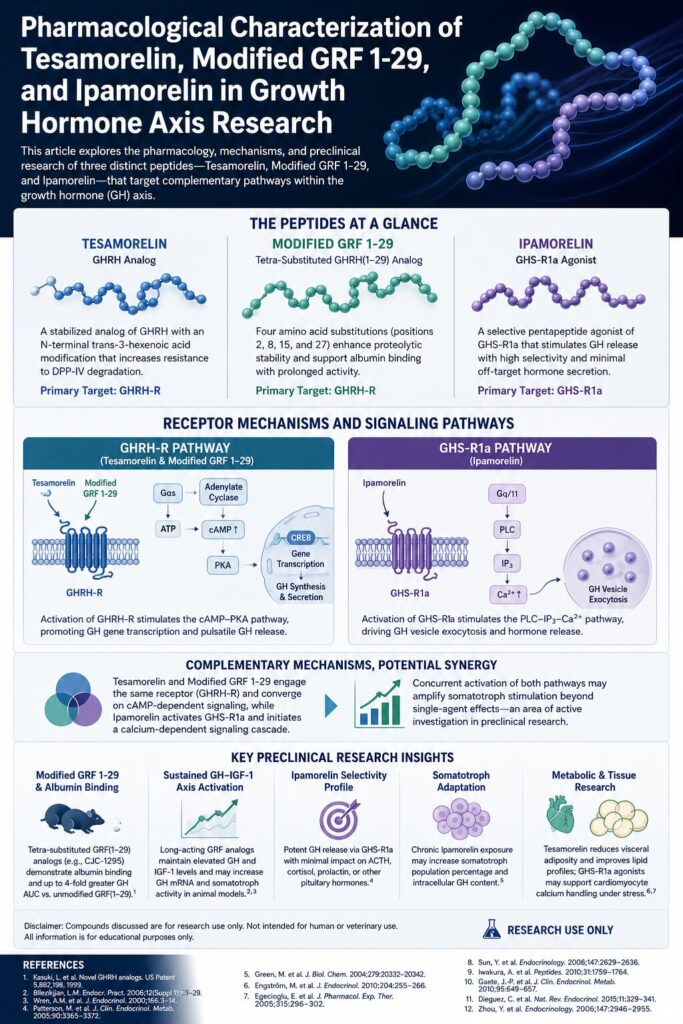
Tesamorelin (CID 16137828) was developed as a stabilized analog of endogenous growth hormone-releasing hormone (GHRH), incorporating an N-terminal trans-3-hexenoic acid group designed to increase resistance to dipeptidyl peptidase IV (DPP-IV) degradation.[1][4] This structural modification is believed to prolong receptor interaction at the pituitary GHRH receptor (GHRH-R) compared with native GHRH, which undergoes rapid enzymatic breakdown in biological systems.[4]
Modified GRF 1-29 (CID 56841945) is a tetra-substituted analog derived from the biologically active 1–29 amino acid fragment of GHRH. Amino acid substitutions at positions 2, 8, 15, and 27 were introduced to improve resistance to proteolytic degradation while maintaining receptor affinity at GHRH-R and preserving the short-acting pulsatile characteristics associated with native GHRH signaling.[1][5] Preclinical investigations of this peptide class suggested that tetra-substituted hGRF(1–29) derivatives may display significantly prolonged plasma stability compared with the unmodified sequence.[5]
Ipamorelin (CID 9831659) is a synthetic pentapeptide developed by Novo Nordisk under the development code NNC 26-0161. Structurally designated Aib-His-D-2-Nal-D-Phe-Lys-NH₂, Ipamorelin emerged from research investigating structural analogs of GHRP-1 that lacked the central Ala-Trp dipeptide motif observed in earlier growth hormone secretagogues.[3][7] Research has suggested that Ipamorelin may represent one of the first highly selective GHS-R1a agonists capable of stimulating GH release with minimal effects on ACTH, cortisol, or prolactin secretion, distinguishing it from earlier compounds such as GHRP-6.[7]
Tesamorelin and Modified GRF 1-29 share a common pharmacological target in GHRH-R and primarily signal through the cyclic AMP (cAMP)-protein kinase A (PKA) pathway.[1][2] Despite this overlap, the peptides differ substantially in structural chemistry and pharmacokinetic behavior.[1][4] Ipamorelin, by contrast, acts through the ghrelin receptor subtype GHS-R1a and promotes GH secretion through calcium-dependent intracellular signaling pathways that complement the cAMP-mediated mechanisms associated with GHRH analogs.[3][7]
Tesamorelin, Modified GRF 1-29, and Ipamorelin: Receptor Mechanisms and Intracellular Signaling
Tesamorelin and Modified GRF 1-29 both bind to GHRH-R located on anterior pituitary somatotroph cells. Activation of this receptor is associated with Gαs-mediated stimulation of adenylate cyclase, resulting in the conversion of ATP into cyclic adenosine monophosphate (cAMP) and downstream activation of protein kinase A (PKA).[4][6]
ATP→cAMPATP \rightarrow cAMPATP→cAMP
PKA activation may subsequently influence phosphorylation-dependent transcriptional pathways involved in growth hormone synthesis and pulsatile GH secretion. Research suggests that these signaling events primarily regulate somatotroph activity without directly targeting peripheral tissues.[4]
Ipamorelin acts through the ghrelin receptor subtype GHS-R1a, a constitutively active GPCR expressed within pituitary and hypothalamic tissues.[3][7] Receptor activation is associated with Gq/G11-mediated phospholipase C (PLC) stimulation, generation of inositol 1,4,5-trisphosphate (IP₃), and mobilization of intracellular calcium stores, ultimately promoting GH vesicle exocytosis.[7]
PLC→IP3→Ca2+↑PLC \rightarrow IP_3 \rightarrow Ca^{2+} \uparrowPLC→IP3→Ca2+↑
Preclinical findings suggest that Ipamorelin may stimulate GH release with minimal co-secretion of ACTH, cortisol, or prolactin, differentiating its selectivity profile from earlier growth hormone-releasing peptides such as GHRP-6 and GHRP-2.[7]
Simultaneous engagement of GHRH-R by Tesamorelin and Modified GRF 1-29, together with GHS-R1a activation by Ipamorelin, may provide a useful framework for investigating convergent cAMP-dependent and calcium-dependent signaling cascades within somatotroph populations. Research suggests that concurrent stimulation of these complementary intracellular pathways may amplify GH secretory activity beyond that observed with isolated receptor activation.[11]
Scientific Research and Experimental Investigations
Modified GRF 1-29: Albumin Binding and Extended GH Axis Activity
Preclinical investigations evaluating tetra-substituted hGRF(1–29) bioconjugates examined their ability to bind endogenous serum albumin and maintain activation of anterior pituitary GHRH receptors.[5] One derivative, structurally related to CJC-1295 and serving as the basis for Modified GRF 1-29, demonstrated approximately a fourfold increase in GH area-under-the-curve over a two-hour period compared with unmodified hGRF(1–29).[5]
Western blot analysis identified immunoreactive peptide-albumin complexes detectable within 15 minutes of administration and persisting beyond 24 hours post-exposure.[5] These observations suggest that albumin bioconjugation may substantially extend peptide half-life and sustain GHRH-R engagement relative to native GHRH sequences.
Long-Acting GHRH Analogs and Sustained GH-IGF-1 Axis Modulation
A controlled experimental investigation evaluated long-acting GHRH analogs structurally related to Modified GRF 1-29 for their ability to sustain GH and insulin-like growth factor-1 (IGF-1) signaling over extended intervals.[6]
GH→IGF-1GH \rightarrow IGF\text{-}1GH→IGF–1
Findings suggested that single exposures to stabilized GHRH analogs may produce prolonged elevations in circulating GH and IGF-1 levels compared with native peptide forms.[6] Additional preclinical studies in GHRH knockout murine models indicated that daily administration of tetra-substituted GHRH analogs may increase pituitary GH mRNA expression and alter somatotroph cellular characteristics.[12]
Ipamorelin: Selective GHS-R1a Pharmacology
The pharmacological profile of Ipamorelin was characterized in preclinical models examining selective GHS-R1a activation.[7] In vitro studies using murine pituitary cell cultures reported GH-releasing potency comparable to GHRP-6, while in vivo models demonstrated concentration-dependent GH secretion with minimal effects on prolactin, thyroid-stimulating hormone (TSH), follicle-stimulating hormone (FSH), or luteinizing hormone (LH).[7]
Unlike earlier secretagogues such as GHRP-6 and GHRP-2, Ipamorelin was not associated with significant elevations in ACTH or cortisol, even at concentrations substantially exceeding GH-releasing thresholds.[7] Research suggests this receptor selectivity profile may more closely resemble endogenous GHRH physiology.
Ipamorelin and Somatotroph Population Dynamics
Long-term exposure studies examining Ipamorelin in pituitary cell monolayer cultures suggested that chronic GHS-R1a stimulation may alter somatotroph population dynamics and intracellular GH storage.[8] Following prolonged exposure, re-stimulation with Ipamorelin, GHRP-6, or GHRH produced elevated intracellular GH accumulation specifically within Ipamorelin-pretreated cultures.[8]
These observations may indicate adaptive regulatory changes in somatotroph function following sustained GHS-R1a activation.
Growth Hormone Secretagogues and Cardiomyocyte Signaling
Preclinical investigations evaluating GHS-R1a agonists mechanistically related to Ipamorelin examined their influence on intracellular calcium regulation in murine cardiomyocytes subjected to simulated ischemia/reperfusion injury.[9]
Ca2+→Cardiac ContractilityCa^{2+} \rightarrow Cardiac\ ContractilityCa2+→Cardiac Contractility
Experimental findings suggested that GHS-R1a-mediated signaling may influence phospholamban phosphorylation and sarcoplasmic reticulum calcium handling under ischemic stress conditions.[9] These observations may contribute to broader understanding of GHS-R1a biology beyond the pituitary GH axis.
Tesamorelin and Visceral Metabolic Regulation
Clinical investigations examining Tesamorelin-associated modulation of the GH-IGF-1 axis evaluated changes in visceral adipose tissue (VAT) and circulating metabolic biomarkers.[10]
Research findings suggested that reductions in VAT were associated with alterations in triglycerides, total cholesterol, and non-HDL cholesterol parameters.[10] These observations may support the use of Tesamorelin as a research model for investigating relationships between GHRH-R activation, GH-IGF-1 signaling, hepatic lipid metabolism, and adipose tissue regulation.
Synergistic Potential of Combined GHRH-R and GHS-R1a Activation
The rationale for combining GHRH-R agonists with GHS-R1a agonists is based on the mechanistic complementarity of their intracellular signaling pathways.[11]
cAMP-PKA+PLC-IP3-Ca2+→GH SecretioncAMP\text{-}PKA + PLC\text{-}IP_3\text{-}Ca^{2+} \rightarrow GH\ SecretioncAMP–PKA+PLC–IP3–Ca2+→GH Secretion
Research suggests that simultaneous activation of the cAMP-PKA pathway through GHRH-R and the PLC-IP₃-Ca²⁺ pathway through GHS-R1a may amplify somatotroph GH secretion beyond levels observed with single-receptor stimulation alone.[11]
Preclinical and exploratory investigations indicate that this signaling convergence may provide a useful framework for studying GH axis regulation, somatotroph physiology, and downstream metabolic adaptations associated with sustained GH-IGF-1 signaling across multiple tissue systems.[11][12]
Disclaimer: The compounds discussed are intended strictly for laboratory research and in vitro experimentation. They are not approved for human or veterinary use outside authorized research settings. Any form of bodily administration is prohibited except where explicitly permitted under applicable regulatory and research frameworks.