Bacteriostatic Water for Injection (BAC Water) is widely used in laboratory and research environments as a diluent for lyophilized compounds. One of its defining characteristics is the inclusion of benzyl alcohol, a preservative intended to inhibit microbial growth after a vial has been punctured.
Current USP General Chapter <797> guidelines recommend discarding multi-dose containers within 28 days of first use unless the manufacturer specifies otherwise. While this recommendation is well established, researchers often ask whether the 28-day limit is driven by degradation of the preservative itself or by concerns related to sterility and contamination.
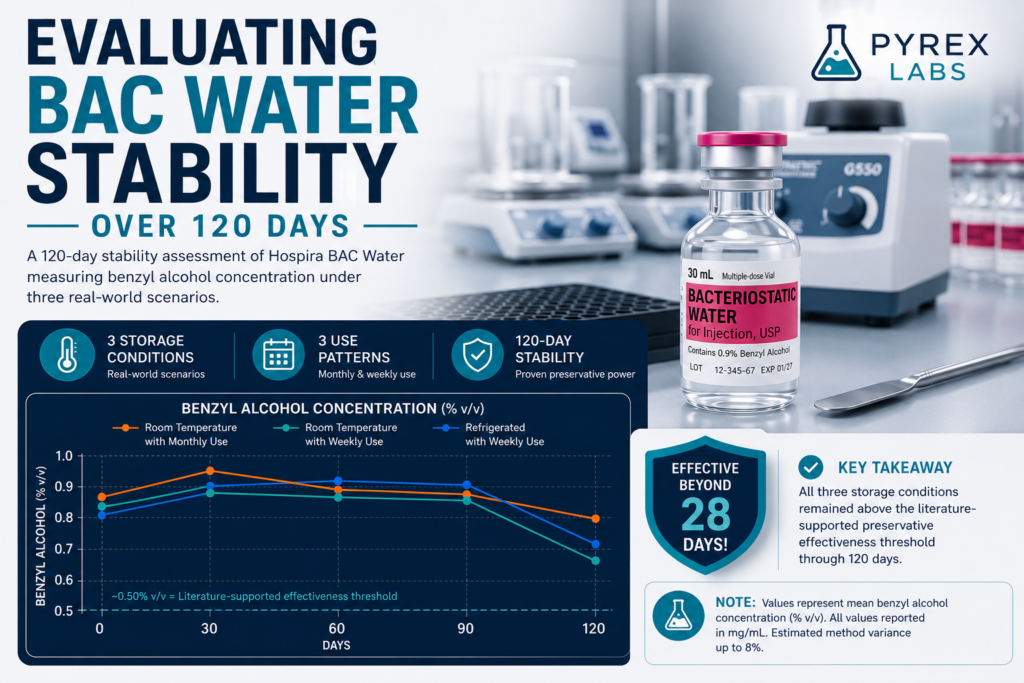
To better understand preservative stability over time, PTDS conducted a 120-day evaluation of Hospira-brand BAC Water. The study examined whether storage conditions and repeated vial access affected benzyl alcohol concentration throughout an extended observation period.
Study Objective
The purpose of this assessment was to determine whether benzyl alcohol concentrations remain stable after repeated vial punctures and prolonged storage.
Researchers evaluated:
- Long-term preservative stability
- The impact of routine vial access
- Differences between room-temperature and refrigerated storage
- Whether benzyl alcohol concentrations remain above commonly cited preservation thresholds
Experimental Design
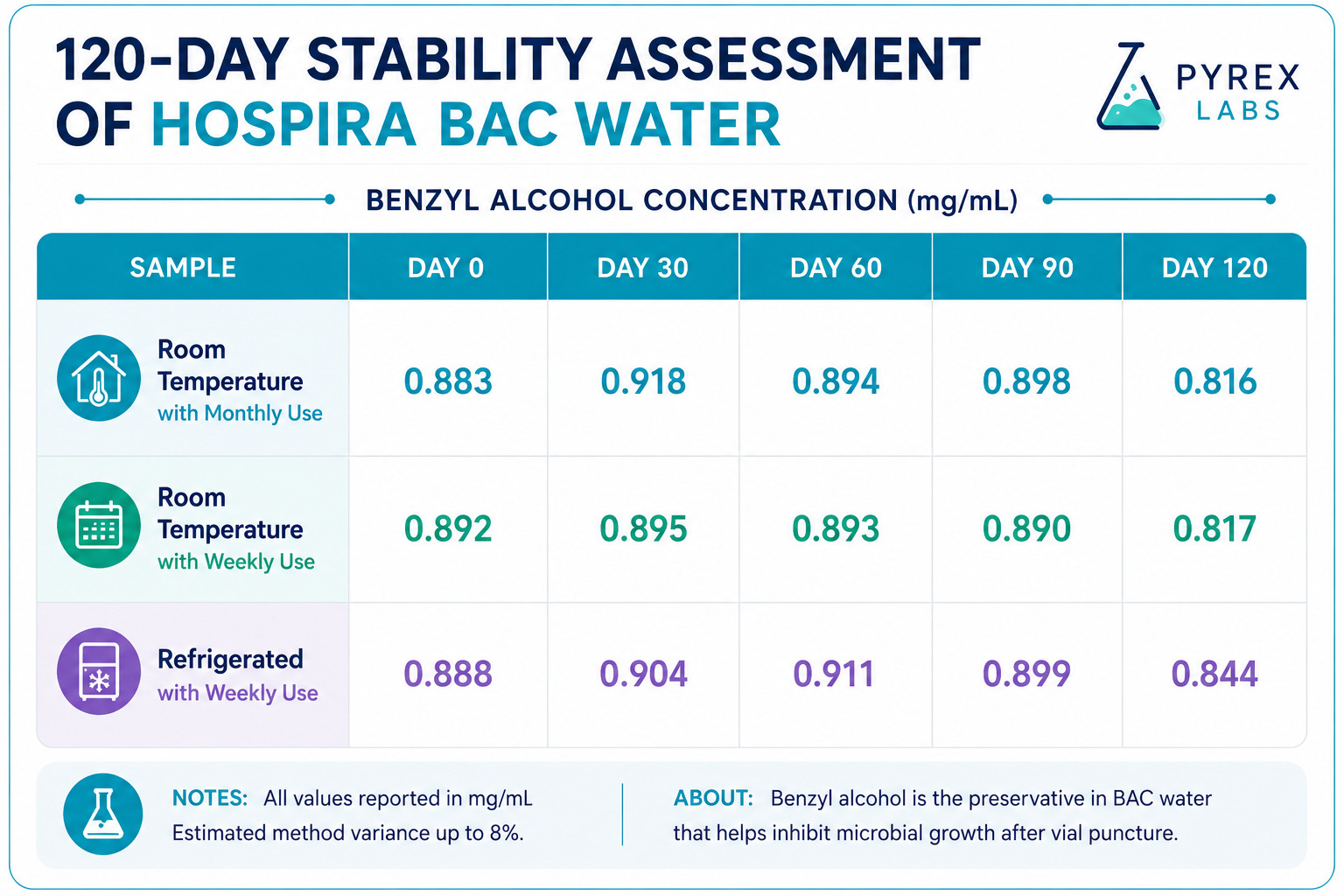
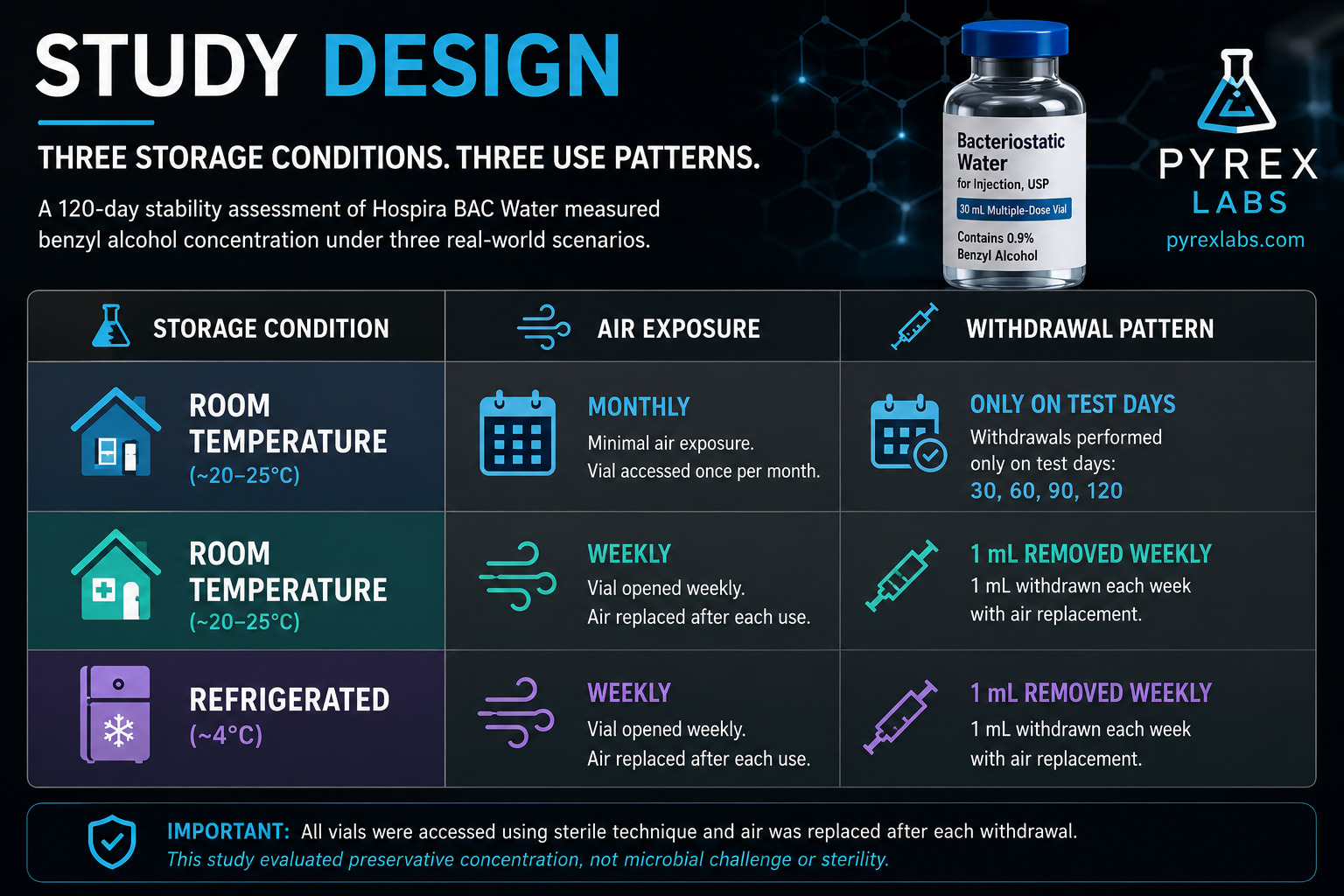
Three separate BAC Water vials were monitored over a 120-day period.
Room Temperature – Minimal Use
This vial served as the control sample and was disturbed only once per month.
Room Temperature – Weekly Use
This sample was designed to mimic a typical research-use scenario involving weekly withdrawals.
Refrigerated – Weekly Use
The third vial was refrigerated and accessed weekly to evaluate whether colder temperatures influenced preservative stability.
Benzyl alcohol concentrations were measured at multiple intervals using liquid chromatography by an independent analytical laboratory.
Commercial BAC Water formulations are generally standardized to approximately 0.9% v/v benzyl alcohol, equivalent to roughly 9.4 mg/mL, depending on assay methodology and density calculations.
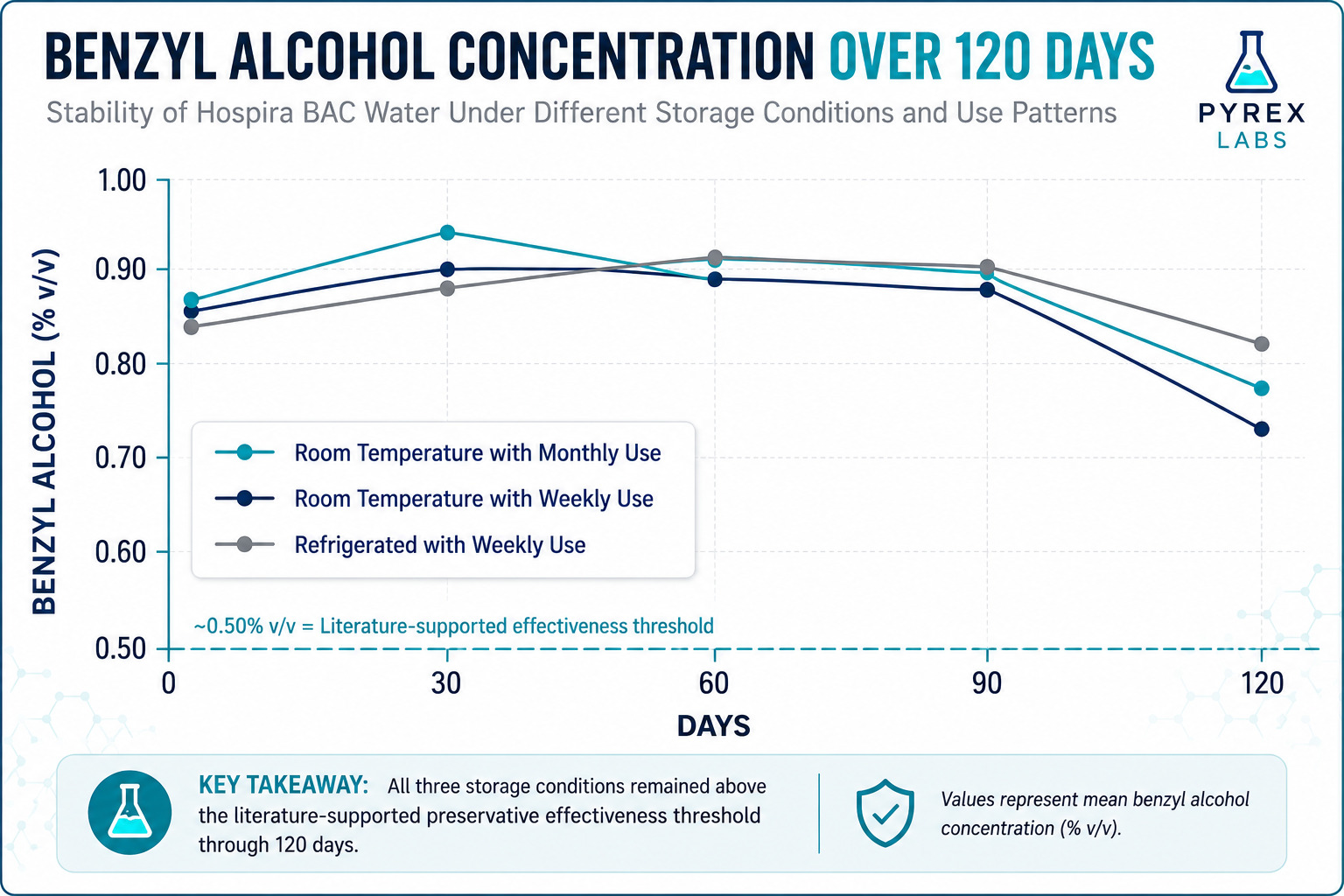
Published literature suggests preservative effectiveness remains acceptable above approximately 0.5% v/v benzyl alcohol.
Results Overview
Stability Through the First 90 Days
One of the most notable observations was the consistency of benzyl alcohol concentrations during the first three months.
At approximately Day 30—the closest measurement to the commonly referenced 28-day period—none of the samples demonstrated meaningful preservative loss.
From Day 0 through Day 90:
- All three storage conditions remained remarkably consistent
- Concentration changes fell largely within expected analytical variance
- No clear degradation trend was observed
- Weekly vial access did not appear to accelerate preservative loss
These findings suggest benzyl alcohol remained chemically stable throughout the initial observation period.
Changes Between Day 90 and Day 120
The most significant reductions occurred during the final month of testing.
Between Day 90 and Day 120:
| Storage Condition |
Change in Benzyl Alcohol |
| Room Temperature – Monthly Use |
-9.13% |
| Room Temperature – Weekly Use |
-8.20% |
| Refrigerated – Weekly Use |
-6.12% |
Although measurable declines were observed, all samples remained comfortably above the literature-supported preservation threshold.
Importantly, the reductions occurred across all three vials, including the minimally disturbed control sample.
This suggests the observed decline may represent a natural degradation process rather than an effect caused by repeated withdrawals.
Key Findings
1. Preservative Degradation Was Not Evident at 28 Days
The data showed no meaningful decrease in benzyl alcohol concentration around the 28-day mark.
In fact, concentrations remained relatively stable through approximately 90 days under all tested conditions.
This suggests that preservative degradation alone may not explain the USP <797> recommendation to discard multi-dose containers after 28 days.
2. Routine Vial Access Had Minimal Impact
The weekly-use room-temperature vial closely mirrored the minimally disturbed control sample.
Under the conditions tested, repeated vial entry using appropriate handling procedures did not appear to significantly accelerate benzyl alcohol loss.
3. Refrigeration Did Not Harm Preservative Stability
Although manufacturer labeling typically recommends room-temperature storage, refrigeration did not negatively affect benzyl alcohol concentrations.
The refrigerated sample actually exhibited the smallest decline during the final testing interval.
While the data do not support refrigeration as a method to extend shelf life, they also provide no indication that refrigeration accelerated preservative breakdown.
4. A Consistent Late-Stage Decline Was Observed
All three samples demonstrated modest decreases between Day 90 and Day 120.
Because the pattern occurred across every storage condition, researchers believe this decline may reflect an intrinsic stability limitation rather than a handling-related effect.
Even so, preservative concentrations remained substantially above the commonly referenced effectiveness threshold.
Study Limitations
While the results are informative, several important limitations should be considered.
Single Sample Per Condition
Only one vial was tested under each storage condition.
As a result, the study cannot fully separate normal vial-to-vial variability from true environmental effects.
Analytical Variability
The laboratory method carried an estimated variance of up to 8%.
Many fluctuations observed during the first 90 days fall within that range and therefore should not be interpreted as definitive evidence of degradation.
Benzyl Alcohol Is an Indirect Indicator
This study measured preservative concentration rather than antimicrobial activity itself.
Although benzyl alcohol concentration is commonly used as a marker of preservative effectiveness, it does not directly measure microbial inhibition.
No Microbial Challenge Testing
Researchers did not intentionally introduce microorganisms into the samples.
Consequently, the study cannot determine whether bacteriostatic performance changed over time despite stable preservative concentrations.
One Manufacturer and One Lot
All testing was performed using a single lot of Hospira BAC Water.
Results may not necessarily apply to other manufacturers or future production lots.
Conclusion
In this 120-day assessment, Hospira Bacteriostatic Water maintained benzyl alcohol concentrations above the literature-supported preservation threshold under all tested storage conditions.
No meaningful preservative degradation was observed near the commonly referenced 28-day mark, and concentrations remained relatively stable through approximately 90 days.
While modest declines occurred between Day 90 and Day 120, preservative levels remained well above the range generally associated with effective preservation.
These findings suggest that the USP <797> 28-day discard recommendation is more likely driven by concerns related to sterility, contamination risk, and safe handling practices rather than rapid degradation of benzyl alcohol itself.
Researchers should remember that preservative stability and sterility are not equivalent concepts. Even if benzyl alcohol concentrations remain adequate, contamination risks associated with repeated vial access remain an important consideration when handling multi-dose containers.