CHAPTER 1: OVERVIEW 📋
I. History of VIP 🏛️
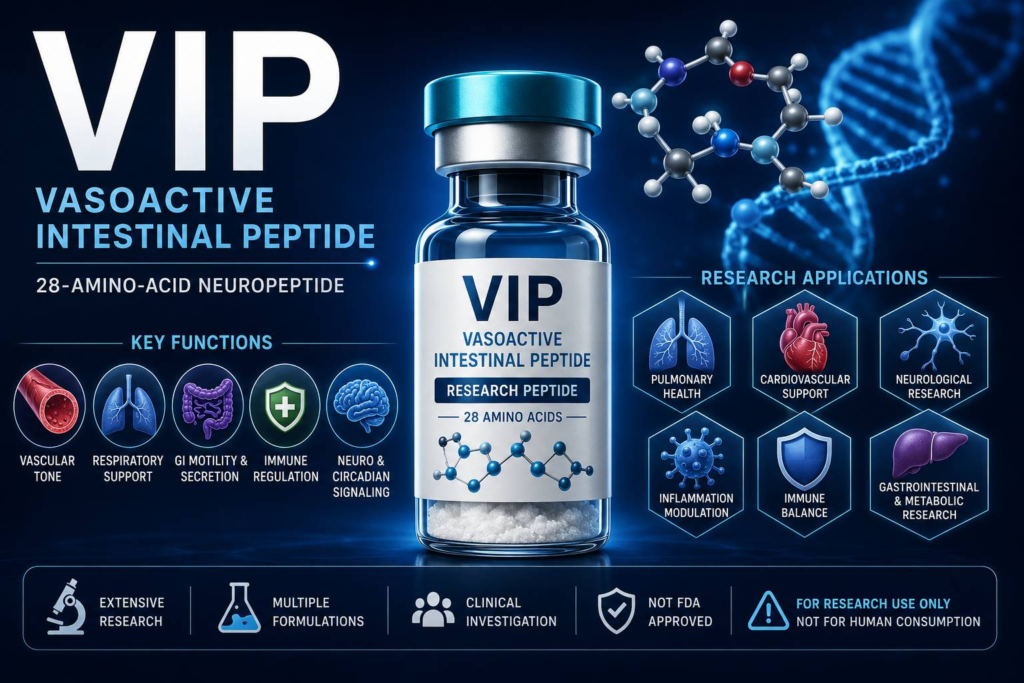
Vasoactive Intestinal Peptide (VIP) is a naturally occurring 28-amino-acid neuropeptide first isolated in 1970 by Sami Said and Viktor Mutt. Although originally identified in intestinal tissue, researchers later discovered that VIP is widely distributed throughout the central and peripheral nervous systems, gastrointestinal tract, lungs, cardiovascular system, and immune system.
VIP belongs to the secretin/glucagon peptide family and functions as both a neurotransmitter and regulatory signaling molecule. Its broad distribution explains why VIP research spans areas such as vascular tone, smooth-muscle relaxation, gastrointestinal secretion, pulmonary physiology, circadian signaling, and immune regulation.
A synthetic form of VIP known as aviptadil has also been investigated clinically, particularly in pulmonary and respiratory research. Importantly, findings involving endogenous VIP, pharmaceutical aviptadil, compounded VIP, and research-grade preparations should not automatically be treated as interchangeable.
II. Science Behind VIP 🧬
VIP produces most of its biological effects through two G-protein-coupled receptors:
VPAC1 is widely expressed in peripheral tissues and numerous immune-cell populations. It participates in gastrointestinal, pulmonary, metabolic, and immune signaling.
VPAC2 is expressed in several tissues, including the central nervous system, smooth muscle, pancreas, and immune cells. It also contributes to circadian regulation through signaling within the suprachiasmatic nucleus.
VIP can additionally interact with PAC1, but PAC1 has substantially greater affinity for PACAP. For this reason, VPAC1 and VPAC2 are considered the principal receptors responsible for VIP signaling.
Activation of VPAC receptors stimulates adenylyl cyclase, increasing intracellular cyclic AMP (cAMP). This activates downstream signaling pathways such as protein kinase A and influences cellular transcription and signaling.
Through these pathways, VIP has been associated with:
- Vasodilation and vascular regulation
- Smooth-muscle relaxation
- Gastrointestinal secretion and motility
- Pulmonary and airway signaling
- Circadian and neuronal communication
- Modulation of inflammatory signaling
- Regulation of selected immune-cell responses
Experimental research suggests VIP can influence inflammatory mediators and regulatory immune pathways. However, these effects are highly dependent on receptor expression, tissue type, disease state, concentration, and experimental conditions. Describing VIP as universally suppressing inflammation or permanently restoring immune tolerance would therefore go beyond current evidence.
III. Early Research & Clinical Interest 💡
Some of VIP’s earliest pharmacological research focused on its powerful vasodilatory and smooth-muscle effects. Investigators subsequently explored its role in respiratory disease, pulmonary circulation, gastrointestinal physiology, neurological signaling, inflammatory processes, and sexual medicine.
VIP signaling has been studied in pulmonary vascular conditions because of its ability to influence vascular resistance and smooth-muscle tone. Synthetic VIP formulations such as aviptadil have consequently entered clinical investigation for selected pulmonary and respiratory indications.
VIP has also been studied in erectile physiology because relaxation of smooth muscle and vascular tissue contributes to erectile function. Combination approaches involving VIP and other vasoactive agents have been investigated in this context.
These applications should be distinguished from broader claims surrounding VIP for chronic inflammatory syndromes, environmental illness, neurological recovery, or generalized “immune resetting.” Such uses remain experimental or insufficiently established unless supported by indication-specific clinical evidence.
CHAPTER 2: RESEARCH SAFETY CHECKLIST ✅
I. Clinical Monitoring 🩸🧬
There is no universally accepted laboratory panel that every VIP research subject must complete. Monitoring should instead reflect the formulation, route of administration, indication, medical history, and research protocol.
Because VIP is a potent vasodilator, blood pressure and cardiovascular symptoms are particularly relevant. Depending on the clinical context, researchers may also monitor hydration, electrolytes, gastrointestinal effects, pulmonary function, and disease-specific biomarkers.
Tests sometimes associated with particular chronic-inflammatory protocols—including C4a, TGF-β1, MARCoNS cultures, visual contrast sensitivity testing, or specialized neuroimaging—are not established universal prerequisites for VIP administration.
These measurements may appear in specific experimental frameworks, but fixed values should not be presented as generally validated thresholds for determining whether VIP is safe or effective.
II. Drug & Supplement Considerations 💊
Extra caution is appropriate when VIP is combined with substances that independently influence vascular tone or blood pressure.
Examples include antihypertensive medications, PDE5 inhibitors, nitrates, alpha-blockers, and other potent vasodilators. Combining vasoactive substances can potentially increase flushing, dizziness, orthostatic symptoms, or hypotension.
Because VIP also participates in immune and gastrointestinal signaling, individuals receiving complex immunomodulatory or gastrointestinal therapies should be evaluated according to their underlying condition and clinical protocol rather than relying on generalized interaction lists.
CHAPTER 3: STARTING VIP RESEARCH 🥼
VIP has been investigated using several administration routes, including intravenous, inhaled, and intranasal delivery. These formulations can have substantially different concentrations, pharmacokinetics, excipients, and stability requirements.
For that reason, there is no scientifically appropriate universal reconstitution formula or conversion such as a fixed number of micrograms per nasal spray.
Preparation should follow the validated instructions for the specific investigational formulation.
Timing & Frequency ⏰
VIP has a relatively short circulating half-life, but that does not mean every formulation requires frequent daily administration. Delivery systems and formulations can substantially change peptide exposure.
Clinical research schedules therefore vary according to the disease and formulation being studied.
Research Duration 🔄
There is likewise no universal 12-week VIP cycle. Clinical studies may involve acute administration, repeated dosing, or longer treatment periods depending on their endpoints.
Claims that every participant should complete a fixed on-cycle/off-cycle schedule should be avoided unless that schedule comes directly from the relevant study protocol.
Storage ❄️
Peptide stability is sensitive to factors such as temperature, formulation, pH, light exposure, and handling. Storage requirements should therefore come from the manufacturer, pharmacy, or investigational protocol for the exact formulation being used.
CHAPTER 4: RESEARCH EXPECTATIONS 🎯
VIP has well-established physiological roles, but clinical outcomes depend heavily on the condition being studied.
Research has explored its potential effects on pulmonary vascular resistance, airway physiology, gastrointestinal function, inflammatory signaling, vascular tone, neurological pathways, and immune-cell activity.
A fixed week-by-week timeline promising improvements in joint stiffness, exercise capacity, cognitive function, neurological imaging, inflammatory biomarkers, or immune status is not supported across VIP research as a whole.
Results should instead be interpreted according to the specific clinical endpoint and controlled study from which they originated.
CHAPTER 5: COMMON SIDE EFFECTS ⚠️
Reported adverse effects vary with formulation and administration route. Potential effects include facial flushing, headache, dizziness, blood-pressure reduction, gastrointestinal discomfort, and local irritation.
Because VIP is biologically active as a vasodilator, clinically significant hypotension is an important consideration, particularly when other blood-pressure-lowering substances are present.
Any severe or persistent reaction requires appropriate clinical assessment rather than simply adjusting an experimental protocol independently.
CHAPTER 6: COMMON RESEARCH MISTAKES 🤦
One of the biggest mistakes in VIP research is combining evidence from fundamentally different sources. Endogenous VIP physiology, animal experiments, cell studies, aviptadil clinical trials, compounded nasal formulations, and anecdotal protocols represent different levels of evidence.
Another mistake is treating specialized chronic-inflammatory protocols as though they represent universally accepted VIP medicine. Biomarkers or diagnostic approaches used by one clinical framework should be clearly identified as such.
Researchers should also avoid assuming that more VIP exposure automatically produces greater therapeutic benefit. Receptor signaling, pharmacokinetics, formulation, disease biology, and adverse effects all influence outcomes.
CHAPTER 7: DISCONTINUATION & FOLLOW-UP 🏁
There is currently no universal evidence-based VIP tapering schedule.
Statements that exogenous VIP inevitably causes VPAC receptor desensitization requiring a specific multi-week taper should therefore be presented cautiously. Whether gradual dose reduction is appropriate depends on the product, duration, indication, clinical condition, and supervising protocol.
Follow-up should focus on the underlying condition, treatment response, adverse effects, and clinically relevant measurements.
CHAPTER 8: COMBINATION RESEARCH 🔗
VIP is sometimes discussed alongside peptides, supplements, anti-inflammatory compounds, or nutritional cofactors. However, a proposed biological rationale does not automatically demonstrate that a combination is synergistic, safer, or clinically superior.
Combinations involving compounds such as KPV, BPC-157, thymosin peptides, magnesium, B vitamins, or omega-3 fatty acids require their own supporting evidence.
For experimental combinations, researchers should distinguish between mechanistic hypotheses and clinically demonstrated synergy.
CHAPTER 9: VIP & MAJOR DISEASE RESEARCH 🧪
VIP signaling has been investigated across numerous disease areas.
In cardiovascular research, its vasodilatory activity and influence on vascular signaling have generated interest, but VIP should not be described as an established treatment for atherosclerosis or heart disease.
In neurological research, VIP participates in neuroendocrine, circadian, vascular, and neuronal signaling. Neuroprotective effects have been investigated experimentally, but claims of predictable reversal of brain atrophy or stroke-related damage exceed established clinical evidence.
In cancer research, VIP and its receptors represent a complex area. Some tumors express VIP receptors, and VIP-related pathways have been explored for diagnostic and therapeutic purposes. The relationship cannot accurately be reduced to the claim that VIP universally promotes or prevents cancer.
In metabolic research, VIP participates in pancreatic and glucose-regulatory signaling, although this does not make VIP an established diabetes therapy.
In respiratory research, VIP has received substantial attention because of its pulmonary vasodilatory and immunomodulatory properties. This area includes research involving synthetic VIP formulations such as aviptadil.
VIP signaling has also been investigated experimentally in renal and hepatic physiology, particularly in relation to vascular, inflammatory, metabolic, and cellular signaling.
CHAPTER 10: SUMMARY 📝
Vasoactive Intestinal Peptide is a 28-amino-acid regulatory neuropeptide with unusually broad physiological activity. Through VPAC1 and VPAC2 receptors, it influences vascular tone, smooth-muscle activity, gastrointestinal function, pulmonary physiology, neuronal communication, circadian rhythms, and immune signaling.
That broad biology makes VIP scientifically interesting—but it also makes oversimplification easy.
Published evidence supports important physiological and investigational roles for VIP, while many highly specific dosing schedules, biomarker targets, chronic-inflammatory protocols, stacking strategies, and claims of permanent systemic recovery remain experimental, formulation-specific, or insufficiently validated.
The most scientifically responsible approach is therefore to separate established VIP biology from preliminary research and clearly distinguish both from anecdotal treatment protocols.
⚠️⚠️⚠️ Disclaimer: This content is provided for educational and informational purposes only. It is not medical advice, diagnosis, treatment guidance, or a dosing protocol. VIP/aviptadil formulations may have different regulatory statuses and safety profiles depending on the jurisdiction and intended use. Investigational or compounded peptides should be handled within appropriate medical, research, and regulatory frameworks.