The modern anti-obesity landscape has been revolutionized by incretin mimetics like semaglutide and tirzepatide. While these therapies routinely produce weight reductions of 20 to 40 pounds or more, standard bathroom scales fail to capture a critical nuance: the composition of that lost weight. A persistent challenge in rapid weight loss is the concurrent loss of lean muscle mass alongside adipose tissue.
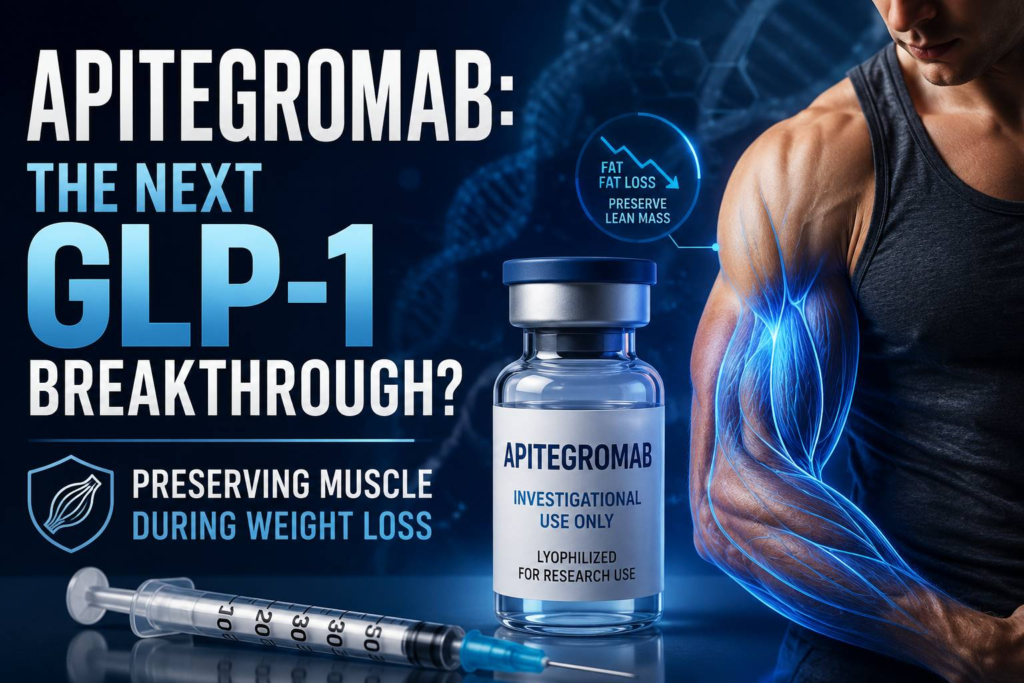
Apitegromab—an investigational monoclonal antibody targeting myostatin—aims to address this limitation. Clinical data suggests that combining standard incretin therapy with myostatin inhibition could fundamentally shift the treatment paradigm from maximizing gross weight loss to optimizing body composition.
The Hidden Cost of Incretin Therapy: Lean Mass Depletion
During significant caloric deficits and rapid weight reduction, a substantial portion of total mass lost is lean tissue rather than pure fat.
-
The Baseline Incretin Problem: In clinical trials evaluating tirzepatide alone, approximately 30% of total weight loss is lean mass. Nearly one out of every three pounds lost comes from metabolically active lean tissue and skeletal muscle.
-
Composition Matters: A 25-pound reduction consisting primarily of adipose tissue is physiologically distinct from a 25-pound reduction that includes significant muscle loss.
Sustaining lean mass is critical for maintaining resting metabolic rate, preserving physical strength, and mitigating the risk of rapid weight regain.
Mechanism of Action: What is Apitegromab?
Apitegromab is not a GLP-1 receptor agonist, nor is it a traditional peptide drug.
-
Monoclonal Antibody Design: Developed by Scholar Rock, apitegromab is a fully human monoclonal antibody designed to selectively inhibit the precursor activation of myostatin (GDF-8).
-
The Myostatin Pathway: Myostatin acts as the human body’s primary molecular brake on skeletal muscle growth and maintenance. By selectively blocking its activation, apitegromab prevents muscle breakdown during periods of systemic catabolism.
The EMBRAZE Phase 2 Trial
To test whether blocking myostatin could protect muscle during incretin-mediated weight reduction, researchers conducted the Phase 2 EMBRAZE clinical trial:
-
Study Cohort: 102 adults classified as overweight or living with obesity.
-
Protocol: All participants received tirzepatide (the dual GIP/GLP-1 receptor agonist found in Mounjaro and Zepbound) for 24 weeks.
-
Control vs. Active Arm: One group received tirzepatide alongside apitegromab, while the control group received tirzepatide with a placebo.
| Endpoint (24-Week Trial Data) |
Tirzepatide + Placebo |
Tirzepatide + Apitegromab |
| Total Weight Lost |
~27.5 lbs |
Slightly lower overall scale weight loss |
| Lean Mass Lost |
~7.6 lbs |
~3.4 lbs |
| Lean Mass Preservation |
Standard baseline |
~55% greater preservation |
| Body Composition Ratio |
~70% Fat / 30% Lean |
~85% Fat / 15% Lean |
Shifting the Quality of Weight Loss
When evaluated solely by the total number on the scale, apitegromab did not accelerate total weight reduction. In fact, total scale loss was slightly lower in the combination arm.
However, advanced body composition imaging revealed a major shift in the underlying physiology:
-
Muscle Sparing: Patients receiving apitegromab lost over 4 fewer pounds of lean mass (3.4 lbs vs. 7.6 lbs).
-
Adipose Selectivity: Incretin therapy combined with apitegromab shifted the weight-loss profile to roughly 85% fat and 15% lean mass, compared to the 70/30 baseline split.
-
Durability: Reassessments conducted 8 weeks after therapy ended demonstrated that the lean mass preservation remained statistically significant.
Key Caveats: Mass vs. Functional Performance
Despite compelling radiological and DEXA scan results, the data carries important clinical qualifications:
-
Functional Outcomes: Preserving lean mass did not immediately translate to improved physical strength. Standardized physical metrics, including grip strength and chair-stand tests, did not show a distinct functional advantage for the apitegromab cohort over placebo.
-
Sample Size: As a Phase 2 trial of 102 participants, larger Phase 3 studies will be necessary to establish whether long-term lean mass retention produces durable metabolic and mobility benefits.
The Next Era of Obesity Pharmacotherapy
The development of pharmacological obesity treatments has progressed through several generations:
-
Generation 1: Single incretin agonists (GLP-1, e.g., semaglutide)
-
Generation 2: Dual incretin agonists (GLP-1 + GIP, e.g., tirzepatide)
-
Generation 3: Triple incretin agonists (GLP-1 + GIP + Glucagon, e.g., retatrutide)
Myostatin inhibition introduces an orthogonal mechanism to this progression. Rather than focusing exclusively on central appetite suppression or increasing energy expenditure, pairing incretin agonists with muscle-preserving antibodies targets body composition directly, moving obesity medicine toward high-quality, fat-selective weight loss.