CHAPTER 1: OVERVIEW 📋
I. History of Cagrilintide 🏛️
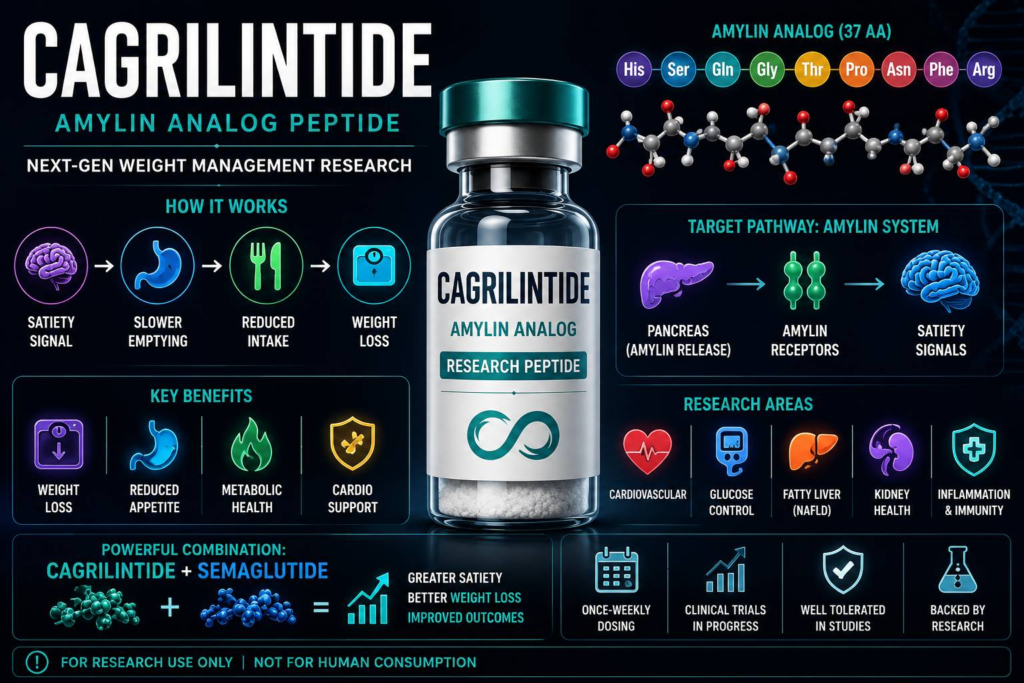
Cagrilintide is an investigational, long-acting analog of amylin, a hormone naturally released by pancreatic beta cells alongside insulin. Amylin contributes to satiety, appetite regulation, and gastric emptying, making its pathway an important target in obesity and metabolic research.
Cagrilintide was engineered to remain active considerably longer than native amylin, allowing it to be investigated using once-weekly administration in clinical trials. It is being studied both as an individual therapy and in combination with GLP-1–based treatments.
Unlike pramlintide, an approved amylin analog used in diabetes care, cagrilintide remains investigational and has not been approved as a standalone weight-management medication.
II. Science Behind Cagrilintide 🧬
Cagrilintide is a long-acting amylin analog with activity at amylin and calcitonin-family receptors. Its biological effects are primarily associated with signaling pathways involved in meal termination and satiety.
Rather than relying exclusively on the GLP-1 pathway, cagrilintide targets a complementary system involved in communicating fullness between the gastrointestinal tract and the brain.
Research suggests several mechanisms may contribute to its effects:
- Increased satiety
- Reduced energy intake
- Slower gastric emptying
- Reduced hunger
- Improved appetite regulation
This different mechanism is one reason researchers are particularly interested in combining amylin-based compounds with GLP-1 receptor agonists.
III. Primary Research Application 💡
The primary area of investigation for cagrilintide is chronic weight management in people with overweight or obesity.
Researchers are studying whether targeting the amylin pathway can produce clinically meaningful weight reduction independently and whether combining it with complementary incretin pathways can enhance outcomes.
One of the most prominent combinations is cagrilintide + semaglutide, commonly referred to as CagriSema in clinical development.
CHAPTER 2: RESEARCH CHECKLIST ✅
I. Important Research Biomarkers 🧪
Clinical research involving metabolic therapies commonly evaluates multiple measures rather than body weight alone.
| Biomarker |
Research Purpose |
| HbA1c |
Long-term glucose regulation |
| Fasting Glucose |
Baseline glycemic control |
| Lipid Profile |
Cardiometabolic health |
| Blood Pressure |
Cardiovascular monitoring |
| Body Weight |
Primary obesity-related outcome |
| Waist Circumference |
Central adiposity |
| Body Composition |
Fat vs. lean-mass changes |
| Pancreatic Markers |
Relevant when clinically indicated |
Changes in these measurements should be interpreted alongside the participant’s baseline health and other medications.
II. Medication & Combination Considerations ⚠️
Because cagrilintide affects appetite, gastrointestinal function, and metabolic physiology, combining it with other therapies can alter both efficacy and tolerability.
Particular attention is warranted with:
Insulin or glucose-lowering medications — changes in food intake and glucose regulation may require clinical monitoring.
Other amylin-based compounds — overlapping mechanisms could increase adverse effects without necessarily improving outcomes.
GLP-1 receptor agonists — this combination is an active area of formal clinical investigation rather than something that should automatically be considered interchangeable with approved therapy.
CHAPTER 3: CLINICAL RESEARCH DESIGN 🥼
I. Formulation 🔬
Clinical-trial cagrilintide is formulated specifically for controlled pharmaceutical administration. Research formulations should not be assumed to have the same concentration, stability, purity, or pharmacokinetic characteristics.
Because cagrilintide remains investigational, preparation and handling should follow the specifications of the particular study formulation.
II. Dose Escalation Research 🚀
Clinical studies have investigated once-weekly cagrilintide across multiple dose levels.
An important feature of metabolic-drug research is gradual dose escalation. This allows investigators to evaluate tolerability while limiting gastrointestinal adverse effects that can occur when exposure increases too quickly.
There is currently no universal self-administration protocol for research-grade cagrilintide.
III. Timing ⏰
Its prolonged pharmacokinetic profile allows cagrilintide to be investigated using weekly rather than daily administration.
Clinical studies generally emphasize consistency and controlled exposure rather than attempting to synchronize administration with individual meals.
IV. Study Duration 🔄
Obesity trials typically require months of observation because meaningful changes in body weight and cardiometabolic health occur gradually.
Longer studies are particularly important for determining:
- Maximum weight-loss response
- Plateau behavior
- Long-term tolerability
- Lean-mass changes
- Cardiometabolic effects
- Weight maintenance
CHAPTER 4: WHAT CLINICAL TRIALS ARE MEASURING 🎯
Early Treatment
Researchers primarily evaluate tolerability, appetite changes, gastrointestinal effects, and early changes in energy intake.
Intermediate Treatment
As exposure continues, investigators can assess changes in body weight, waist circumference, appetite, and metabolic biomarkers.
Longer-Term Treatment
Longer trials provide better information about:
total weight reduction → treatment plateau → metabolic improvement → tolerability → weight maintenance
Results vary considerably between individuals, so a fixed week-by-week weight-loss expectation should not be assumed.
CHAPTER 5: COMMONLY REPORTED SIDE EFFECTS ⚠️
Like other therapies that substantially affect appetite and gastrointestinal physiology, cagrilintide has been associated with gastrointestinal adverse events during clinical investigation.
Commonly studied effects include:
| Side Effect |
Clinical Consideration |
| Nausea |
Often associated with dose escalation |
| Vomiting |
May occur in some participants |
| Constipation |
Gastrointestinal motility can change |
| Diarrhea |
Reported in metabolic-drug trials |
| Reduced Appetite |
Part of the intended pharmacologic effect |
| Abdominal Discomfort |
Severity and persistence should be monitored |
Clinical trials use structured titration and monitoring procedures to evaluate these effects.
CHAPTER 6: COMMON MISCONCEPTIONS 🤦
“Higher Doses Automatically Mean Better Results”
Greater exposure can also increase adverse effects. Clinical research aims to identify the best benefit-to-tolerability balance.
“Cagrilintide Is Just Another GLP-1”
It isn’t. Cagrilintide primarily targets amylin-related signaling, giving it a biologically distinct mechanism.
“Weight Loss Equals Fat Loss”
Substantial weight reduction can include both fat mass and lean tissue. Body-composition outcomes therefore matter.
“It Eliminates Hunger Completely”
The goal of amylin-based research is improved satiety and appetite regulation, not complete elimination of normal hunger signaling.
“Clinical-Trial Results Guarantee Individual Results”
Trial averages describe populations. Individual responses can differ substantially.
CHAPTER 7: DISCONTINUATION & WEIGHT MAINTENANCE 🏁
Cagrilintide is being investigated primarily as part of long-term obesity management, rather than as a short-duration weight-loss intervention.
When pharmacologic appetite suppression is discontinued, the biological mechanisms regulating hunger and body weight may re-emerge.
Researchers therefore remain interested in what happens after treatment stops, including changes in:
appetite → caloric intake → body weight → metabolic markers
Long-term maintenance remains an important question for virtually every modern obesity therapy.
CHAPTER 8: COMBINATION RESEARCH 🔗
Cagrilintide + Semaglutide
The best-known combination is CagriSema, which combines cagrilintide’s amylin activity with semaglutide’s GLP-1 receptor agonism.
This provides two complementary approaches to appetite regulation and metabolic control.
Why Researchers Are Interested
GLP-1 and amylin signaling overlap in some physiological outcomes but operate through different biological pathways.
The research question is therefore whether:
GLP-1 signaling + amylin signaling → greater metabolic benefit
without producing unacceptable increases in adverse effects.
Other experimental combinations should not automatically be assumed to provide additional benefits simply because their mechanisms differ.
CHAPTER 9: CAGrilintide & METABOLIC HEALTH 🔬
Cardiovascular Health ❤️
Weight reduction can improve several cardiovascular risk factors, including blood pressure, lipid levels, and central adiposity. Whether cagrilintide produces additional cardiovascular benefits independent of weight loss requires appropriate clinical evidence.
Cerebrovascular Health 🧠
Improving obesity-related cardiometabolic risk factors could theoretically reduce factors associated with stroke, but cagrilintide should not be characterized as a stroke-prevention therapy without direct outcome evidence.
Diabetes & Glucose Regulation 🩸
Amylin physiology is closely connected with glucose regulation, gastric emptying, and post-meal metabolic responses. These relationships make glucose-related outcomes important endpoints in cagrilintide research.
Fatty Liver Disease 🫀
Substantial weight reduction can improve liver fat and metabolic liver disease. Researchers are therefore interested in how next-generation obesity therapies may affect hepatic health.
Kidney Health
Changes in body weight, blood pressure, glucose regulation, and hydration can all influence renal physiology. Kidney-related outcomes remain important safety measurements during metabolic-drug research.
Cancer
There is currently insufficient evidence to characterize cagrilintide as either a cancer treatment or cancer-prevention therapy. Cancer-related claims should remain separate from established obesity-trial outcomes.
CHAPTER 10: SUMMARY 📝
Cagrilintide represents a different approach to next-generation obesity treatment because it targets the amylin pathway rather than relying exclusively on GLP-1 signaling.
By mimicking important aspects of amylin physiology, researchers hope to enhance satiety, reduce energy intake, regulate appetite, and support clinically meaningful weight reduction.
Its greatest scientific interest may ultimately come from combination therapy. Pairing amylin signaling with GLP-1 receptor agonism allows researchers to target multiple complementary biological systems involved in appetite and metabolic regulation.
Clinical development of combinations such as CagriSema will help determine whether this multi-pathway strategy can produce better long-term outcomes while maintaining acceptable tolerability.
Cagrilintide nevertheless remains an investigational compound. Clinical-trial findings should not be converted directly into self-administration protocols, and research formulations should not be assumed equivalent to pharmaceutical products used in controlled trials.
⚠️ Disclaimer: This article is for educational and informational purposes only. It does not provide medical advice, diagnosis, treatment recommendations, dosing instructions, or a self-administration protocol. Investigational peptides may carry risks, interactions, side effects, and regulatory considerations.