CHAPTER 1: OVERVIEW 📋
I. History of Delta Sleep-Inducing Peptide (DSIP) 🏛️
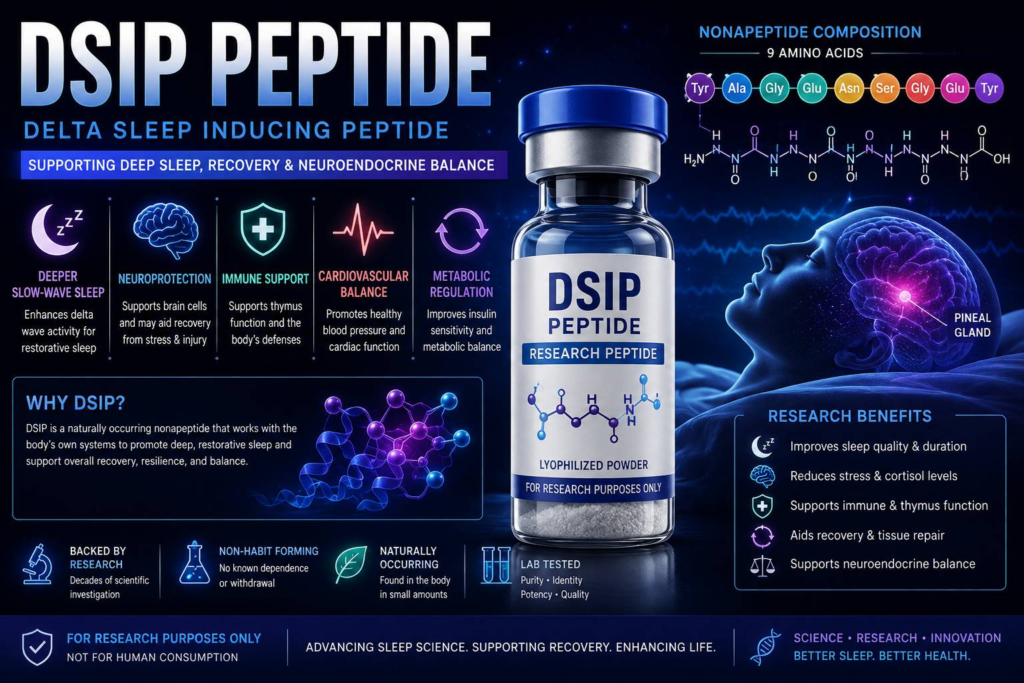
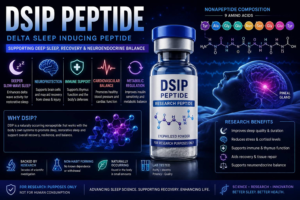
Delta Sleep-Inducing Peptide (DSIP) is a naturally occurring nonapeptide composed of nine amino acids that was first described in the 1970s during experiments investigating sleep-related biological signals.
Early researchers became interested in DSIP because of its apparent relationship with slow-wave or delta sleep. This led to decades of investigation into its possible roles in sleep regulation, stress physiology, neuroendocrine signaling, and recovery.
Despite its name, DSIP should not be viewed simply as a conventional sedative. Its biological activity appears considerably more complex, and many aspects of its mechanism remain unresolved.
II. Science Behind DSIP 🧬
DSIP has been investigated as a potential regulatory peptide rather than a traditional sleep-inducing drug. Research has explored possible interactions with neurotransmitter and neuroendocrine systems involved in:
- Sleep–wake regulation
- Stress response
- Hormonal signaling
- Pain perception
- Circadian biology
Some experimental findings suggest DSIP may influence sleep architecture and stress-related signaling, but results across studies have not always been consistent.
Importantly, the exact receptor and complete signaling pathway responsible for DSIP’s reported effects remain incompletely characterized.
III. Early Research Applications 💡
Much of the historical interest in DSIP centered on sleep regulation and insomnia. Researchers have also investigated it in relation to stress, pain, neuroendocrine function, and substance-withdrawal symptoms.
These findings have made DSIP an interesting experimental compound, but they should not be interpreted as proof that DSIP is an established treatment for insomnia or other medical conditions.
CHAPTER 2: RESEARCH CHECKLIST ✅
I. Research Considerations 🧪
Because DSIP remains experimental, research should focus on measurable outcomes rather than assuming that sedation equals effectiveness.
Common areas of investigation include:
| Research Area |
What May Be Monitored |
| Sleep Architecture |
REM and non-REM sleep patterns |
| Slow-Wave Sleep |
Changes in delta-wave activity |
| Sleep Latency |
Time required to fall asleep |
| Sleep Efficiency |
Percentage of time asleep while in bed |
| Cortisol |
Changes in stress-response patterns |
| Heart Rate |
Resting and overnight cardiovascular response |
| Glucose |
Metabolic changes during research |
Polysomnography, EEG measurements, and validated sleep assessments provide more meaningful research data than subjective sleep quality alone.
II. Important Interaction Considerations ⚠️
DSIP’s pharmacology is not fully established, which makes interaction predictions difficult. Particular caution is warranted when studying it alongside substances that substantially alter the central nervous system or sleep architecture.
This includes sedatives, benzodiazepines, opioids, alcohol, and other sleep-promoting compounds. Combining experimental substances can make it difficult to determine which compound is responsible for an observed effect or adverse reaction.
CHAPTER 3: DSIP RESEARCH DESIGN 🥼
I. Formulation & Handling 🧪
DSIP used in laboratory research may be supplied in lyophilized form. Handling requirements depend on the formulation, manufacturer, analytical standard, and intended experimental design.
Researchers should follow validated laboratory procedures for preparation, sterility, stability, temperature control, and documentation rather than relying on universal reconstitution instructions.
II. Dose Research 🔬
Published DSIP research has investigated different administration routes and exposure levels, and there is no universally established clinical dosing standard for routine sleep treatment.
Experimental design should therefore be based on the specific study methodology, formulation, pharmacokinetic data, and institutional oversight rather than generalized dosing schedules.
III. Timing & Circadian Research ⏰
Because DSIP is primarily investigated in relation to sleep physiology, researchers frequently examine outcomes around the normal sleep period.
Relevant variables include:
sleep onset → slow-wave sleep → REM cycles → morning recovery
Timing matters because sleep-related hormones and neurotransmitters naturally fluctuate throughout the night.
IV. Research Duration 🔄
DSIP studies have varied substantially in duration. Longer observation periods can help researchers distinguish temporary changes from persistent alterations in sleep architecture.
Controlled research should also account for confounding variables such as caffeine, alcohol, stress, exercise, medications, light exposure, and irregular sleep schedules.
CHAPTER 4: WHAT RESEARCHERS STUDY 🎯
Instead of expecting a predictable week-by-week progression, DSIP research generally focuses on several measurable domains.
Sleep Quality 🌙
Researchers may examine sleep latency, nighttime awakenings, total sleep duration, and perceived sleep quality.
Delta-Wave Activity 🧠
One of the most interesting questions is whether DSIP meaningfully alters slow-wave sleep, the restorative stage associated with prominent delta activity.
Stress Response 🧘
DSIP has also been investigated for possible effects on stress-related neuroendocrine signaling.
Recovery ⚡
Changes in morning alertness, fatigue, and perceived recovery may provide additional information about sleep quality.
Neuroendocrine Function 🧬
Experimental work has explored possible relationships between DSIP and several hormonal systems, although these mechanisms remain under investigation.
CHAPTER 5: SAFETY & SIDE EFFECTS ⚠️
Human safety data for DSIP remain limited compared with approved sleep medications.
Reported or theoretically relevant effects in experimental settings may include:
| Effect |
Research Consideration |
| Headache |
Monitor severity and duration |
| Nausea |
Record alongside timing and exposure |
| Drowsiness |
Assess daytime impairment |
| Sleep Changes |
Monitor objective and subjective sleep quality |
| Paradoxical Alertness |
Some responses may differ from expected sedation |
A lack of severe effects in small studies does not establish long-term safety.
CHAPTER 6: COMMON RESEARCH MISTAKES 🤦
Treating DSIP Like a Sleeping Pill
DSIP is better understood as an experimental regulatory peptide than as a conventional sedative.
Ignoring Sleep Hygiene
Caffeine, alcohol, irregular schedules, stress, and nighttime light exposure can overwhelm subtle changes being studied.
Measuring Only “Hours Slept”
More sleep does not necessarily mean better sleep. Sleep architecture and sleep efficiency may be more informative.
Assuming More Is Better
Peptide effects are not necessarily linear. Higher experimental exposure does not automatically produce stronger or more desirable results.
Drawing Conclusions Too Quickly
Night-to-night sleep naturally varies. Short observation periods can easily produce misleading conclusions.
CHAPTER 7: DISCONTINUATION & FOLLOW-UP 🏁
DSIP does not have a well-established clinical withdrawal syndrome comparable with dependence-forming sedative medications.
However, because human evidence remains limited, researchers should avoid assuming that every administration pattern can be discontinued without consequences.
Post-exposure monitoring can help determine whether observed sleep changes persist, disappear, or return toward baseline.
CHAPTER 8: COMBINATION RESEARCH 🔗
Researchers may encounter DSIP discussed alongside other compounds involved in sleep, stress, circadian rhythm, or neuroendocrine research.
Examples include melatonin, Epitalon, Selank, and growth-hormone secretagogues.
These combinations should not automatically be considered synergistic. Combining experimental compounds introduces additional variables, making safety and causal interpretation substantially more difficult.
CHAPTER 9: DSIP & HEALTH RESEARCH 🔬
Cardiovascular Research ❤️
Experimental studies have explored DSIP’s relationship with autonomic regulation and physiological responses to stress. Evidence is not sufficient to consider DSIP a cardiovascular treatment.
Neurological Research 🧠
Sleep architecture, neuroprotection, stress signaling, and nervous-system recovery remain important areas of investigation.
Cancer Research 🎗️
Animal observations have generated hypotheses regarding DSIP and tumor biology, but these findings do not establish an anticancer effect in humans.
Diabetes & Metabolism 🩸
Possible relationships between DSIP, stress physiology, sleep quality, and metabolic regulation have been explored experimentally. Clinical significance remains uncertain.
Immune Function 🫁
Because restorative sleep contributes to normal immune function, researchers are interested in whether sleep-regulating peptides could indirectly influence immune physiology. DSIP should not be considered a treatment for respiratory infections.
Kidney & Liver Function
Available research does not establish DSIP as a treatment for kidney or liver disease. Organ-function monitoring remains relevant when evaluating experimental compounds.
CHAPTER 10: SUMMARY 📝
Delta Sleep-Inducing Peptide (DSIP) is an intriguing experimental nonapeptide with a long history in sleep and neuroendocrine research.
Rather than acting like a traditional sedative, DSIP has been investigated as a potential modulator of sleep architecture, stress signaling, circadian physiology, and neuroendocrine function.
Its most interesting research questions involve slow-wave sleep, restorative sleep, stress response, neurological recovery, and hormonal regulation. At the same time, the evidence base remains limited and sometimes inconsistent, and DSIP does not have a universally accepted clinical dosing protocol or established role as a routine sleep treatment.
For that reason, DSIP is best discussed as a research compound with unresolved but scientifically interesting biology, rather than as a proven treatment for insomnia, longevity, metabolic disease, or other medical conditions.
⚠️ Disclaimer: This content is provided for educational and informational purposes only. DSIP remains an experimental research compound and this article is not medical advice, diagnosis, treatment guidance, or a self-administration protocol. Peptides and experimental compounds may carry risks, interactions, side effects, and regulatory considerations.
Continue exploring:
- DSIP WordPress tags
- DSIP meta title and description