CHAPTER 1: PEPTIDE OVERVIEW 📋
I. History of Semax 🏛️
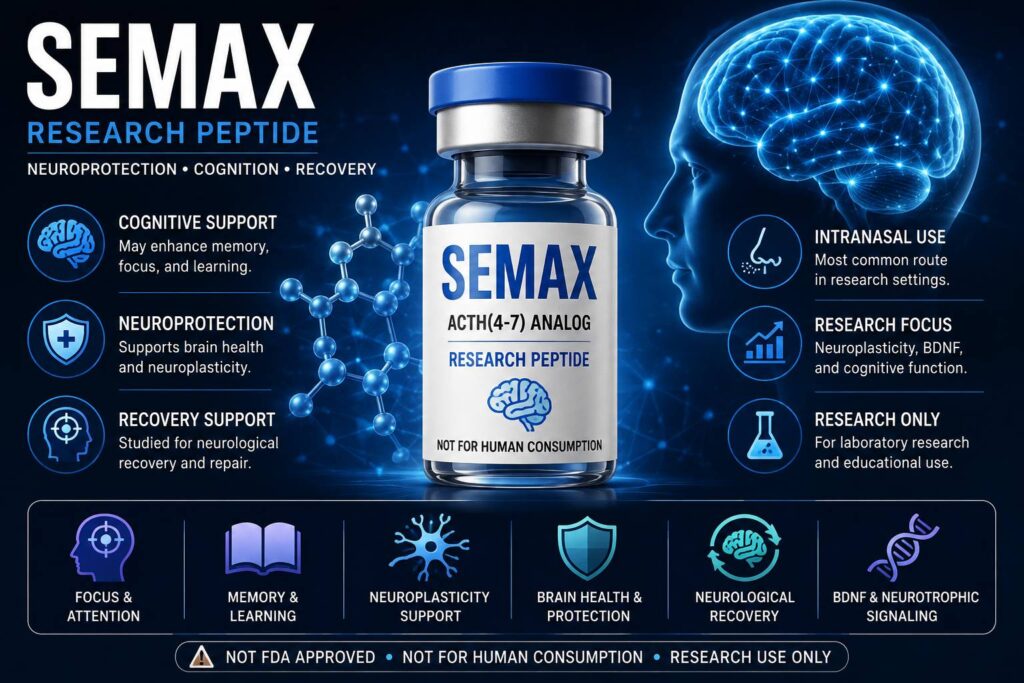
Semax is a synthetic peptide developed in Russia during the late Soviet and post-Soviet research period. It was designed from a fragment of adrenocorticotropic hormone (ACTH) with the goal of preserving certain neurological effects without producing the hormonal activity associated with full-length ACTH.
Semax has been investigated primarily for its potential neuroprotective, cognitive, and neurological effects, particularly in research involving cerebral ischemia and recovery following neurological injury.
Although Semax has been used medically in Russia and some neighboring countries, it is not FDA-approved in the United States for stroke, cognitive enhancement, or other medical conditions.
II. Science Behind Semax 🧬
Semax is a synthetic heptapeptide with the sequence:
Met-Glu-His-Phe-Pro-Gly-Pro
It incorporates the ACTH(4–7) fragment with a Pro-Gly-Pro extension, which improves resistance to enzymatic degradation.
Research suggests Semax may influence several neurological pathways, including:
- BDNF-related signaling
- Neuroplasticity
- Neurotrophic signaling
- Oxidative-stress responses
- Inflammatory pathways
- Dopaminergic and serotonergic signaling
- Cerebral blood-flow mechanisms
One of the most studied areas is its potential influence on brain-derived neurotrophic factor (BDNF) and other pathways involved in neuronal adaptation and recovery.
However, claims that Semax simply or immediately “raises BDNF” to a predictable level oversimplify a much more complicated biological process.
III. Primary Research Applications 💡
Semax has received research attention in areas including:
Neurological recovery: Particularly experimental and regional clinical research involving ischemic stroke.
Neuroprotection: Investigation of mechanisms that could potentially protect neurons during metabolic, inflammatory, or oxidative stress.
Cognition: Experimental work involving memory, attention, learning, and information processing.
Neuroplasticity: Research examining pathways involved in neuronal adaptation and repair.
The evidence for these applications varies substantially, and findings from animal studies should not automatically be interpreted as established human benefits.
CHAPTER 2: RESEARCH & SAFETY CHECKLIST ✅
I. Blood Tests & Biomarkers 🩸🧬
There is currently no validated Semax-specific laboratory panel that researchers or patients must complete before Semax exposure.
Tests such as vitamin D, ferritin, homocysteine, lipid levels, and fasting glucose may provide useful information about general health, but there are no scientifically established Semax-specific “required ranges.”
Depending on medical history and research circumstances, general assessments might include:
CBC: General hematological health.
Comprehensive Metabolic Panel: Liver, kidney, electrolyte, and metabolic function.
Fasting Glucose / HbA1c: Useful when glucose regulation is clinically relevant.
Liver and Kidney Function: Particularly relevant when investigating an experimental compound or when underlying disease is present.
Additional testing should be determined by an appropriate healthcare professional rather than arbitrary peptide-specific thresholds.
II. Medication & Supplement Considerations 💊
Semax’s human drug-interaction profile has not been comprehensively characterized.
Extra caution is appropriate when combining experimental neuroactive compounds with medications that influence the central nervous system, including:
- SSRIs/SNRIs
- MAO inhibitors
- Prescription stimulants
- Other psychoactive medications
- Sedatives
- Other experimental nootropics
However, claims that combining Semax with an SSRI automatically causes serotonin syndrome are not adequately established.
Likewise, it should not be assumed that Semax reliably “amplifies” amphetamine medications to a dangerous degree without supporting clinical evidence.
People taking psychiatric or neurological medications should not stop or modify prescribed treatment simply to use Semax.
CHAPTER 3: ADMINISTRATION & RESEARCH CONSIDERATIONS 🥼
Semax does not have an FDA-approved dosing regimen for cognition, performance enhancement, stroke recovery, or neuroprotection in the United States.
Consequently, dosing schedules circulated online should not be presented as universally established medical protocols.
I. Administration Route 🧪
Semax is most commonly associated with intranasal administration in Russian clinical literature and experimental use.
Different formulations may have different:
- Concentrations
- Stability characteristics
- Absorption profiles
- Storage requirements
Lyophilized research material should not automatically be assumed to be appropriate for preparation as a nasal product.
II. Dose & Frequency 🚀
Research protocols have used varying doses depending on the formulation, route, and research objective.
There is currently no universally validated:
- Starting dose
- Maintenance dose
- Maximum dose
- Daily frequency
- Performance-enhancement protocol
The commonly circulated microgram schedules found in peptide communities should therefore be distinguished from established medical dosing.
III. Timing ⏰
There is insufficient evidence establishing that Semax must be administered specifically in the morning or early afternoon.
Because individuals may respond differently to neuroactive compounds, effects on alertness, mood, and sleep should not be assumed to be universal.
IV. Research Duration 🔄
There is no well-established requirement that Semax must follow a specific:
10–14 days on / 10–20 days off
or
5 days on / 2 days off
schedule.
Likewise, there is insufficient evidence demonstrating that these schedules are necessary to prevent receptor desensitization.
V. Storage ❄️
Storage requirements depend on the specific Semax formulation.
Manufacturer or validated laboratory stability information should take priority over generalized internet recommendations.
CHAPTER 4: RESEARCH EXPECTATIONS 🎯
Semax does not have a scientifically validated week-by-week timeline guaranteeing specific cognitive effects.
Research interests include:
Cognitive Function 🧠
Experimental studies have explored potential effects involving:
- Attention
- Memory
- Learning
- Mental processing
- Cognitive performance
Neuroplasticity
Semax has been investigated for effects on neurotrophic and neuroplasticity-related pathways, including BDNF-associated signaling.
Neurological Recovery
Some of the most notable clinical interest surrounding Semax involves ischemic cerebrovascular disease and neurological recovery.
However, these findings should not be interpreted as justification for self-treating stroke or another neurological emergency.
Stress & Adaptation
Experimental evidence suggests potential interactions with neurotransmitter and stress-response systems, but predictable effects on mood or stress resilience have not been established for every individual.
Claims such as “improved verbal fluency in Week 1” or “memory consolidation in Weeks 3–4” are therefore better treated as anecdotal rather than validated timelines.
CHAPTER 5: POTENTIAL SIDE EFFECTS ⚠️
Human safety information remains more limited than it is for widely approved neurological medications.
Nasal Irritation
Intranasal formulations may potentially cause:
- Nasal dryness
- Irritation
- Sneezing
- Local discomfort
Headache
Headache is possible, although its frequency is not firmly established.
Changes in Alertness
Some individuals may experience unexpected changes in:
- Energy
- Alertness
- Fatigue
- Sleep
Mood or Behavioral Changes
Because Semax influences neurological pathways, unexpected changes in mood, anxiety, agitation, or concentration should be taken seriously.
Product Quality
With unapproved research products, additional risks can arise from:
- Incorrect concentration
- Contamination
- Degradation
- Mislabeling
- Poor sterility
These risks are separate from Semax’s pharmacology.
CHAPTER 6: COMMON RESEARCH MISTAKES 🤦
Treating Semax as a Proven Cognitive Enhancer
Interesting neurological research does not mean Semax reliably increases intelligence, productivity, memory, or focus in healthy individuals.
Assuming More Is Better
Experimental compounds can produce nonlinear responses. Increasing exposure does not guarantee greater cognitive effects.
Assuming Cycling Prevents “Receptor Burnout”
There is insufficient evidence supporting claims that chronic Semax exposure inevitably causes receptor desensitization requiring predetermined cycling schedules.
Ignoring Sleep & Lifestyle
No experimental peptide should be expected to compensate reliably for chronic sleep deprivation, poor nutrition, excessive alcohol consumption, or other major health factors.
Improper Intranasal Administration
Intranasal delivery depends on formulation, particle characteristics, concentration, and nasal physiology. Simply placing an arbitrary peptide solution in a spray bottle does not guarantee predictable absorption.
CHAPTER 7: DISCONTINUATION 🏁
There is no established evidence that Semax produces the same type of physical dependence or withdrawal syndrome associated with opioids, benzodiazepines, or certain other medications.
There is also no established requirement for a routine 3–5 day taper.
However, available long-term human evidence remains limited, so it is too strong to claim that every individual can discontinue every Semax regimen “cold turkey” without any effects.
Claims that cognitive benefits reliably persist for weeks after discontinuation also require stronger human evidence.
CHAPTER 8: SEMAX COMBINATIONS 🔗
Popular Semax combinations are frequently discussed in nootropic communities, but most have not been evaluated through controlled clinical trials.
Selank
Perhaps the best-known combination.
Semax is generally investigated for neuroprotective and cognitive mechanisms, while Selank has attracted attention primarily for anxiolytic and stress-related effects.
The theoretical combination is interesting, but there is no established clinical evidence proving a “calm focus” synergy.
Creatine
Creatine plays an important role in cellular energy metabolism and has independent evidence involving exercise and neurological function.
This does not establish a specific pharmacological synergy with Semax.
Alpha-GPC / Choline
Choline participates in acetylcholine synthesis and neurological function.
There is insufficient evidence demonstrating that combining it with Semax specifically produces greater neuroplasticity or cognitive performance.
CHAPTER 9: SEMAX & MAJOR HEALTH CONDITIONS 🏥
Heart Disease ❤️
Preclinical research has explored Semax in models involving ischemic injury and oxidative stress.
This does not establish Semax as a treatment for heart disease or myocardial infarction in humans.
Stroke & Cerebrovascular Disease 🧠
This is one of Semax’s more notable research areas.
Semax has been studied in Russia in connection with ischemic stroke and neurological recovery, but evidence standards, treatment protocols, and regulatory acceptance differ internationally.
Semax should never substitute for emergency stroke treatment.
Cancer 🎗️
The relationship between neurotrophic factors, angiogenesis, and cancer is complex.
There is insufficient evidence to conclude that Semax either prevents cancer or meaningfully accelerates cancer in humans.
Diabetes Mellitus 🩸
Semax has not been established as a treatment for diabetes.
Claims that it predictably increases blood glucose or requires diabetes-medication adjustment should not be made without appropriate clinical evidence.
Respiratory Disease 🫁
Preclinical research involving oxidative stress and tissue injury may be scientifically interesting, but Semax is not an established treatment for pneumonia, COPD, or respiratory infections.
Kidney Disease
There is insufficient human evidence demonstrating a therapeutic role for Semax in chronic kidney disease.
Liver Disease
Experimental research has explored neuropeptides and tissue-protective mechanisms, but Semax should not currently be characterized as an established treatment for toxic liver injury.
CHAPTER 10: SUMMARY 📝
Semax is a synthetic ACTH-derived heptapeptide developed primarily for neurological and neuroprotective research.
Its most important research areas include:
- Neuroprotection
- BDNF-related signaling
- Neuroplasticity
- Memory and learning
- Cognitive function
- Cerebral ischemia
- Neurological recovery
- Neurotransmitter regulation
Semax is particularly interesting because experimental and regional clinical research suggests biological activity involving several pathways important to neuronal survival, adaptation, and recovery.
At the same time, many claims circulating online—including guaranteed increases in focus, specific week-by-week cognitive improvements, mandatory cycling schedules, powerful drug interactions, and treatment of numerous unrelated diseases—extend beyond what current human evidence can reliably establish.
The most scientifically appropriate description is that Semax is an experimental neuroactive peptide with promising neuroprotective and cognitive research, but substantially more high-quality human research is needed to establish its effectiveness, long-term safety, optimal administration, and clinical role.
⚠️ Disclaimer: This material is for educational and informational purposes only. It is not medical advice, diagnosis, dosing guidance, or a treatment recommendation. Semax is not FDA-approved in the United States for cognitive enhancement, stroke treatment, or other medical conditions. Consult a qualified healthcare professional before using or combining experimental peptides, medications, or supplements.