PT-141 (Bremelanotide): Research Overview, Mechanism, Safety & Clinical Evidence
CHAPTER 1: OVERVIEW 📋
I. History of PT-141
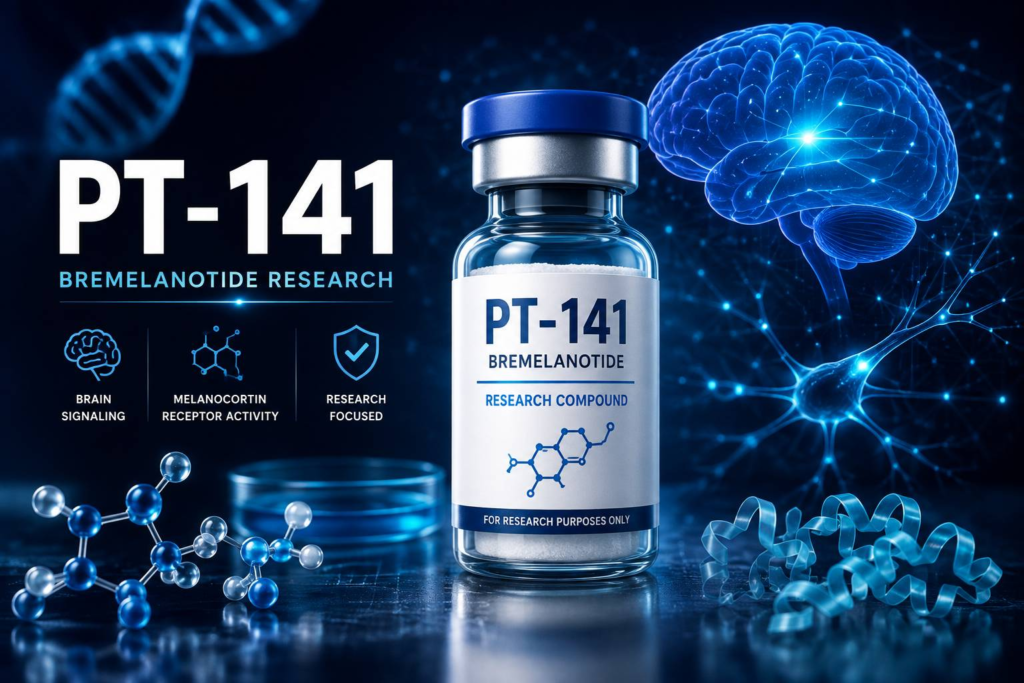
PT-141, also known as bremelanotide, originated from research involving melanocortin peptides. It is a synthetic cyclic peptide related to α-melanocyte-stimulating hormone (α-MSH) and was developed after researchers observed that melanocortin compounds could influence sexual arousal in addition to pigmentation.
Development eventually focused on bremelanotide as a treatment for sexual desire disorders. In 2019, the FDA approved bremelanotide under the brand name Vyleesi for acquired, generalized hypoactive sexual desire disorder (HSDD) in premenopausal women.
II. Science Behind PT-141 🧬
Unlike PDE5 inhibitors such as sildenafil, which primarily influence blood flow, PT-141 acts mainly through the central nervous system.
Bremelanotide is a melanocortin receptor agonist, with activity at receptors including MC3R and MC4R. These receptors are involved in neural pathways associated with sexual motivation and arousal.
This different mechanism is why PT-141 has attracted research interest: it targets signaling in the brain rather than functioning simply as a peripheral vasodilator.
III. Established and Investigational Uses 💡
The FDA-approved indication for bremelanotide is acquired, generalized HSDD in premenopausal women. PT-141 has also been investigated experimentally in men with erectile dysfunction and other forms of sexual dysfunction, but these uses are not FDA-approved.
CHAPTER 2: SAFETY & RESEARCH CHECKLIST ✅
PT-141 can affect cardiovascular parameters and commonly causes nausea, so health status and medication use are important considerations.
| Consideration |
What Researchers Monitor |
Potential Concern |
| Blood Pressure |
Baseline cardiovascular status |
Uncontrolled hypertension |
| Heart Health |
Cardiovascular disease/risk |
Temporary increases in blood pressure |
| Kidney Function |
Renal function |
Greater exposure with significant impairment |
| Liver Function |
Hepatic function |
Greater exposure with significant impairment |
| Pregnancy |
Pregnancy status |
Bremelanotide is not recommended during pregnancy |
| Skin/Pigmentation |
Changes in gums, face or skin |
Focal hyperpigmentation with repeated exposure |
Medication Considerations 💊
Because bremelanotide can slow gastric emptying, it may affect the absorption of certain oral medications. This is particularly important for drugs where maintaining adequate concentrations is critical.
Medication combinations should therefore be reviewed with a qualified healthcare professional rather than assuming that another medication or supplement is automatically compatible.
CHAPTER 3: ADMINISTRATION & FDA-LABELED USE 💉
For the FDA-approved product, bremelanotide is supplied as a ready-to-use prefilled autoinjector. It is not an FDA-approved product that requires the user to reconstitute lyophilized powder.
The labeled dose is 1.75 mg administered subcutaneously as needed, at least 45 minutes before anticipated sexual activity. The FDA labeling limits administration to no more than one dose within 24 hours and no more than eight doses per month.
These instructions apply to the FDA-approved formulation. Unapproved compounded or research-market PT-141 products can differ in concentration, purity, stability, and formulation and should not be assumed equivalent.
CHAPTER 4: WHAT TO EXPECT 🎯
PT-141 does not function like an immediate mechanical erection drug. Its pharmacology centers on melanocortin signaling involved in sexual desire and arousal.
Response varies considerably between individuals. Clinical evaluation of bremelanotide has focused primarily on improvements in sexual desire and reductions in distress associated with low sexual desire rather than simply measuring physical sexual performance.
If there is no meaningful improvement after an appropriate treatment period, FDA labeling recommends discussing discontinuation with the prescribing clinician.
CHAPTER 5: COMMON SIDE EFFECTS ⚠️
Nausea is the most frequently reported adverse effect and can be substantial for some patients. Other reported effects include flushing, headache, injection-site reactions and vomiting.
Bremelanotide can also cause a temporary increase in blood pressure and decrease in heart rate after administration. For this reason, it is contraindicated in people with uncontrolled hypertension or known cardiovascular disease.
Another distinctive concern is focal hyperpigmentation, including darkening of areas such as the face, gums and breasts. Some pigmentation changes may not completely resolve after discontinuation.
CHAPTER 6: COMMON MISCONCEPTIONS 🤦
“PT-141 is basically Viagra.”
It isn’t. PDE5 inhibitors primarily facilitate erectile physiology through vascular mechanisms, whereas PT-141 acts through melanocortin pathways in the nervous system.
“More PT-141 means stronger results.”
Higher exposure can increase adverse effects without guaranteeing better outcomes.
“Research-market PT-141 is identical to Vyleesi.”
Not necessarily. FDA-approved bremelanotide has standardized manufacturing, concentration and delivery specifications that cannot automatically be applied to unapproved products.
“It is approved for men.”
PT-141 has been studied in men, but the FDA-approved indication is specifically acquired, generalized HSDD in premenopausal women.
CHAPTER 7: DISCONTINUATION 🏁
Bremelanotide is used as needed rather than as a continuously administered daily medication, so it does not require a traditional taper.
Persistent or concerning adverse effects—including significant blood-pressure changes, severe nausea or pigmentation changes—should be evaluated by a healthcare professional.
CHAPTER 8: COMBINATIONS & INTERACTIONS 🔗
Combining PT-141 with other medications intended to affect sexual function should not automatically be considered “synergistic.” Drugs such as sildenafil or tadalafil have different mechanisms and cardiovascular effects, and combination use should be evaluated clinically.
The same principle applies to hormones, oxytocin, supplements and other peptides. Evidence for many popular “stacks” is limited, and theoretical mechanisms should not be presented as established clinical benefits.
CHAPTER 9: PT-141 & HEALTH CONDITIONS 🏥
Cardiovascular Disease ❤️: PT-141 can temporarily raise blood pressure and lower heart rate. The FDA-approved product is contraindicated in patients with uncontrolled hypertension or known cardiovascular disease.
Diabetes 🩸: Sexual dysfunction can have vascular, neurological, hormonal and psychological causes in people with diabetes. PT-141 has been investigated in sexual dysfunction research, but it should not be described as a treatment for diabetes or diabetic vascular damage.
Cancer 🎗️: PT-141 is not a cancer treatment. Melanocortin-related pigmentation changes can occur, making unusual or changing pigmented lesions something that should be medically evaluated.
Kidney & Liver Disease: Significant renal or hepatic impairment may increase systemic exposure to bremelanotide, potentially increasing adverse effects.
Respiratory Disease 🫁: PT-141 is not established as a treatment for pneumonia or respiratory infections.
CHAPTER 10: SUMMARY 📝
PT-141 (bremelanotide) is a melanocortin receptor agonist that works primarily through neural pathways associated with sexual desire and arousal. Its mechanism distinguishes it from conventional PDE5 inhibitors that primarily target erectile blood flow.
Bremelanotide has an established FDA-approved role for acquired, generalized HSDD in premenopausal women, while research in men and other populations remains outside that approved indication.
Its most important safety considerations include nausea, temporary blood-pressure elevation, reduced heart rate and focal hyperpigmentation. The strongest educational content should therefore distinguish established clinical evidence from experimental or off-label claims.
⚠️ Disclaimer: This article is for educational and informational purposes only and is not medical advice, diagnosis, or individualized treatment guidance. PT-141/bremelanotide can cause clinically significant adverse effects and interact with medications. FDA-approved bremelanotide should be used according to its prescribing information and under appropriate medical supervision.