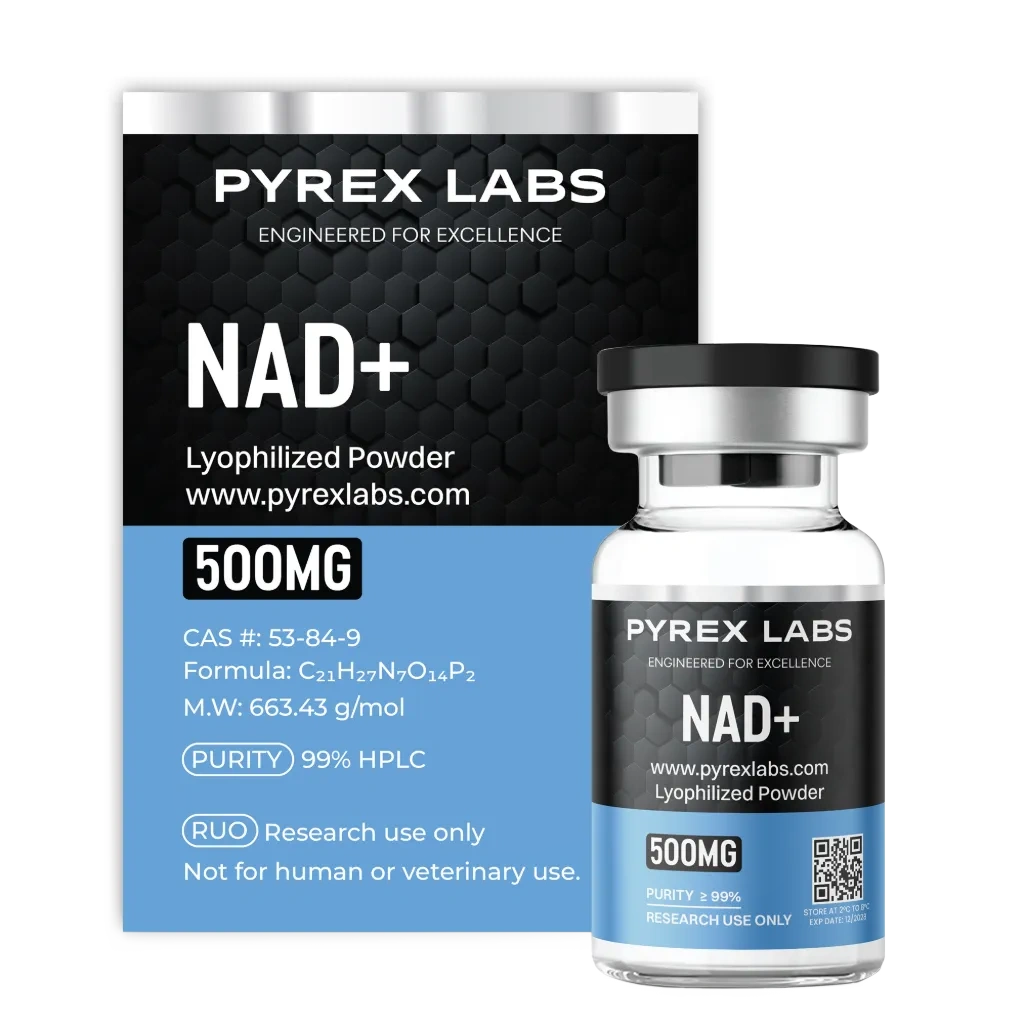
NAD+
$39.95
- Buy 5+ of each and save 5%
- Buy 10+ of each and save 8%
- Product is sold in powder form, needs reconstitution before use. Please read more on our FAQ page.
NAD+ (Nicotinamide Adenine Dinucleotide) is an essential coenzyme found in every living cell, playing a central role in cellular energy metabolism, DNA repair, epigenetic regulation, and stress response pathways from Pyrex Labs.
NAD+ serves dual functions:
-
Redox Cofactor: Required for glycolysis, fatty acid oxidation, TCA cycle, and oxidative phosphorylation (ATP production)
-
Signaling Substrate: Consumed by sirtuins (SIRT1-7), PARPs (DNA repair), and CD38 (calcium signaling)
Age-related NAD+ decline is implicated in metabolic disorders, cognitive decline, and neurodegenerative conditions. Research applications include cellular metabolism, mitochondrial function, aging studies, and sirtuin/PARP pathway investigations.
Each vial contains lyophilized powder tested to ≥98% purity by HPLC, with identity confirmed by mass spectrometry.
SHARE:
SHARE:
- Products sold on our website are designed for in vitro testing and lab experimentation exclusively.
- All the products you see on the website are being sold in a lyophilized powder state (freeze-dried), in a sealed sterile vial; and should be reconstituted.
- The product’s label clearly states the amount of product a vial contains; some products are offered in different variations.
- The products we are selling come in a sealed vial but require additional lab equipment for proper testing.
AVAILABILITY:
- Ships today if you order and pay by 12 PM CST
- Some product may take up to 72 hours to ship
- Backordered items will ship in 3-5 days
NAD+ (Nicotinamide Adenine Dinucleotide) is an essential redox coenzyme found in every living cell, playing a central role in cellular energy metabolism, DNA repair, epigenetic regulation, and stress response pathways . NAD+ exists in two forms: the oxidized form NAD+ and its reduced form NADH, and the NAD+/NADH ratio is critical for maintaining cellular health and metabolic homeostasis .
As a key coenzyme, NAD+ is required for fundamental metabolic processes including glycolysis, fatty acid oxidation, the citric acid (TCA) cycle, and oxidative phosphorylation in the electron transport chain . Beyond its role in redox reactions, NAD+ serves as an essential substrate for three major classes of signaling enzymes: sirtuins (SIRT1-7), poly(ADP-ribose) polymerases (PARPs), and CD38/CD157 ectoenzymes . These NAD+-consuming enzymes regulate diverse biological processes including gene expression, DNA repair, calcium signaling, and inflammation .
Declining NAD+ levels are associated with aging and various chronic disorders, including metabolic diseases, cognitive decline, cardiovascular conditions, and neurodegenerative disorders . This age-related decline has driven significant research interest in NAD+ metabolism and NAD+ boosting strategies as potential interventions for age-associated conditions .
Each vial contains lyophilized powder tested to ≥98% purity by HPLC, with identity confirmed by mass spectrometry.
Best for: Cellular metabolism research, mitochondrial function studies, sirtuin and PARP pathway investigations, aging research, and metabolic disorder models.
Key Research Applications
-
Cellular Energy Metabolism: Investigated as a central coenzyme in glycolysis, TCA cycle, and oxidative phosphorylation for ATP production
-
Mitochondrial Function Research: NAD+ is critical for mitochondrial health, energy production, and regulation of mitochondrial homeostasis mechanisms including mitophagy and the mitochondrial unfolded protein response (UPRmt)
-
DNA Repair Studies: Serves as substrate for PARP enzymes that detect and repair DNA damage, maintaining genomic stability
-
Sirtuin Activation Research: NAD+-dependent deacylases (SIRTs) regulate transcription, stress resistance, and longevity pathways
-
Aging & Longevity Studies: Age-related NAD+ decline is implicated in multiple hallmarks of aging, and NAD+ repletion is studied as a potential geroprotective strategy
-
Neurodegenerative Research: Investigated for potential therapeutic applications in cognitive decline and neurodegenerative diseases
-
Immune Function Studies: Plays a role in macrophage and T cell metabolic reprogramming during differentiation and activation
Mechanism of Action
NAD+ exerts its biological effects through two primary mechanisms:
Redox Cofactor Function: NAD+ accepts high-energy electrons in catabolic reactions, converting to NADH. NADH then donates electrons to the electron transport chain for ATP synthesis. The NAD+/NADH ratio determines the efficiency of mitochondrial energy production and metabolic flux through key pathways .
Signaling Substrate Function: NAD+ is consumed by three major enzyme families :
| Enzyme Family | Primary Function |
|---|---|
| Sirtuins (SIRT1-7) | Deacylation of histones and transcription factors; regulate gene expression, stress resistance, and metabolism |
| PARPs | DNA damage detection and repair; ADP-ribosylation of target proteins |
| CD38/CD157 | Calcium signaling, immunoregulation, NAD+ hydrolysis |
NAD+ Biosynthesis Pathways
Mammalian cells synthesize NAD+ through three canonical pathways :
| Pathway | Precursor | Primary Tissues |
|---|---|---|
| De Novo Pathway | Tryptophan (essential amino acid) | Liver, kidneys |
| Preiss-Handler Pathway | Nicotinic Acid (NA) | Various tissues |
| Salvage Pathway | Nicotinamide (NAM) | Most tissues (primary pathway) |
Key Research Precursors:
-
Nicotinamide Riboside (NR): Nucleoside precursor; converted to NMN via NRK1/2
-
Nicotinamide Mononucleotide (NMN): Direct NAD+ precursor; converted via NMNAT enzymes
-
NAM (Nicotinamide): Vitamin B3 form; recycled via NAMPT (rate-limiting enzyme)
Specifications
| Specification | Detail |
|---|---|
| Product | NAD+ (Nicotinamide Adenine Dinucleotide) |
| Molecular Formula | C₂₁H₂₇N₇O₁₄P₂ |
| Molecular Weight | 663.43 Da |
| CAS Number | 53-84-9 |
| Form | Lyophilized white to off-white powder, sealed glass vial |
| Purity | ≥98% (HPLC) |
| Solubility | Water / Sterile water for research |
| Storage (lyo) | −20°C, desiccated, protected from light |
| Storage (reconstituted) | Prepare fresh or aliquot; avoid repeated freeze-thaw cycles |
| Intended use | Laboratory and in-vitro research only |
Key Research Findings
NAD+ Decline in Aging: Aging across species is associated with a progressive decline in NAD+ levels, driven by impaired biosynthesis (reduced NAMPT activity) and heightened consumption (increased CD38, PARP activity) . This decline actively contributes to pathophysiology by impairing sirtuin activity, compromising DNA repair, and driving cellular senescence and chronic inflammation (“inflammaging”) .
NAD+ Boosting Research:
| Precursor | Key Research Findings |
|---|---|
| NR (Nicotinamide Riboside) | Increases NAD+ levels; shown to activate sirtuins, improve mitochondrial function |
| NMN (Nicotinamide Mononucleotide) | Increases NAD+; studied in metabolic, cardiovascular, and neurodegenerative models |
| NAM (Nicotinamide) | Rapidly absorbed; acute effects on NAD+ metabolome |
Human Clinical Data: A 2026 randomized, placebo-controlled study in healthy adults (n=65) demonstrated that 14 days of supplementation with NR and NMN increased whole-blood NAD+ concentrations approximately 2-fold compared to placebo. NAM did not produce a sustained increase .
Tissue-Specific Distribution: NAD+ and mitochondria are concentrated in energetically demanding tissues including brain, heart, skeletal muscle, kidney, and liver . Most tissues rely on the salvage pathway utilizing circulating NAM, with NAMPT as the rate-limiting enzyme .
Reconstitution Guidance
Reconstitute NAD+ with sterile water or appropriate research buffer for your experimental protocol. Direct diluent gently down the inner wall of the vial rather than onto the lyophilized powder. Swirl slowly until fully dissolved — do not shake.
For best results, prepare fresh solutions for immediate use or aliquot into single-use tubes and freeze at −80°C. NAD+ is susceptible to degradation in solution; avoid multiple freeze-thaw cycles.
Storage & Stability
Before Reconstitution: Store the unopened, lyophilized vial at −20°C in a desiccated, light-protected environment. Stable under these conditions for the shelf-life indicated on the certificate of analysis.
After Reconstitution: Prepare fresh solutions for optimal results. For short-term storage (hours), keep at 2–8°C. For longer storage, prepare single-use aliquots and freeze at −80°C. Avoid repeated freeze-thaw cycles.
Quality Assurance
Every lot of NAD+ undergoes comprehensive release testing against internal specifications, including:
-
HPLC for purity confirmation (≥98%)
-
Mass spectrometry for identity verification
-
Visual inspection of vial integrity
Each vial is coded with a lot number that links directly to release testing documentation. A lot-specific Certificate of Analysis (COA) is available upon request.
Important Research Notes
NAD+ and the Hallmarks of Aging: Recent research has established NAD+ as a central metabolic hub that regulates all 14 interconnected hallmarks of aging, including genomic instability, telomere attrition, epigenetic alterations, loss of proteostasis, mitochondrial dysfunction, cellular senescence, and chronic inflammation .
NAD+ in Immune Function: NAD+ metabolism plays a significant role in immune cell function, particularly in macrophages and T cells. Upon activation, immune cells undergo metabolic reprogramming that depends on NAD+ availability, influencing polarization, cytokine production, and inflammatory responses .
NAD+ in Disease Contexts:
-
Metabolic Disease: NAD+ depletion observed in diabetes and obesity
-
Cardiovascular Disease: Decreased NAD+ levels associated with vascular dysfunction
-
Neurodegenerative Disease: NAD+ decline linked to cognitive decline
-
Cancer: Elevated NAD+ levels observed in some tumor cells
Research Considerations: Human data on NAD+ decline with age present a more heterogeneous picture than preclinical studies, with some studies reporting no significant change in certain tissues. This likely reflects methodological variations, tissue-specific dynamics, and lifestyle influences .
Related Products from Pyrex Labs
Researchers who order NAD+ frequently also purchase:
-
Nicotinamide Riboside (NR) – NAD+ precursor for salvage pathway research
-
NMN (Nicotinamide Mononucleotide) – Direct NAD+ precursor
-
SIRT1 Assay Kit – For sirtuin activity studies
-
PARP Inhibitors – For NAD+ consumption pathway research
-
CD38 Inhibitors – For NAD+ degradation studies
-
BPC-157 – For tissue repair research
-
MOTS-c – For mitochondrial and metabolic research
Frequently Asked Questions
What is NAD+? NAD+ (Nicotinamide Adenine Dinucleotide) is an essential coenzyme found in every living cell. It exists in oxidized (NAD+) and reduced (NADH) forms and is critical for energy metabolism, DNA repair, and cellular signaling .
Why is NAD+ important for research? NAD+ serves dual roles: as a redox cofactor for metabolic reactions (glycolysis, TCA cycle, oxidative phosphorylation) and as a substrate for signaling enzymes (sirtuins, PARPs, CD38) that regulate gene expression, DNA repair, inflammation, and stress responses .
What causes NAD+ levels to decline with age? Age-related NAD+ decline is driven by impaired biosynthesis (reduced NAMPT activity) and increased consumption (elevated CD38 and PARP activity). This decline contributes to multiple hallmarks of aging .
What are the main NAD+ precursors used in research? The three main NAD+ precursors are Nicotinamide Riboside (NR), Nicotinamide Mononucleotide (NMN), and Nicotinamide (NAM). NR and NMN have been shown to increase NAD+ levels approximately 2-fold in human studies .
How is NAD+ synthesized in cells? Mammalian cells synthesize NAD+ through three pathways: the de novo pathway (from tryptophan, primarily in liver/kidneys), the Preiss-Handler pathway (from nicotinic acid), and the salvage pathway (from nicotinamide, the primary pathway in most tissues) .
Is NAD+ approved for human use? No. This product is for research purposes only and is not FDA-approved for human consumption, medical treatment, or veterinary applications. Pyrex Labs products are intended solely for scientific investigation and research purposes.
Do you provide a Certificate of Analysis? Yes. A lot-specific COA is available upon request for every vial shipped.
Disclaimer
⚠️ FOR RESEARCH PURPOSES ONLY. NOT FOR HUMAN USE.
Not approved by the FDA. Not intended for diagnostic, therapeutic, or medical applications in humans or animals. For in-vitro laboratory research exclusively. Pyrex Labs products are intended solely for scientific investigation and research purposes by qualified professionals.