CHAPTER 1: NAD+ OVERVIEW 📋
I. History
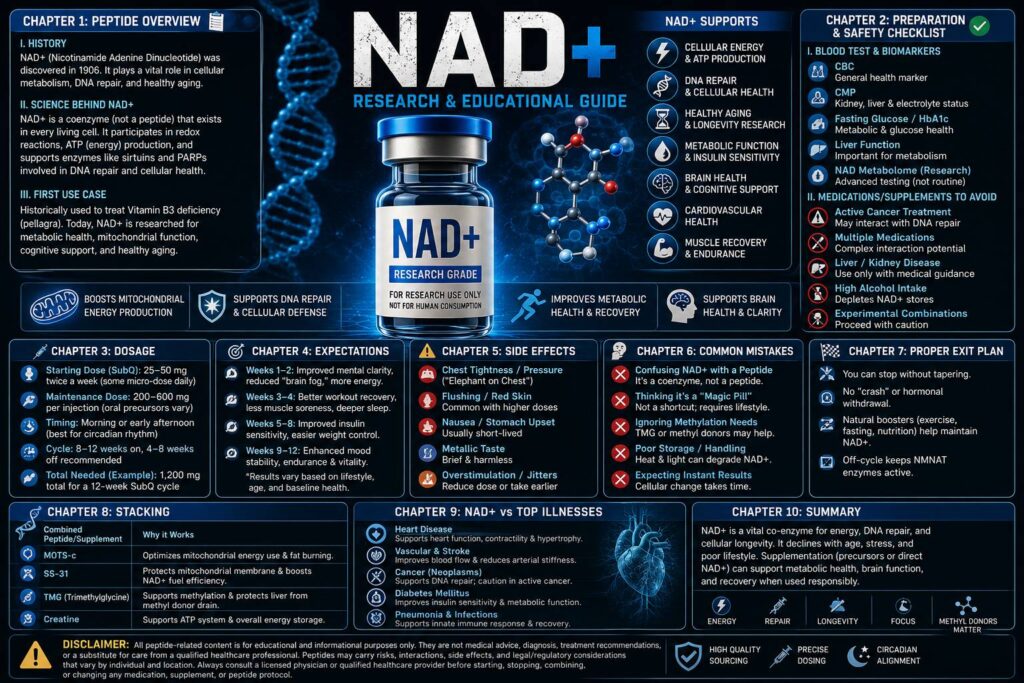
NAD+ (Nicotinamide Adenine Dinucleotide) is an essential coenzyme found in virtually every living cell. Its scientific history dates to 1906, when Arthur Harden and William John Young identified a heat-stable factor involved in fermentation.
Subsequent research established NAD+’s central role in cellular metabolism. Modern interest has expanded considerably because NAD+ also serves as a substrate for enzymes involved in DNA repair, cellular signaling, stress responses, and aging biology.
Unlike many compounds discussed in peptide research, NAD+ is not a peptide. It is a nucleotide-derived coenzyme naturally produced and recycled by the body.
II. Science Behind NAD+
NAD exists primarily in two interconvertible forms:
- NAD+ — the oxidized form
- NADH — the reduced form
Together, NAD+/NADH participate in redox reactions that help cells convert nutrients into usable energy. These reactions are fundamental to glycolysis, the citric acid cycle, and mitochondrial oxidative phosphorylation.
NAD+ also serves as a substrate for important enzyme families, including:
Sirtuins: NAD+-dependent enzymes involved in metabolism, stress responses, gene regulation, and cellular maintenance.
PARPs: Enzymes that consume NAD+ during certain DNA-repair processes.
CD38 and related enzymes: Participate in NAD+ metabolism and cellular signaling.
These functions explain why NAD+ has become an important research target in metabolism, mitochondrial biology, aging, neurobiology, and cellular stress.
III. Early Clinical Relevance
The historical medical importance of NAD biology is closely connected to vitamin B3. Niacin and nicotinamide are NAD+ precursors, and severe vitamin B3 deficiency causes pellagra.
More recently, NAD+, NADH, and NAD+ precursors such as nicotinamide riboside (NR) and nicotinamide mononucleotide (NMN) have been investigated for a wide range of metabolic and age-related applications.
IV and injectable NAD+ have also been promoted by some clinics for wellness and substance-use recovery, but many of these applications have limited high-quality clinical evidence.
CHAPTER 2: PREPARATION & SAFETY CHECKLIST ✅
There is currently no standardized laboratory panel required before NAD+ supplementation, and no validated blood NAD+ concentration that determines whether someone needs supplementation.
Evaluation should instead be based on individual health status, medications, route of administration, and reason for use.
I. Potential Laboratory Considerations
Depending on the clinical situation, a healthcare professional may consider:
CBC: Provides general information about blood-cell health.
Comprehensive Metabolic Panel: May help evaluate kidney, liver, electrolyte, and metabolic status.
Fasting Glucose / HbA1c: Useful when metabolic or glucose regulation is relevant.
Liver Function: May be appropriate depending on medications, medical history, and supplementation strategy.
NAD Metabolome Testing: Specialized assays exist primarily in research settings, but they are not routine clinical requirements and do not currently provide a universal “optimal NAD+” target.
II. Medication & Supplement Considerations
NAD+ participates in fundamental cellular processes, but this does not mean it has a simple universal interaction profile.
Particular caution may be appropriate with:
- Active cancer treatment
- Complex metabolic disease
- Significant liver or kidney disease
- Multiple medications
- Experimental combinations involving other metabolic compounds
Claims that NAD+ must always be combined with methyl donors such as TMG to prevent methyl depletion are not established as a universal requirement.
Likewise, NAD+ supplementation should not be assumed to counteract the effects of alcohol, statins, or other medications.
CHAPTER 3: DOSAGE & ADMINISTRATION 💉
There is no universally accepted injectable or subcutaneous NAD+ protocol for longevity, energy, weight loss, cognitive enhancement, or general wellness.
Research and clinical practices vary substantially depending on whether NAD+ is administered orally through precursors, intravenously, or through other formulations.
Oral NAD+ Precursors
Much of the human research on increasing NAD+ availability has focused on precursors such as:
- Nicotinamide riboside (NR)
- Nicotinamide mononucleotide (NMN)
- Niacin
- Nicotinamide
These compounds differ in metabolism, evidence, and regulatory status.
Injectable / IV NAD+
Specific protocols such as 25–50 mg subcutaneously twice weekly, daily microdosing, or fixed 8–12-week cycles should not be presented as established medical standards.
IV NAD+ is used by some clinics, but standardized evidence-based dosing guidelines for general wellness or longevity have not been established.
Timing
There is insufficient evidence that NAD+ must always be administered in the morning or that later administration inherently disrupts circadian rhythms.
Cycle Length
There is also insufficient evidence supporting a mandatory 8–12-week cycle followed by a 4–8-week washout.
Claims that continuous NAD+ supplementation suppresses the body’s natural production of NMNAT enzymes require stronger evidence.
CHAPTER 4: WHAT TO EXPECT 🎯
NAD+ is fundamental to cellular metabolism, but that does not mean supplementation produces a predictable week-by-week transformation.
Human research into NAD+ augmentation has investigated areas including:
- NAD+ metabolite concentrations
- Mitochondrial function
- Energy metabolism
- Insulin sensitivity
- Muscle physiology
- Cardiovascular function
- Cellular stress responses
- Aging biology
Claims that users will experience immediate mental clarity during Weeks 1–2, improved recovery by Week 4, enhanced insulin sensitivity by Week 8, or peak endurance by Week 12 are not established universal outcomes.
Importantly, successfully increasing NAD+-related biomarkers does not guarantee improvements in energy, cognition, body composition, or longevity.
CHAPTER 5: POTENTIAL SIDE EFFECTS ⚠️
Safety and tolerability depend substantially on the formulation, route, dose, administration rate, and individual.
IV Administration
Rapid IV NAD+ administration has been associated anecdotally and clinically with uncomfortable symptoms that may include:
- Nausea
- Abdominal discomfort
- Headache
- Flushing
- Chest discomfort or tightness
Chest pain or significant chest tightness should not simply be assumed to be a harmless infusion-rate effect. New or severe chest symptoms warrant appropriate medical evaluation.
Injection-Site Reactions
Injectable preparations can potentially cause:
- Redness
- Swelling
- Soreness
- Bruising
- Irritation
- Infection
Gastrointestinal Symptoms
NAD+ precursors may cause gastrointestinal effects in some individuals depending on the compound and amount used.
Long-Term Uncertainty
The long-term clinical consequences of maintaining unusually high NAD+ availability through repeated supplementation remain an active area of investigation.
CHAPTER 6: COMMON RESEARCH MISTAKES 🤦
Calling NAD+ a Peptide
NAD+ is a coenzyme, not a peptide. This distinction is important when describing its chemistry and mechanism.
Treating NAD+ as a Cellular “Battery”
The battery analogy can make the concept easier to understand, but NAD+ does not literally supply energy.
Instead, it participates in electron-transfer reactions and metabolic pathways that enable ATP production.
Treating NAD+ as a Weight-Loss Compound
NAD+ is essential for metabolism, but supplementation has not been established as a stand-alone fat-loss treatment.
Assuming More NAD+ Is Always Better
NAD+ biology involves tightly regulated pathways. Increasing availability does not automatically produce proportionally greater health benefits.
Assuming TMG Is Mandatory
Methylation pathways and NAD+ metabolism can interact, particularly depending on the precursor used, but universal TMG supplementation is not an established requirement for every NAD+ strategy.
Poor Product Handling
Injectable formulations should be stored and handled according to validated manufacturer or pharmacy instructions rather than universal internet rules.
CHAPTER 7: DISCONTINUATION 🏁
NAD+ is naturally produced and recycled by the body and is not a conventional hormone.
There is currently no established evidence demonstrating that ordinary NAD+ supplementation causes a classic hormonal-type withdrawal syndrome requiring tapering.
However, claims that everyone can stop any NAD+ protocol without consideration of the indication, route, or medical context are too broad.
There is also insufficient evidence that users must deliberately “resume natural boosters” or follow intermittent fasting after discontinuation to reactivate NMNAT enzymes.
For medically supervised administration, discontinuation should follow the treating professional’s guidance.
CHAPTER 8: NAD+ COMBINATIONS 🧬
Combining NAD+-related interventions with other experimental compounds is increasingly popular, but mechanistic compatibility does not establish clinical synergy.
MOTS-c + NAD+
MOTS-c is a mitochondrial-derived peptide investigated for metabolic signaling, while NAD+ participates broadly in cellular metabolism.
The combination is scientifically interesting but has not been established as a clinically validated “energy stack.”
SS-31 + NAD+
SS-31 (elamipretide) has been investigated for its interaction with mitochondrial membranes and cardiolipin.
Combining it with NAD+ may sound biologically complementary, but controlled evidence demonstrating superior outcomes from the combination is lacking.
TMG + NAD+
TMG (trimethylglycine) participates in methyl-donor metabolism.
It is sometimes recommended alongside NAD+-raising strategies, but the need for supplementation depends on the specific precursor and individual circumstances rather than being universally required.
Creatine + NAD+
Creatine supports rapid cellular energy buffering through the phosphocreatine system, while NAD+/NADH participates in redox metabolism.
Both relate to cellular energetics, but they function through different biochemical pathways.
CHAPTER 9: NAD+ & MAJOR HEALTH CONDITIONS 🏥
Heart Disease
NAD+ metabolism plays an important role in cardiac energy production, mitochondrial function, oxidative stress, and cellular signaling.
Research into NAD+-raising interventions in cardiovascular disease is promising, but NAD+ supplementation has not been established as a therapy that reverses cardiac aging or reliably improves heart function in humans.
Vascular Disease & Stroke
NAD+ metabolism is relevant to vascular and neurological health.
Clinical research involving NAD+ precursors continues, but evidence should not be generalized into claims that NAD+ supplementation treats peripheral artery disease or prevents stroke.
Cancer
NAD+ biology in cancer is complex.
Normal cells require NAD+ for metabolism and DNA repair, but cancer cells also depend heavily on metabolic and DNA-repair pathways.
For this reason, NAD+ should not be described broadly as either cancer-preventive or cancer-promoting.
People undergoing cancer treatment should discuss high-dose NAD+-raising interventions with their oncology team.
Diabetes & Metabolic Health
NAD+ metabolism is strongly connected to mitochondrial function, insulin signaling, skeletal muscle metabolism, and pancreatic biology.
NAD+-raising strategies are being investigated for metabolic disease, but supplementation has not been established as a treatment that reverses Type 2 diabetes.
Respiratory Disease & Infection
Viral infections and inflammatory states can alter cellular metabolism, including pathways that consume NAD+.
Research accelerated during the COVID-19 pandemic, but this does not establish NAD+ supplementation as a treatment for COVID-19, pneumonia, or other infections.
CHAPTER 10: SUMMARY 📝
NAD+ (Nicotinamide Adenine Dinucleotide) is an essential cellular coenzyme involved in energy metabolism, redox reactions, DNA repair, cellular signaling, and numerous processes associated with mitochondrial and metabolic health.
Unlike BPC-157, TB-500, Ipamorelin, and similar research compounds, NAD+ is not a peptide. It is a naturally occurring molecule required for fundamental cellular function.
Modern NAD+ research is particularly interested in:
- Mitochondrial biology
- Cellular energy metabolism
- Sirtuin activity
- DNA repair
- Metabolic health
- Muscle physiology
- Cardiovascular biology
- Neurological health
- Healthy-aging research
NAD+ concentrations and metabolism can change with age, disease, cellular stress, and other physiological factors. However, this does not establish that raising NAD+ levels will automatically reverse aging, eliminate fatigue, restore insulin sensitivity, improve cognition, or prevent chronic disease.
Human studies of NR, NMN, NAD+, and other NAD+-raising approaches continue to investigate whether biochemical increases in NAD+ translate into meaningful long-term clinical benefits.
The most scientifically accurate description is that NAD+ is a fundamental molecule of cellular metabolism and a major target of modern aging and metabolic research, while many therapeutic and longevity claims surrounding supplementation remain under investigation.
⚠️ Disclaimer: This material is provided solely for educational and informational purposes. It is not medical advice, diagnosis, dosing guidance, or a treatment recommendation. Injectable or IV NAD+ may carry additional risks and should only be administered under appropriate professional supervision. Consult a licensed healthcare professional before starting, stopping, or combining NAD+ products, medications, supplements, or experimental compounds.