Chapter 1: Overview
History of Melanotan
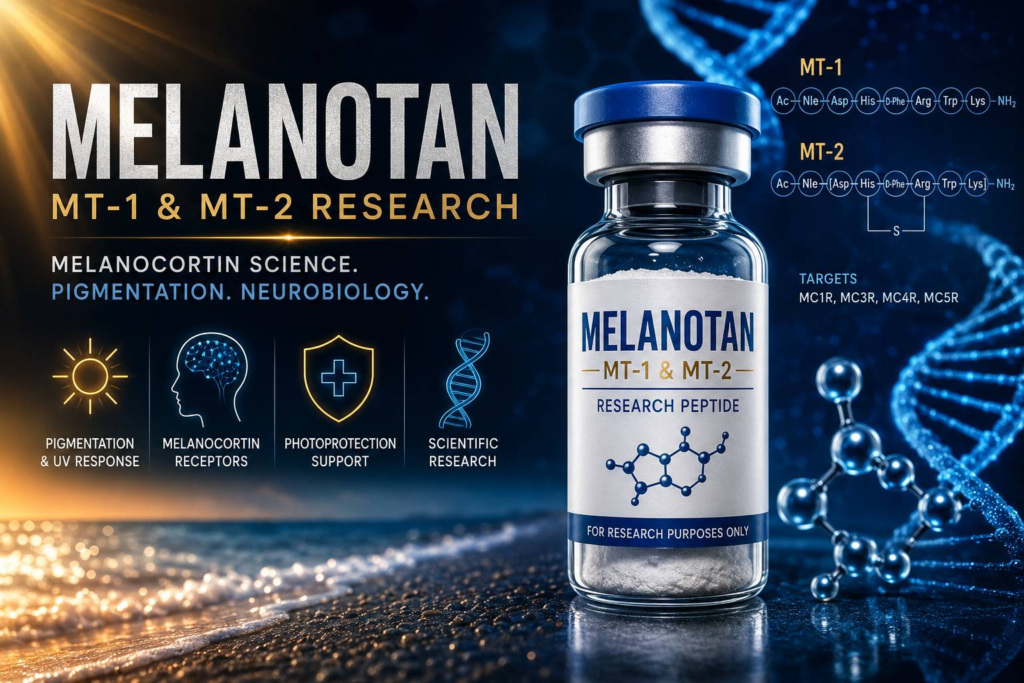
Melanotan research began at the University of Arizona in the 1980s as scientists explored synthetic analogs of alpha-melanocyte-stimulating hormone (α-MSH). The goal was to develop compounds capable of stimulating melanin production while lasting longer than the naturally occurring hormone.
This work eventually produced two notable compounds: Melanotan I (MT-1) and Melanotan II (MT-2). MT-1 later became the foundation for afamelanotide, a regulated medication used for erythropoietic protoporphyria. MT-2, by contrast, remains an unapproved investigational compound and has never received FDA approval for tanning, weight management, or sexual-function purposes.
Science Behind MT-1 and MT-2
Both compounds interact with the body’s melanocortin receptor system, but their receptor activity differs.
MT-1 primarily activates MC1R, a receptor strongly associated with melanocytes and melanin production. MT-2 is less selective, interacting with several melanocortin receptors. This broader receptor activity helps explain why MT-2 has been studied not only for pigmentation but also for effects involving appetite, autonomic function, and sexual arousal.
Activation of MC1R promotes production of eumelanin, the darker form of melanin responsible for brown-to-black pigmentation.
Importantly, increased pigmentation should not be considered a substitute for sunscreen or established UV-protection practices.
Early Research Applications
The original research objective was photoprotection and pigmentation. MT-1 ultimately contributed to the development of afamelanotide, while observations involving MT-2 helped stimulate development of more selective melanocortin compounds, including bremelanotide (PT-141).
Chapter 2: Research & Safety Considerations
Melanotan research requires more nuance than a simple list of “safe ranges.” There are no established clinical laboratory ranges that make unapproved MT-2 use safe, and routine blood testing cannot eliminate its risks.
Areas commonly considered in clinical or research evaluation include cardiovascular status, kidney and liver function when medically indicated, and—particularly important for pigmentation-related compounds—a baseline assessment of existing moles and pigmented lesions.
Changes involving a mole’s asymmetry, border, color, diameter, or evolution warrant evaluation by a qualified dermatologist.
Medication interactions and underlying health conditions also matter. Because MT-2 has systemic melanocortin activity, combining it with other agents that affect blood pressure, cardiovascular function, pigmentation, or sexual response may introduce additional uncertainty.
Chapter 3: Research Handling & Administration Context
Melanotan peptides are commonly encountered in lyophilized form in research settings. However, there is an important distinction between discussing laboratory handling and presenting an unapproved compound as a self-treatment protocol.
For MT-2 specifically, there is no FDA-approved dosing, reconstitution, loading, maintenance, or cycling schedule for tanning or other consumer uses. Online protocols describing specific injection quantities should therefore not be presented as medically established standards.
MT-1 should likewise be distinguished from afamelanotide, which is an approved pharmaceutical formulation administered under a defined medical framework rather than an interchangeable DIY version of “Melanotan I.”
Storage and stability also depend on the formulation and manufacturer. Investigational material should be handled according to validated product-specific stability data rather than assuming that all reconstituted melanotan preparations remain stable for the same period.
Chapter 4: What Research Suggests
Pigmentation
The most established biological effect of melanocortin agonism is increased melanogenesis. Pigmentation may gradually increase as melanocytes produce additional melanin.
The magnitude and duration of this response can vary considerably according to genetics, baseline skin pigmentation, receptor activity, formulation, and UV exposure.
Appetite and Metabolism
MT-2’s activity outside MC1R has generated research interest in appetite and energy regulation. These findings are mechanistically interesting but should not be interpreted as evidence that MT-2 is an approved or established obesity treatment.
Sexual Response
MT-2 research also produced unexpected observations involving sexual arousal. This research ultimately contributed to development of bremelanotide, a more targeted melanocortin-based pharmaceutical.
Chapter 5: Adverse Effects & Safety Signals
Reported or biologically plausible concerns associated with melanotan compounds include nausea, facial flushing, headache, appetite changes, spontaneous erections, and increased pigmentation of freckles or existing moles.
MT-2 deserves additional caution because products sold outside regulated pharmaceutical channels can introduce risks involving incorrect concentration, contamination, sterility, degradation, and mislabeling.
Persistent or painful erections require urgent medical attention. Significant cardiovascular symptoms, severe vomiting, unusual muscle symptoms, or concerning changes to pigmented skin lesions also warrant medical evaluation.
Darkening of a mole does not itself prove melanoma, but pigmentation changes can complicate monitoring and should not be ignored.
Chapter 6: Common Misconceptions
One major misconception is that a darker tan provides adequate protection against ultraviolet radiation. It does not replace broad-spectrum sunscreen, protective clothing, shade, or other established sun-safety measures.
Another is that MT-1 and MT-2 are interchangeable. Their receptor selectivity, development history, regulatory status, and safety evidence differ substantially.
A third is assuming that material marketed online as “research grade” has pharmaceutical-grade purity. That label alone does not establish identity, sterility, concentration, or manufacturing quality.
Chapter 7: Discontinuation
MT-2 is not generally discussed as producing the classic physical dependence associated with many psychoactive substances, but that does not mean stopping or changing an investigational compound is automatically risk-free.
Pigmentation may gradually fade after melanocortin stimulation ends. The timing varies between individuals and depends on factors including baseline pigmentation and UV exposure.
People experiencing significant adverse effects should seek medical guidance rather than relying on a predetermined online “exit protocol.”
Chapter 8: Combination Research
Melanotan compounds are sometimes discussed online alongside cosmetic peptides, antioxidants, or other metabolic compounds. Evidence supporting many of these combinations is limited.
Mechanistic theories should therefore be distinguished from demonstrated clinical outcomes. Combining multiple experimental compounds can also make it substantially harder to identify which substance caused an adverse reaction.
Chapter 9: Melanotan and Health Conditions
Cardiovascular Health
MT-2 can produce systemic physiological effects, so individuals with cardiovascular disease or unstable blood pressure warrant particular caution. Experimental findings should not be interpreted as evidence that melanotan prevents heart disease or stroke.
Cancer and Pigmented Lesions
Melanocortin biology is complex. It would be inaccurate to claim that MT-1 or MT-2 has been demonstrated to prevent melanoma through enhanced DNA repair.
Because melanotan can darken freckles and existing nevi, new or changing pigmented lesions should receive professional dermatologic evaluation.
Diabetes and Metabolic Health
Melanocortin receptors participate in energy regulation, but MT-2 is not an established treatment for diabetes, insulin resistance, or obesity.
Respiratory Disease
There is insufficient clinical evidence to characterize melanotan as preventing or treating pneumonia or respiratory infections.
Kidney and Liver Health
Serious adverse events have occasionally been described in association with unregulated melanotan use, although causality can be difficult to establish from individual case reports. Symptoms suggesting significant kidney, liver, or muscular injury require medical evaluation.
Chapter 10: Summary
Melanotan I and Melanotan II are synthetic melanocortin-related peptides with important but distinctly different research histories. Their best-understood biological effect involves melanocortin receptor activation and pigmentation.
MT-1 research ultimately contributed to afamelanotide, an approved treatment for a specific medical condition. MT-2 remains investigational and unapproved, despite widespread discussion online surrounding tanning, appetite, and sexual response.
The most important distinction for readers is between experimental evidence and established clinical practice. Animal studies, mechanistic theories, case reports, and online protocols should not be presented as equivalent to controlled human clinical evidence.
For a medical research article, MT-2 is best approached as an interesting example of melanocortin pharmacology—while clearly acknowledging the substantial uncertainty surrounding unregulated products, long-term safety, and non-approved human use.
Disclaimer: This article is provided for educational and research-information purposes only. It is not medical advice, a diagnosis, or a treatment protocol. MT-2 is not FDA-approved for tanning or self-directed therapeutic use. Anyone considering a melanocortin-related medication or concerned about changing skin lesions should consult an appropriately qualified healthcare professional.