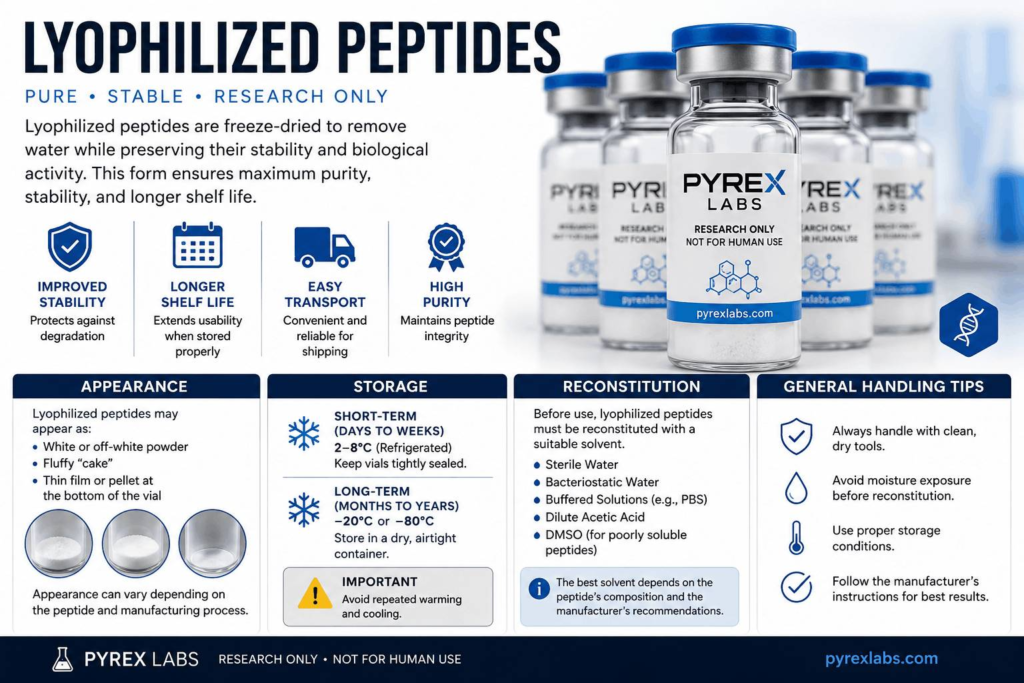
Lyophilization, or freeze-drying, is a controlled process in which water is sublimated from a frozen formulation under reduced pressure. The result is a dry, stable presentation—commonly a porous cake or powder—that facilitates defined storage and handling protocols. For peptide materials, this process is a manufacturing methodology, not an indicator of purity, identity, or functional suitability. Any conclusions regarding identity, quantity, stability, sterility, or experimental applicability must be substantiated through independent specifications, validated analytical data, and comprehensive stability documentation.
1. The Freeze-Drying Process: Three Critical Stages
The lyophilization cycle proceeds through three distinct phases:
-
Freezing: During this stage, water crystallizes into ice, concentrating the peptide and formulation components in the non-ice phase. The final ice morphology is influenced by cooling rate, nucleation temperature, formulation composition, and container geometry.
-
Primary Drying (Sublimation): Chamber pressure is reduced, and controlled thermal energy is applied to drive sublimation, enabling ice to transition directly from solid to vapor without passing through a liquid phase.
-
Secondary Drying (Desorption): Residual water that remains bound or adsorbed to the dried matrix is further reduced through desorption under reduced pressure.
Each stage requires precise control over temperature, pressure, and time, with due consideration for the formulation’s physical and thermal limits. Importantly, a lyophilization cycle optimized for one material cannot be assumed to be transferable to another without empirical validation.
Sublimation is fundamentally distinct from evaporation under ambient conditions. As the vapor exits through a progressively thickening dried layer, product resistance evolves dynamically. Therefore, chamber parameters and shelf temperatures must be interpreted in tandem with real-time product temperature measurements, not merely as static setpoints.
2. Reduction in Water Content and Its Impact on Degradation Pathways
Given that water facilitates hydrolysis and enhances molecular mobility, lowering residual moisture can attenuate certain degradation reactions. A lyophilized format also offers practical advantages for shipping, storage, and controlled reconstitution—explaining its widespread adoption for peptides that exhibit limited solution stability.
Nevertheless, lyophilization does not confer indefinite stability. Peptides remain susceptible to oxidation, deamidation, aggregation, and other chemical or physical changes, contingent upon sequence, formulation, environmental conditions (temperature, oxygen, light), and packaging integrity. Stability must be assessed for the complete product–container system, and the term “lyophilized” alone cannot be construed as a stability guarantee.
3. Residual Moisture: A Quantifiable but Formulation-Dependent Attribute
Secondary drying reduces, but does not necessarily eliminate, all water molecules. Residual moisture is a measurable quality parameter, typically assessed via Karl Fischer titration or validated spectroscopic techniques. Acceptable ranges are formulation-specific, as both excessive moisture and excessive dryness may adversely affect product performance in certain systems.
Excipients—including buffers, bulking agents, stabilizers, salts, and counterions—significantly influence glass transition behavior, crystallinity, pore architecture, moisture retention, and peptide stability. Consequently, the total dried mass in a vial may exceed the mass attributable to the peptide alone.
Moisture content may also vary within a single batch or across different regions of a cake. Thus, the reported value is only meaningful when the sampling strategy and analytical method are representative of the material in question. When moisture is relevant to experimental outcomes, laboratories should verify whether the reported value derives from a single vial, a composite sample, or a defined batch-sampling scheme.
4. Visual Cake Appearance: Descriptive, Not Diagnostic
The appearance of the lyophilized cake provides observational information but should not be mistaken for an analytical assay.
Research indicates that freezing conditions can significantly affect pore structure, cracking, shrinkage, and moisture behavior, even when measured peptide content remains comparable. Conversely, an aesthetically pleasing cake still requires full analytical characterization. It is advisable to photograph atypical appearances, retain lot-specific documentation, and evaluate visual observations against the supplier’s defined acceptance criteria.
5. Storage Requirements Are Inherently Material-Specific
Temperature, humidity, light exposure, oxygen, seal integrity, and time each influence the stability of a dried peptide formulation. Appropriate storage conditions should be derived from product-specific stability data, not generalized assumptions applicable to all peptides. Upon receipt, documentation should include condition, lot number, dates, and any observed packaging anomalies.
Container-closure integrity is an integral component of storage control. A stopper or seal that permits moisture ingress can compromise the material, even under otherwise acceptable temperature conditions. Vials with loose caps, displaced stoppers, cracks, condensation, or evidence of temperature excursions should be investigated thoroughly before the material is placed into routine inventory.
Once the sealed dry state is breached, stability parameters may change. Laboratories must adhere to approved internal procedures and product-specific documentation, rather than defaulting to generic reconstitution protocols.
6. Holistic Material Review: Moving Beyond Nomenclature
A comprehensive material evaluation should address the following:
-
Alignment of label and Certificate of Analysis (COA) with the same lot number
-
Appropriate analytical methods used for identity and purity confirmation
-
Clear statement of peptide content and formulation composition
-
Availability of storage and stability data relevant to the intended use
Residual moisture and stability metrics may be particularly critical when the research application is sensitive to these variables.
Lyophilization is a reproducible and controlled means of producing a dry presentation, but its research utility depends on cycle design, thorough material characterization, and proper storage practices. The lyophilized format should be regarded as one element of material control, not as a substitute for rigorous analytical evidence. All research-grade peptides are intended for in vitro laboratory use exclusively and are not approved for human or animal administration.