CHAPTER 1: PEPTIDE OVERVIEW 📋
I. History
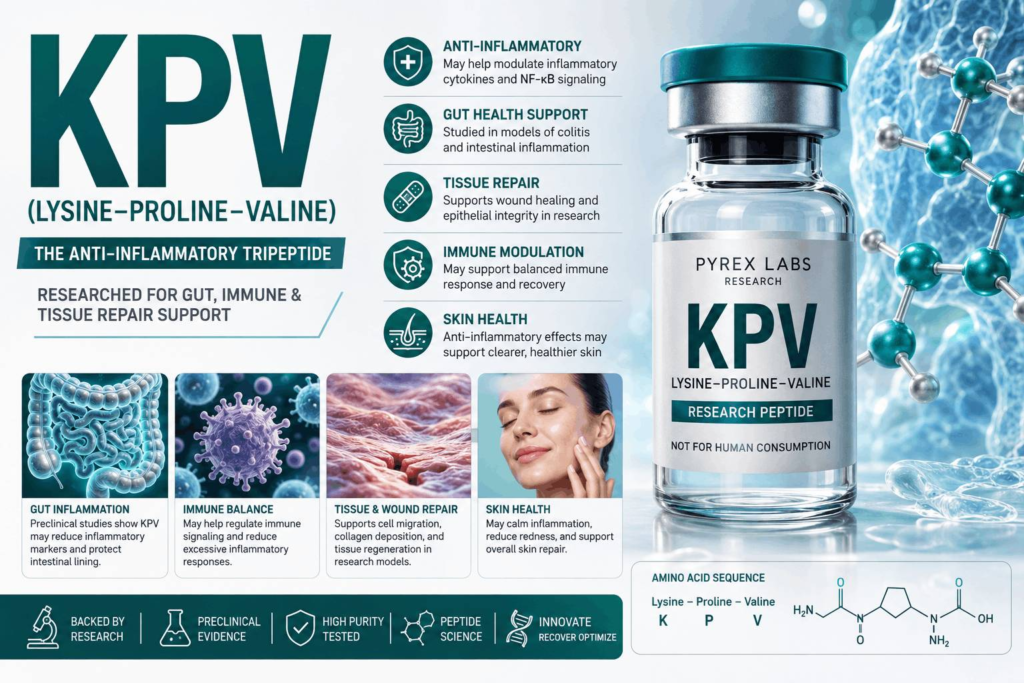
KPV (Lysine–Proline–Valine) is a three-amino-acid peptide derived from the C-terminal region of alpha-melanocyte-stimulating hormone (α-MSH).
KPV has attracted research interest because it appears to retain some of α-MSH’s anti-inflammatory activity without producing its melanocortin-associated pigmentation effects.
Most of the evidence surrounding KPV currently comes from cell, animal, and preclinical research, particularly studies involving intestinal and inflammatory pathways.
II. Science Behind the Peptide
KPV is a tripeptide composed of lysine, proline, and valine. Research suggests that it may influence inflammatory signaling pathways, including pathways involving NF-κB and pro-inflammatory cytokines.
Experimental studies have investigated effects on inflammatory mediators such as:
- TNF-α
- IL-1β
- IL-6
- Other inflammatory signaling molecules
KPV has also been studied in intestinal models because peptide transport systems such as PEPT1 may influence its uptake in the gastrointestinal tract.
These findings make KPV scientifically interesting for research involving intestinal inflammation, epithelial integrity, immune signaling, and inflammatory regulation.
III. Early Research Applications
Some of KPV’s most frequently discussed research involves intestinal inflammation and experimental models of inflammatory bowel disease.
Researchers have also investigated KPV in models involving:
- Colitis
- Skin inflammation
- Wound healing
- Epithelial injury
- Immune signaling
These findings remain largely preclinical and should not be interpreted as proof that KPV treats these conditions in humans.
CHAPTER 2: PREPARATION & SAFETY CHECKLIST ✅
KPV is an experimental peptide without an established FDA-approved therapeutic indication. There is therefore no standardized clinical screening protocol specifically validated for KPV use.
I. Potential Biomarkers in Research or Medical Monitoring
Depending on the reason for evaluation, a healthcare professional may consider general markers such as:
hs-CRP: A nonspecific marker that can help assess systemic inflammation.
Metabolic markers: Fasting glucose, HbA1c, or other testing may be appropriate when metabolic health is being evaluated.
CBC/CMP: General laboratory testing may be appropriate depending on an individual’s health status and medications.
Condition-specific testing: Additional biomarkers should be selected according to the underlying medical concern rather than assuming every KPV user requires the same laboratory panel.
Tests such as zonulin or HOMA-IR should not be treated as universal KPV safety requirements or mandatory targets.
II. Medication & Supplement Considerations
There are currently insufficient human clinical data to establish a comprehensive KPV drug-interaction profile.
Claims that antibiotics, ACE inhibitors, corticosteroids, or NSAIDs universally interfere with KPV through PEPT1 competition have not been established sufficiently to serve as general clinical rules.
Anyone taking prescription medication—particularly for inflammatory, cardiovascular, gastrointestinal, autoimmune, or metabolic conditions—should discuss experimental peptide use with a qualified healthcare professional.
CHAPTER 3: DOSAGE & ADMINISTRATION 💉
There is currently no universally accepted or FDA-approved human dosing protocol for KPV.
Research discussions may reference oral, topical, or injectable administration, but dosing varies significantly between experimental settings and products.
Because standardized human pharmacokinetic, efficacy, and long-term safety data remain limited, specific amounts such as 250–500 mcg once or twice daily should not be presented as an established medical standard.
Route of Administration
KPV has been investigated through different routes, including:
- Oral
- Topical
- Experimental injectable administration
The appropriate route depends on the research objective and formulation.
Timing
There is insufficient evidence to conclude that KPV must be taken on an empty stomach, before bed, or at another particular time of day to produce optimal results.
Cycle Length
There is also no validated requirement for a 6-, 8-, or 12-week cycle, nor evidence establishing that users require scheduled breaks to maintain “receptor sensitivity.”
CHAPTER 4: WHAT TO EXPECT 🎯
KPV should not be presented as producing guaranteed improvements according to a specific week-by-week schedule.
Current research is primarily interested in its potential influence on:
- Inflammatory signaling
- Intestinal inflammation
- Epithelial barrier function
- Immune responses
- Skin inflammation
- Tissue-repair processes
Claims that users should experience reduced bloating during Weeks 1–2, improved joints during Weeks 3–4, clearer skin during Weeks 4–6, or measurable metabolic improvements by Week 12 have not been established in controlled human trials.
Individual outcomes cannot currently be predicted reliably.
CHAPTER 5: POTENTIAL SIDE EFFECTS ⚠️
KPV does not yet have the extensive human safety database available for approved medications.
Potential concerns depend partly on the route of administration.
Injection-Site Reactions
Experimental injectable preparations may potentially cause redness, soreness, swelling, bruising, irritation, or infection.
These reactions should not automatically be described as histamine responses or evidence that KPV is stabilizing mast cells.
Gastrointestinal Effects
Oral formulations could potentially cause gastrointestinal discomfort, although the incidence and severity have not been adequately characterized in large human trials.
Allergic Reactions
As with peptide-containing products, hypersensitivity is possible.
Unknown Long-Term Effects
One of the most important limitations is simply that long-term human safety data remain insufficient.
Product purity, sterility, concentration, contaminants, and formulation quality may introduce risks independent of the KPV molecule itself.
CHAPTER 6: COMMON RESEARCH MISCONCEPTIONS 🤦
Treating KPV as a Proven Treatment
Promising preclinical findings do not establish that KPV can treat inflammatory bowel disease, autoimmune disease, cardiovascular disease, diabetes, infections, or cancer in humans.
Assuming Injectable Is Always Better
Different routes produce different exposure profiles. There is not enough clinical evidence to conclude that injectable KPV is universally superior to oral or topical formulations.
Expecting Immediate Results
Experimental peptides do not have guaranteed response timelines. Any proposed benefit depends on the condition, formulation, dose, route, and individual biology.
Ignoring Product Quality
Research peptides obtained outside regulated pharmaceutical channels may have uncertain identity, purity, potency, sterility, or stability.
Replacing Established Treatment
KPV should not be substituted for prescribed treatment of inflammatory, gastrointestinal, metabolic, infectious, cardiovascular, or autoimmune disease.
CHAPTER 7: DISCONTINUATION 🏁
KPV is not a steroid or conventional hormone, and there is currently no established evidence demonstrating that it causes the type of hypothalamic-pituitary hormonal suppression associated with certain hormonal therapies.
There is also no validated clinical evidence requiring a taper or scheduled maintenance phase after experimental KPV administration.
If KPV is being used under medical supervision, discontinuation should follow the healthcare professional’s instructions.
CHAPTER 8: KPV & PEPTIDE COMBINATIONS 🧬
Combining experimental peptides is frequently discussed in peptide communities, but combination-specific human clinical evidence is extremely limited.
BPC-157 + KPV
Both compounds have been investigated independently in experimental models involving inflammation and tissue responses. However, claims that they form an established “gut repair stack” have not been demonstrated in controlled human trials.
TB-500 + KPV
TB-500-related compounds and KPV involve different experimental biological pathways. Evidence demonstrating that this combination rebuilds cardiac tissue or prevents cardiovascular inflammation in humans is lacking.
GHK-Cu + KPV
GHK-Cu has been investigated in skin and tissue-repair research, while KPV has been investigated for anti-inflammatory properties. Their combination remains experimental.
Thymosin Alpha-1 + KPV
Thymosin alpha-1 has immunomodulatory activity and considerably more clinical research than KPV. However, a specific KPV combination protocol has not been established.
LL-37 + KPV
LL-37 is an antimicrobial peptide involved in innate immunity. Combining it with KPV for Candida, SIBO, or other infections should not be presented as an established eradication protocol.
The biological plausibility of a peptide combination does not establish its safety or clinical effectiveness.
CHAPTER 9: KPV & MAJOR HEALTH CONDITIONS 🏥
Cardiovascular Disease
Inflammation contributes to atherosclerosis and cardiovascular disease, but there is insufficient human evidence that KPV restores endothelial tight junctions, prevents LDL oxidation, reverses atherosclerosis, or prevents cardiovascular events.
KPV should not replace established cardiovascular prevention or treatment.
Stroke & Vascular Disease
Experimental anti-inflammatory effects do not establish that KPV stabilizes plaques or prevents stroke.
There is currently insufficient clinical evidence supporting KPV for stroke prevention, atrial fibrillation, or vascular disease treatment.
Cancer
Some preclinical research has explored melanocortin-derived peptides and inflammatory pathways relevant to cancer biology.
However, findings from laboratory or animal models cannot establish KPV as a cancer treatment or preventive therapy.
Anyone undergoing cancer treatment should discuss experimental peptides with their oncology team before use.
Diabetes & Metabolic Health
Inflammation and metabolic dysfunction are closely connected, making anti-inflammatory pathways scientifically interesting in diabetes research.
However, KPV has not been established as a treatment for insulin resistance or diabetes, and claims of predictable reductions in fasting glucose or HOMA-IR require stronger human clinical evidence.
Respiratory Disease & Infection
KPV’s anti-inflammatory properties have generated interest in epithelial and inflammatory research, but it should not be represented as a proven treatment for pneumonia or respiratory infections.
Claims that KPV directly eliminates bacterial, fungal, or respiratory infections remain unsupported by adequate human clinical evidence.
CHAPTER 10: SUMMARY 📝
KPV (Lysine–Proline–Valine) is a small tripeptide derived from α-MSH that has attracted considerable research interest because of its potential anti-inflammatory and immunomodulatory properties.
Preclinical research suggests possible activity involving NF-κB signaling, inflammatory cytokines, intestinal inflammation, epithelial tissues, and immune regulation.
These mechanisms make KPV an interesting research compound for scientists studying inflammation, gastrointestinal biology, skin biology, epithelial integrity, and immune signaling.
However, KPV remains an experimental compound with limited controlled human clinical evidence. Claims that it cures chronic inflammation, repairs cardiovascular disease, eradicates infections, reverses insulin resistance, or treats cancer go substantially beyond the available evidence.
The most accurate way to discuss KPV is therefore as a promising research peptide whose potential therapeutic applications still require rigorous human clinical investigation.
⚠️ Disclaimer: This content is provided solely for educational and informational purposes. KPV is an experimental peptide and this article does not provide medical advice, diagnosis, dosing instructions, or treatment recommendations. Research findings—particularly laboratory and animal findings—do not necessarily demonstrate safety or effectiveness in humans. Consult a licensed healthcare professional before starting, stopping, combining, or changing any medication, supplement, or peptide protocol.