The landscape of obesity pharmacotherapy is evolving rapidly. While much of the recent public conversation has centered around Eli Lilly’s experimental triple-agonist retatrutide, Roche has emerged as a major contender with its own investigational weight-loss molecule: enicepatide (also known as CT-388).
Recent Phase 2 trial results for enicepatide produced benchmark figures that highlight its potential to disrupt the current anti-obesity drug market, revealing profound efficacy in total body weight reduction and glycemic control.
Breakdown of the Phase 2 Clinical Trial Results
The Phase 2 clinical trial evaluated 469 adult participants living with obesity or overweight alongside at least one weight-related comorbidity. Over a 48-week period, participants received varying doses of once-weekly subcutaneous enicepatide or a placebo.
Key Efficacy Outcomes at the Highest Dose (24 mg)
-
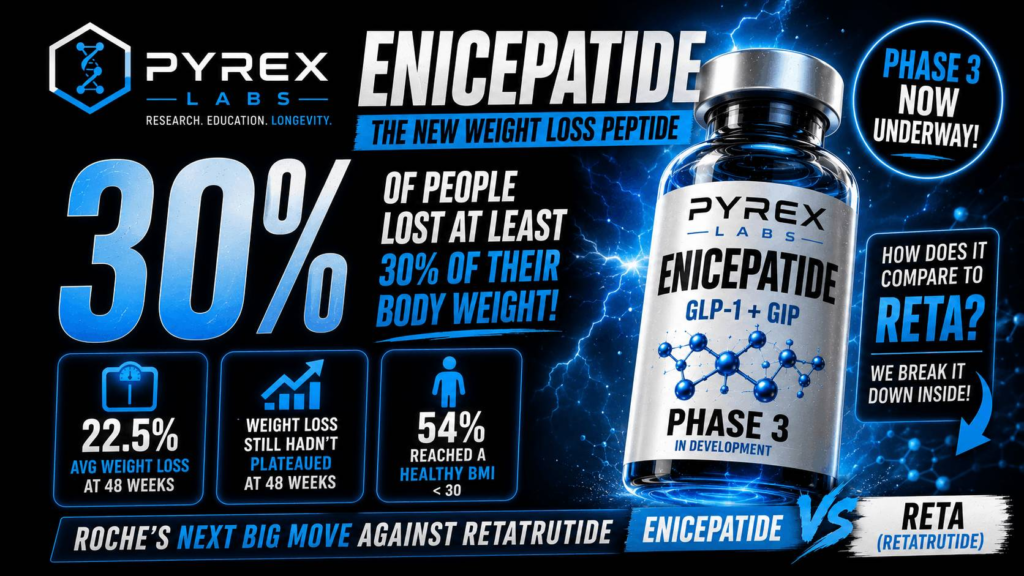
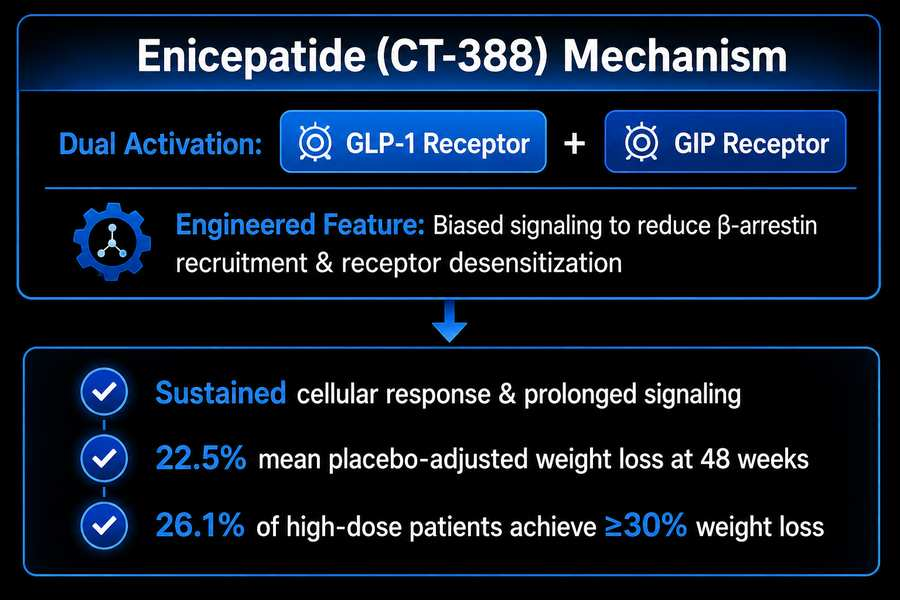
Mean Placebo-Adjusted Weight Loss: Participants on the highest dose (24 mg) achieved a 22.5% placebo-adjusted weight loss at week 48.
-
30% Weight Loss Threshold: 26.1% of participants (more than 1 in 4) on the highest dose lost at least 30% of their total body weight.
-
20% Weight Loss Threshold: Almost half (48%) of participants in the 24 mg group achieved a body weight reduction of 20% or greater.
-
Resolution of Obesity Classification: 54% of participants saw their Body Mass Index (BMI) drop below 30 kg/m², effectively placing them below the clinical threshold for obesity.
-
Glycemic Improvement: Among participants who entered the trial with pre-diabetes, approximately 73% returned to a normal blood sugar range by week 48.
The Trajectory: No Observed Weight Loss Plateau
One of the most notable findings from the study was that the weight loss trajectory in the 24 mg cohort had not leveled off by week 48. In many historical obesity drug trials, weight loss begins to plateau between weeks 36 and 48. With enicepatide, participants were still actively losing weight when the study concluded at 48 weeks, raising major questions about what total efficacy could look like in longer Phase 3 trials.
How Enicepatide Works: Engineered Receptor Signaling
Like tirzepatide (the active ingredient in Zepbound and Mounjaro), enicepatide targets two key gut hormone pathways:
-
GLP-1 (Glucagon-like peptide-1): Promotes satiety, delays gastric emptying, and improves glucose-dependent insulin secretion.
-
GIP (Glucose-dependent insulinotropic polypeptide): Enhances insulin secretion, regulates lipid metabolism, and works synergistically with GLP-1 to suppress appetite.
Addressing Receptor Desensitization
When hormone receptors are continuously exposed to synthetic agonists, cells often undergo receptor desensitization—a process driven by proteins called β-arrestins. Think of it like a loud alarm: over time, the body tunes out repeated signals.
Enicepatide was specifically engineered with biased signaling designed to minimize β-arrestin recruitment. By reducing receptor desensitization, the molecule aims to maintain strong, prolonged intracellular signaling over extended treatment periods without losing potency.
Safety, Side Effects, and Discontinuations
As an incretin-based therapy, enicepatide’s adverse event profile aligns with the broader GLP-1/GIP drug class:
| Parameter |
Outcome in Enicepatide Phase 2 |
| Most Common Side Effects |
Gastrointestinal (nausea, vomiting, diarrhea) |
| Severity |
Predominantly mild to moderate |
| Treatment Discontinuation (AEs) |
5.9% in enicepatide groups vs. 1.3% in placebo group |
Roche’s Pipeline Strategy: Combination Possibilities
Roche is advancing enicepatide into large-scale Phase 3 trials, including studies evaluating adults with obesity and overweight accompanied by Type 2 diabetes.
Beyond standalone therapy, Roche is exploring combination regimens across its metabolic portfolio:
-
Petrelintide Integration: Roche is co-developing petrelintide, an investigational long-acting amylin analog.
-
Dual-Pathway Targeting: Combining enicepatide (GLP-1/GIP) with petrelintide (amylin) allows researchers to engage multiple distinct metabolic pathways simultaneously—targeting appetite, satiety, and gastric dynamics through complementary physiological mechanisms.
While direct cross-trial comparisons should be made with caution due to differences in study populations and methodologies, enicepatide’s Phase 2 data underscores how competitive the next wave of metabolic medicines will be alongside agents like retatrutide and tirzepatide.