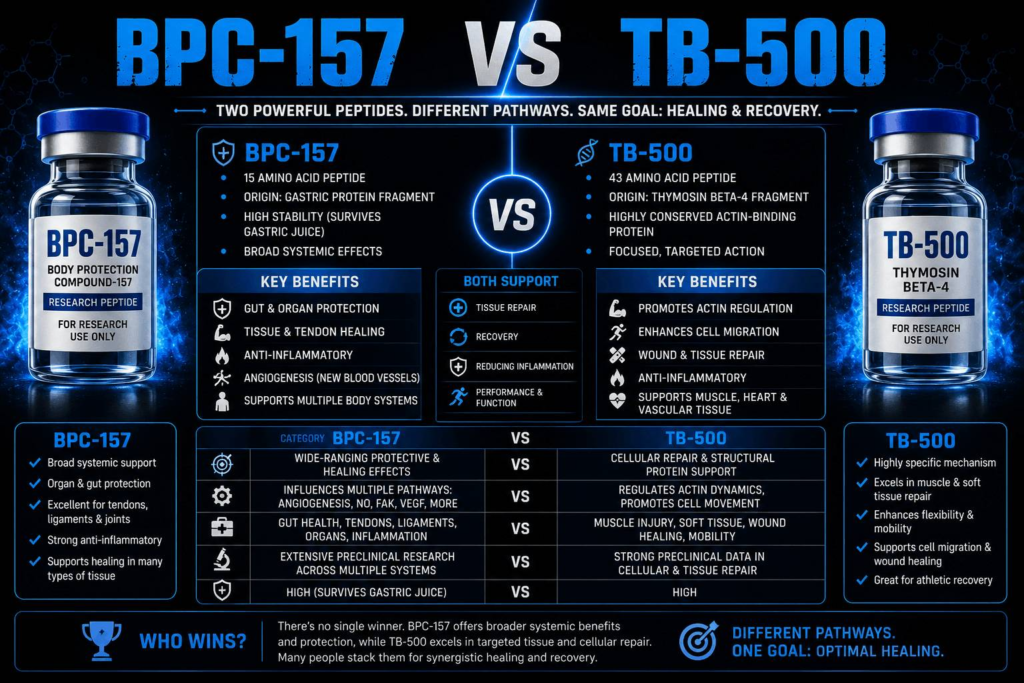
For years, discussion around recovery-focused peptides has been dominated by two major compounds: BPC-157 and TB-500. Despite their widespread popularity in wellness, biohacking, and athletic recovery communities, head-to-head empirical research comparing their efficacy—or testing their combined effects—has been virtually non-existent.
A groundbreaking independent study conducted by researchers in Turkey provides the first head-to-head comparative analysis of BPC-157 and Thymosin Beta-4 (TB4) in an animal model of Achilles tendon repair. The findings offer crucial insights into how these peptides influence tissue architecture, collagen organization, and biomechanical strength.
Study Design and Methodology
To test the therapeutic potential of these compounds, researchers utilized a rodent model of acute tendon injury:
-
Surgical Model: Rats underwent full surgical transection (severing) of the Achilles tendon followed by immediate surgical repair.
-
Treatment Cohorts: Animals were divided into four distinct groups:
-
Control Group: Vehicle treatment.
-
BPC-157 Group: Daily intraperitoneal administration.
-
TB-500 / TB4 Group: Daily intraperitoneal administration based on Thymosin Beta-4 dosing protocols.
-
Combination Group: BPC-157 plus TB-500 / TB4 administered together.
-
Duration: Treatments were administered daily over a 30-day period.
-
Outcome Measures: Tissue samples were evaluated using histopathology, biomechanical testing, Sirius Red staining under polarized light, and immunohistochemistry for collagen expression.
Important Caveat Regarding “TB-500” vs. Full-Length TB4
A key detail highlighted in the research analysis is the distinction between TB-500 and Thymosin Beta-4 (TB4):
Although the published paper lists the compound as TB-500, the dosing rationales and product descriptions align with full-length 43-amino-acid Thymosin Beta-4. Therefore, the study results most accurately reflect the biological activity of full-length TB4 rather than the isolated 7-amino-acid fragment commonly sold online.
Key Findings & Biomechanical Outcomes
To evaluate how well the repaired tendons healed, researchers utilized standardized histological scoring systems—specifically the Bonar Score and the Mowin Score—which grade tendon health based on cellular organization, vascularity, and extracellular matrix maturity (lower scores indicate healthier, more mature tissue).
1. Thymosin Beta-4 Was the Standout Performer
The TB4 cohort demonstrated the most robust overall recovery:
-
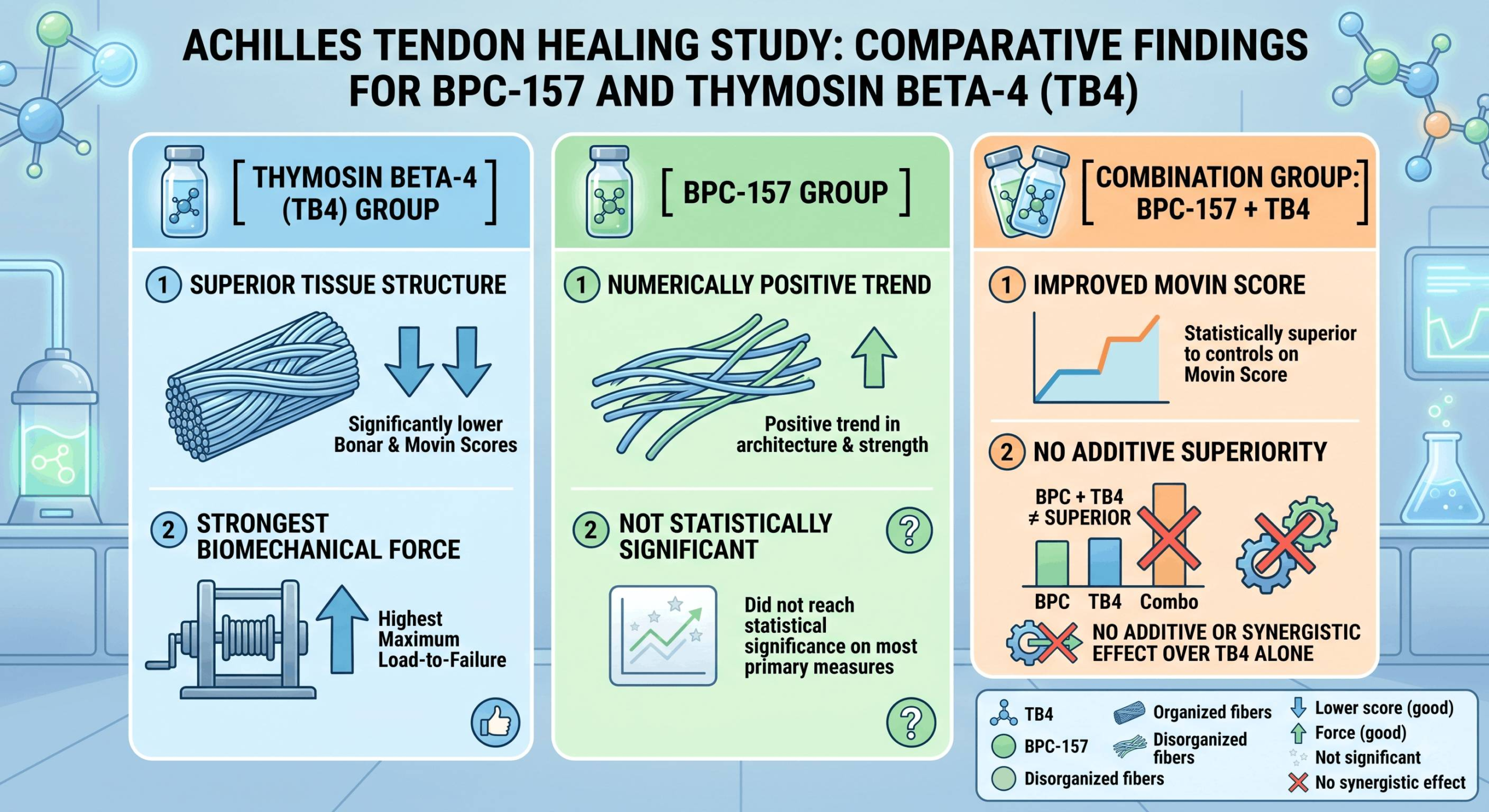
Histological Maturity: Showed statistically significant reductions in both Bonar and Mowin scores compared to control, reflecting more organized, mature tendon architecture.
-
Biomechanical Strength: Achieved the highest maximum load-to-failure force. Tendons in the TB4 group required significantly more mechanical force to break, indicating superior functional recovery.
2. BPC-157 Showed Positive Trends Without Statistical Significance
-
Directional Benefits: BPC-157 yielded numerical improvements in tissue structure and load-to-failure metrics relative to control.
-
Statistical Threshold: However, these improvements did not achieve statistical significance across most primary endpoints under the 30-day trial parameters.
3. No Synergistic Effect in the Combination Group
A common practice in biohacking protocols is “stacking” BPC-157 and TB-500/TB4 under the assumption that they provide complementary benefits. However, head-to-head testing revealed:
-
The combination cohort did not outperform the TB4-only group.
-
While the combination group showed significant improvements over controls on the Mowin score, there was no additive or synergistic benefit over using TB4 individually.
-
Researchers speculate this may be due to overlapping downstream biological pathways, a receptor saturation ceiling, or suboptimal combined dosing ratios.
Collagen Matrix and Tissue Remodeling Insights
To assess extracellular matrix reorganization, researchers examined the ratio between Type I and Type III collagen:
-
Type I Collagen: The thick, structured, load-bearing collagen characteristic of healthy, mature tendons.
-
Type III Collagen: The thinner, disorganized collagen formed during early, rapid wound healing.
Using Sirius Red staining under polarized light, both BPC-157 and TB4 groups showed increased intensity for Type I collagen alignment compared to controls, signaling improved structural orientation of fibers. Interestingly, immunohistochemistry revealed no overall increase in total collagen protein synthesis, indicating that the peptides primarily aided in fiber alignment and matrix organization rather than raw collagen mass production.
Why This Independent Study Matters
This research marks a significant milestone in peptide literature for two main reasons:
-
Independent Replication: Historically, over 70% of published literature on BPC-157 originated from a single research group based in Zagreb, Croatia. Independent replication by outside research teams is critical for building scientific credibility. This Turkish study provides much-needed independent validation, confirming that BPC-157 produces directionally positive healing trends even if statistical magnitude varied.
-
Debunking Synergistic Assumptions: Prior to this trial, claims regarding the synergistic superiority of combining BPC-157 and TB4 were purely anecdotal. This head-to-head evaluation provides the first empirical baseline showing that stacking the two may not yield additional physical benefits over single-agent therapy in acute surgical tendon repairs.
Limitations to Consider
While these findings are promising, several study limitations must be noted:
-
Animal Model: The trial was conducted on rodents with acute, surgically transected tendons, which does not directly mirror chronic overuse tendinopathy or micro-tears in humans.
-
Sample Size: Each experimental group contained 8 rats, with subsets of 4 tendons allocated per specific analytical modality.
-
Administration Route: Therapies were delivered via systemic intraperitoneal injection rather than localized subcutaneous or targeted administration.
Conclusion
This independent trial provides valuable clarity for the scientific community. While both BPC-157 and Thymosin Beta-4 contributed to positive structural alignment during tendon repair, full-length Thymosin Beta-4 emerged as the most effective single agent for improving biomechanical strength and tissue maturity. Furthermore, the absence of an additive effect in the combination group challenges long-held assumptions regarding peptide stacking, highlighting the need for continued, rigorous clinical research.