CHAPTER 1: PEPTIDE OVERVIEW 📋
I. History
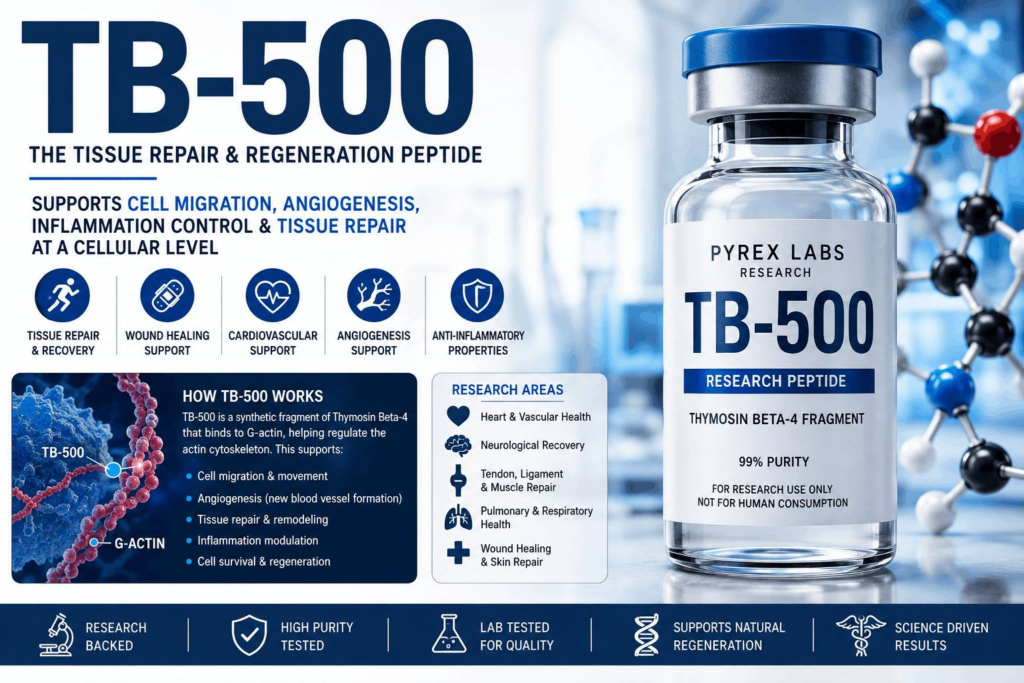
TB-500 is a synthetic peptide associated with research into Thymosin Beta-4 (Tβ4), a naturally occurring 43-amino-acid peptide found in many tissues and cell types.
Thymosin Beta-4 was originally studied for its relationship to the thymus, but subsequent research identified broader biological roles involving actin regulation, cellular migration, angiogenesis, inflammation, and tissue repair.
TB-500 is commonly discussed in research-peptide literature because it is intended to reproduce certain biological activities associated with Tβ4. However, TB-500 and naturally occurring full-length Thymosin Beta-4 should not automatically be treated as interchangeable compounds, particularly when interpreting research.
II. Science Behind the Peptide
One of the most important biological functions associated with Thymosin Beta-4 is its interaction with G-actin, the soluble form of actin involved in cellular structure and movement.
Through actin-related pathways, Tβ4 has been investigated for potential effects involving:
- Cell migration
- Angiogenesis
- Wound healing
- Tissue remodeling
- Inflammatory signaling
- Blood-vessel formation
- Cell survival
These mechanisms have made the Tβ4 pathway an interesting target in experimental research involving injured muscle, tendons, ligaments, skin, cardiac tissue, and other tissues.
III. Early Research Applications
Early work involving thymosin peptides helped establish their importance in cellular biology and immune research.
Modern interest in Tβ4-related compounds has expanded toward regenerative medicine and tissue-repair research, including experimental models of:
- Wound healing
- Corneal injury
- Cardiac damage
- Muscle injury
- Tendon and ligament repair
- Neurological injury
Importantly, promising findings involving Thymosin Beta-4 do not automatically prove that commercially marketed TB-500 produces identical effects in humans.
CHAPTER 2: PREPARATION & SAFETY CHECKLIST ✅
TB-500 does not have an established FDA-approved therapeutic indication, and there is no standardized clinical screening panel specifically validated for TB-500 use.
I. Potential Health Monitoring
Depending on an individual’s health and the research context, a qualified healthcare professional may consider general laboratory testing such as:
CBC: Provides general information about blood-cell status.
CMP: Can help evaluate liver, kidney, electrolyte, and metabolic health.
Kidney Function: Creatinine and eGFR may be appropriate when clinically indicated.
Liver Function: ALT, AST, alkaline phosphatase, and bilirubin can provide general hepatic information.
Inflammatory Markers: CRP or hs-CRP may be useful when systemic inflammation is clinically relevant.
None of these tests establishes whether TB-500 is individually “safe,” and values such as eosinophils, homocysteine, or CRP should not be presented as universal TB-500 clearance tests.
II. Medication & Supplement Considerations
There is currently insufficient controlled human research to define a comprehensive TB-500 drug-interaction profile.
Claims that statins necessarily interfere with TB-500’s regenerative activity, or that specific supplements universally cancel its effects, are not sufficiently established.
Likewise, assumptions about mixing multiple peptides in a single vial should not be based on internet protocols. Chemical compatibility, pH, stability, sterility, and formulation can differ substantially between compounds.
Anyone taking prescription medications or undergoing treatment for cardiovascular, metabolic, inflammatory, immune, or other medical conditions should discuss experimental peptide use with a qualified healthcare professional.
CHAPTER 3: DOSAGE & ADMINISTRATION 💉
There is currently no universally accepted or FDA-approved human dosing regimen for TB-500.
Protocols circulating online—such as specific milligram amounts per week, loading phases, maintenance doses, or high-dose injury protocols—should not be presented as established clinical standards.
Route of Administration
TB-500 is commonly discussed as an injectable research peptide. However, standardized human pharmacokinetic and dosing data remain limited.
Claims that subcutaneous administration is the only reliable route for systemic healing have not been established through adequate clinical trials.
Timing
There is insufficient evidence demonstrating that administering TB-500 at night, before sleep, or splitting doses between morning and evening produces superior outcomes.
Cycle Length
Frequently discussed 4-, 6-, 8-, or 12-week cycles originate largely from experimental or non-standardized practices rather than validated clinical guidelines.
There is also insufficient evidence showing that cycling is necessary to prevent receptor desensitization.
CHAPTER 4: WHAT TO EXPECT 🎯
There is no clinically validated week-by-week timeline for TB-500.
Research involving Tβ4-related pathways has investigated biological processes including:
- Cellular migration
- Actin regulation
- Angiogenesis
- Tissue remodeling
- Wound repair
- Inflammatory regulation
- Muscle and connective-tissue recovery
Claims that users should experience reduced stiffness by Week 2, improved flexibility by Week 6, tendon repair by Week 8, or accelerated postsurgical recovery by Week 12 have not been established in controlled human TB-500 trials.
Laboratory mechanisms should not be interpreted as guaranteed physical outcomes.
CHAPTER 5: POTENTIAL SIDE EFFECTS ⚠️
The human safety profile of TB-500 has not been characterized as extensively as that of approved medications.
Injection-Site Reactions
Experimental injectable preparations may potentially cause:
- Redness
- Swelling
- Soreness
- Itching
- Bruising
- Infection
Headache, Fatigue or Gastrointestinal Symptoms
These symptoms are sometimes reported anecdotally, but reliable incidence rates and direct causality have not been established.
Allergic or Immune Reactions
As with other peptide-containing preparations, hypersensitivity is possible.
Angiogenesis Considerations
Because Tβ4-related biology includes pathways associated with angiogenesis and cellular migration, its implications in conditions involving abnormal cell growth remain an important area of research.
Product Quality
Unapproved research products can introduce risks unrelated to the peptide itself, including incorrect concentration, contamination, impurities, degradation, or lack of sterility.
CHAPTER 6: COMMON RESEARCH MISTAKES 🤦
Treating Internet Doses as Clinical Protocols
A frequently repeated dose does not become medically validated simply because it appears on multiple peptide websites or forums.
Assuming More Produces Faster Healing
Regenerative biology is complex. Higher exposure does not necessarily produce faster or better tissue repair and may introduce additional unknown risks.
Neglecting Physical Rehabilitation
A peptide cannot substitute for appropriate rehabilitation, progressive loading, mobility work, physical therapy, or medical management of an injury.
Assuming TB-500 and Tβ4 Research Are Identical
This is one of the most important distinctions when evaluating claims.
Evidence involving full-length Thymosin Beta-4 cannot automatically be attributed to every TB-500 preparation.
Ignoring Product Quality
Purity, identity, sterility, storage, and concentration matter significantly when evaluating any experimental injectable compound.
CHAPTER 7: DISCONTINUATION 🏁
TB-500 is not a conventional hormone, and there is currently no established evidence demonstrating a classic hormonal withdrawal syndrome following discontinuation.
Likewise, claims that users require a maintenance taper, 6-week off-period, or pulsed dosing schedule to prevent receptor adaptation are not supported by established clinical guidelines.
There is currently no universally validated TB-500 “exit protocol.”
When an experimental peptide is being used under professional supervision, discontinuation should follow the healthcare professional’s instructions.
CHAPTER 8: TB-500 & PEPTIDE COMBINATIONS 🧬
Combination protocols involving multiple experimental peptides are frequently discussed online, but human evidence establishing the safety or superiority of these combinations is limited.
BPC-157 + TB-500
Often referred to informally as a “Wolverine Stack,” this combination is promoted for tissue-repair research because the compounds are proposed to influence different biological pathways.
However, controlled human evidence establishing that the combination accelerates injury recovery is lacking.
GHK-Cu + TB-500
GHK-Cu has been investigated in tissue-remodeling and skin-related research, while Tβ4-related pathways have been studied in cell migration and repair.
Their combined use remains experimental.
KPV + TB-500
KPV has been investigated primarily for anti-inflammatory properties, while Tβ4-related research focuses heavily on cellular migration and repair.
Claims of a clinically proven synergistic effect have not been established.
Growth Hormone Secretagogues + TB-500
Combining TB-500 with compounds affecting growth-hormone signaling introduces additional biological variables and potential risks.
There is insufficient evidence to establish a standardized or clinically validated combination protocol.
CHAPTER 9: TB-500 & MAJOR HEALTH CONDITIONS 🏥
1. Heart Disease
Thymosin Beta-4 has generated scientific interest in cardiac-repair research.
Preclinical studies have investigated processes including cardiomyocyte survival, vascular development, inflammation, and cardiac remodeling following injury.
However, describing TB-500 as proven to reverse myocardial fibrosis or restore heart function after a heart attack goes beyond established human evidence.
It should not replace standard cardiovascular treatment.
2. Vascular Disease & Stroke
Tβ4-related research has investigated angiogenesis, neurovascular repair, and neurological recovery in experimental models.
Animal findings suggesting improved recovery after neurological injury are scientifically interesting but do not establish TB-500 as a human stroke treatment.
Stroke requires immediate evidence-based medical care.
3. Cancer
This area requires particular caution.
Because Tβ4-related pathways can influence angiogenesis, cellular migration, and tissue remodeling, researchers have investigated complex relationships between these pathways and cancer biology.
Available research does not justify describing TB-500 as a treatment that prevents cancer spread.
Individuals with active or previous cancer should discuss experimental peptide exposure with their oncology team.
4. Diabetes & Wound Healing
Tβ4 has been investigated experimentally for wound healing and tissue regeneration, including research relevant to difficult-to-heal wounds.
This does not establish TB-500 as a treatment for diabetic ulcers, diabetes, or insulin resistance.
Diabetic wounds require appropriate professional wound and metabolic care.
5. Respiratory Disease
Thymosin Beta-4-related pathways have been explored experimentally in models involving lung inflammation, injury, and fibrosis.
However, TB-500 has not been established as a treatment for pneumonia, sepsis, COVID-19, SARS, pulmonary fibrosis, or other respiratory diseases.
CHAPTER 10: SUMMARY 📝
TB-500 is an experimental peptide associated with research into the biological activity of Thymosin Beta-4, a naturally occurring peptide involved in actin regulation, cellular migration, angiogenesis, inflammatory signaling, and tissue remodeling.
These mechanisms have generated substantial interest in research involving:
- Muscle and connective tissue
- Tendon and ligament biology
- Wound healing
- Cardiac tissue
- Blood-vessel formation
- Neurological injury
- Regenerative medicine
The research is scientifically promising, but an important distinction must be maintained between preclinical Thymosin Beta-4 findings and proven clinical effects of TB-500 in humans.
TB-500 should therefore be described as a research compound rather than an established therapy for injury recovery, cardiovascular disease, stroke, diabetes, cancer, or respiratory disease.
⚠️ Disclaimer: This content is provided for educational and informational purposes only. TB-500 is an experimental peptide and this article does not provide medical advice, diagnosis, dosing instructions, or treatment recommendations. Laboratory and animal findings do not necessarily demonstrate safety or effectiveness in humans. Consult a licensed healthcare professional before starting, stopping, combining, or changing any medication, supplement, or peptide protocol.