CHAPTER 1: OVERVIEW 📋
I. History of SNAP-8
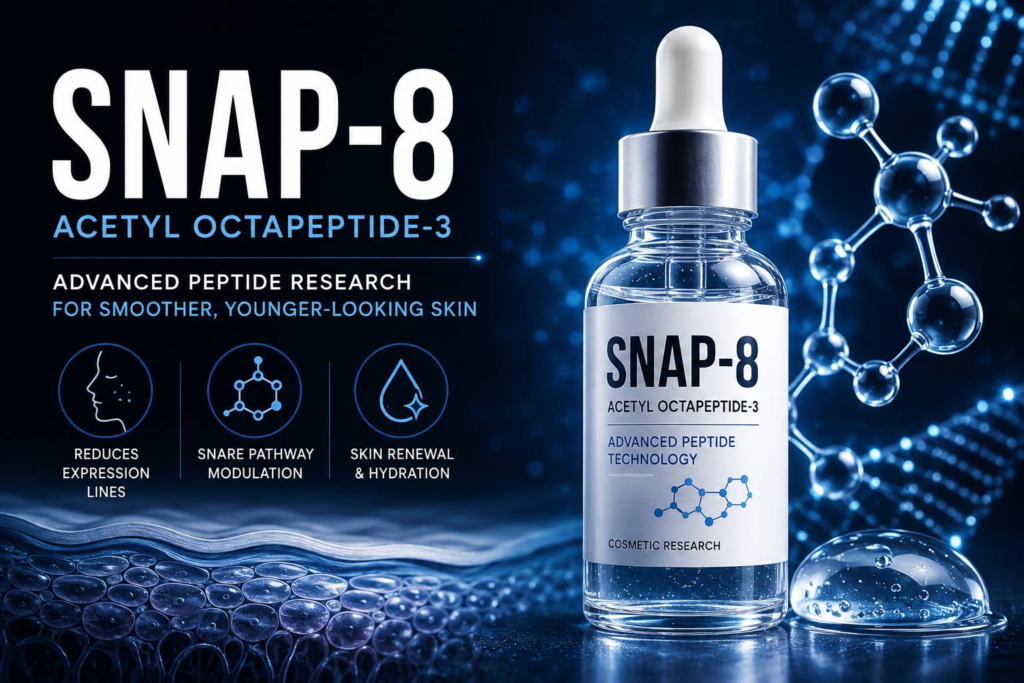
SNAP-8, scientifically known as Acetyl Octapeptide-3, is a synthetic cosmetic peptide developed as an extension of earlier expression-line peptides such as Acetyl Hexapeptide-8 (Argireline).
The peptide was designed for use in topical anti-aging formulations, with the goal of reducing the appearance of dynamic expression lines without invasive procedures.
Unlike injectable neuromodulators, SNAP-8 is primarily studied and marketed as a topically applied cosmetic ingredient.
II. Science Behind SNAP-8 🧬
SNAP-8 is an octapeptide, meaning it contains eight amino-acid residues. Its proposed cosmetic mechanism involves mimicking part of SNAP-25, a protein involved in the SNARE complex responsible for neurotransmitter release at nerve terminals.
By competing with normal SNARE-complex formation, SNAP-8 is proposed to modulate acetylcholine release at superficial neuromuscular junctions.
The resulting effect is intended to reduce the intensity of repetitive facial muscle contractions associated with expression lines. Importantly, this mechanism should not be described as equivalent to botulinum toxin. SNAP-8 is a cosmetic peptide with substantially different potency, delivery, and supporting evidence.
III. Primary Research & Cosmetic Application 💡
SNAP-8 is primarily incorporated into topical anti-aging skincare products targeting areas affected by repetitive facial movement, including:
- Forehead lines
- Crow’s-feet
- Expression lines
- Fine lines around the eyes and mouth
Research interest has also expanded into peptide delivery, skin penetration, biomaterials, and other applications, although these areas remain experimental.
CHAPTER 2: RESEARCH & SAFETY CHECKLIST ✅
Because SNAP-8 is generally used topically, traditional systemic laboratory testing is not typically part of normal cosmetic use. More relevant considerations involve the skin itself and the formulation containing the peptide.
| Consideration |
Desired Condition |
Reason for Caution |
| Skin Barrier |
Healthy, intact skin |
Broken or severely irritated skin may increase sensitivity |
| Dermal Tolerance |
No significant irritation |
Persistent redness, swelling or itching warrants discontinuation |
| Product Stability |
Properly formulated and stored |
Degradation can reduce peptide activity |
| Formulation Compatibility |
Compatible skincare ingredients |
Harsh or highly reactive ingredients may increase irritation |
| Sensitivity |
Product tolerated after initial use |
Sensitive skin may respond differently to concentrated formulations |
Ingredient Compatibility 🧴
SNAP-8 is commonly formulated alongside moisturizing and skin-supportive ingredients. However, introducing several potent products simultaneously can make irritation difficult to identify.
Particular care may be appropriate when combining a new SNAP-8 product with strong exfoliating acids, retinoids, benzoyl peroxide, or other potentially irritating skincare ingredients.
Rather than assuming these combinations chemically “destroy” SNAP-8 under all conditions, compatibility depends on the complete formulation, pH, stability testing, concentration, and packaging.
CHAPTER 3: USING SNAP-8 IN COSMETIC RESEARCH 🧪
I. Formulation
Commercial SNAP-8 is typically incorporated into a finished serum, cream, gel, or other topical formulation. Concentrations vary considerably between products.
Raw peptide powder should not automatically be treated like an injectable research peptide. Formulation requires appropriate knowledge of solubility, pH, preservatives, stability, contamination control, and final peptide concentration.
II. Application
Finished SNAP-8 skincare products are generally applied directly to areas where expression lines are visible.
Application frequency should follow the specific manufacturer’s formulation instructions, since different products can contain substantially different concentrations and supporting ingredients.
III. Timing ⏰
SNAP-8 may be incorporated into morning or evening skincare routines depending on the formulation.
Applying a finished product to clean skin before heavier creams or occlusive products is common, but the correct order ultimately depends on the complete skincare routine.
IV. Duration
SNAP-8 should not be marketed as producing an immediate Botox-like transformation. Cosmetic peptides generally require consistent use over several weeks before appearance changes can reasonably be evaluated.
Results can also vary considerably based on age, skin condition, formulation quality, concentration, penetration, and the depth of existing wrinkles.
CHAPTER 4: EXPECTATIONS 🎯
Early Use
The first noticeable changes may come from the moisturizing ingredients surrounding SNAP-8 rather than the peptide itself. Better hydration can temporarily make fine lines appear less prominent.
Continued Use
With consistent application, some formulations containing acetyl octapeptide-3 may improve the visible appearance of expression lines and skin smoothness.
Long-Term Use
Continued application is generally required to maintain cosmetic benefits. Because SNAP-8 does not permanently alter facial musculature, any peptide-related effect would be expected to diminish after discontinuation.
Claims such as a precise “63% wrinkle reduction” should only be used when tied directly to the specific study, formulation, concentration, methodology, and population that produced the number. It should not be presented as a guaranteed result for all SNAP-8 products.
CHAPTER 5: POSSIBLE SIDE EFFECTS ⚠️
Topical cosmetic peptides are generally intended to have localized effects, but the complete formulation can still produce skin reactions.
Potential reactions include redness, itching, dryness, burning, tingling, or irritation, particularly in sensitive skin or when multiple active skincare products are introduced simultaneously.
If significant irritation develops, discontinue the product and seek professional advice when appropriate.
CHAPTER 6: COMMON MISTAKES 🤦
Expecting overnight results: SNAP-8 is not an injectable neuromodulator. Cosmetic changes generally require consistent topical use.
Assuming every SNAP-8 serum is identical: The percentage printed on a product does not tell the entire story. Formulation quality, peptide concentration, stability, delivery system, and supporting ingredients matter.
Applying too many actives at once: Introducing SNAP-8 alongside several acids, retinoids, and exfoliants can increase irritation and make it difficult to identify the cause.
Ignoring storage instructions: Peptide-containing formulations can be sensitive to environmental conditions. Follow the manufacturer’s storage recommendations.
Treating SNAP-8 like injectable Botox: The two should not be considered interchangeable. They differ substantially in mechanism, delivery, potency, evidence, and regulatory status.
CHAPTER 7: DISCONTINUATION 🏁
Topical SNAP-8 does not require a taper.
If application is discontinued, any cosmetic benefit would be expected to gradually diminish as normal facial movement and skin-aging processes continue.
There is no established withdrawal syndrome associated with stopping a topical SNAP-8 cosmetic formulation.
CHAPTER 8: COMPLEMENTARY SKINCARE 🔗
SNAP-8 may appear in broader skincare routines alongside ingredients that target different aspects of skin appearance.
Hyaluronic acid can support hydration and temporarily improve skin plumpness. Vitamin C is commonly used for antioxidant support and collagen-related skincare. Retinoids have considerably stronger clinical evidence for photoaging and fine lines, although they can cause irritation and should be introduced appropriately.
Other peptides, moisturizers and sunscreen can also complement an anti-aging routine. Rather than describing these combinations as proven peptide “stacks,” they are better presented as complementary skincare approaches.
CHAPTER 9: SNAP-8 & SYSTEMIC HEALTH 🏥
SNAP-8 is principally a topical cosmetic ingredient, not a treatment for systemic diseases.
Heart & Cardiovascular Disease ❤️: There is no established evidence that topical SNAP-8 prevents or treats cardiovascular disease.
Stroke & Cerebrovascular Disease 🧠: SNAP-8 is not an established treatment or preventive therapy for stroke.
Cancer 🎗️: SNAP-8 should not be described as preventing or treating cancer. Absence of known carcinogenicity is not equivalent to demonstrating cancer prevention.
Diabetes 🩸: SNAP-8 is not a treatment for diabetes or insulin resistance.
Respiratory Disease 🫁: There is no established therapeutic role for SNAP-8 in pneumonia or respiratory infections.
Kidney & Liver Disease: Normal topical cosmetic use is intended to produce localized exposure, but this should not be interpreted as proof that every formulation is risk-free for every medical condition.
CHAPTER 10: SUMMARY 📝
SNAP-8 (Acetyl Octapeptide-3) is a synthetic cosmetic peptide developed primarily for topical anti-aging skincare. Its proposed mechanism involves modulating components associated with the SNARE neurotransmitter-release pathway, potentially reducing the appearance of expression-related wrinkles.
Its greatest appeal is its non-invasive topical application, making it substantially different from injectable neuromodulators. However, SNAP-8 should not be marketed as “topical Botox,” and laboratory or manufacturer-specific wrinkle-reduction figures should not be presented as universal outcomes.
For a research-focused article, the most accurate approach is to present SNAP-8 as a promising cosmetic peptide with a plausible molecular mechanism but more limited clinical evidence than established dermatological treatments.
⚠️ Disclaimer: This content is provided for educational and informational purposes only. It is not medical advice, diagnosis, or treatment guidance. Cosmetic products vary significantly in formulation, concentration, purity, stability, and tolerability. Anyone experiencing persistent skin irritation or managing a dermatological condition should consult an appropriately qualified healthcare professional.