CHAPTER 1: PEPTIDE OVERVIEW 📋
I. History of Selank
Selank is a synthetic peptide developed by researchers at the Institute of Molecular Genetics of the Russian Academy of Sciences. It is structurally related to tuftsin, a naturally occurring immunomodulatory tetrapeptide.
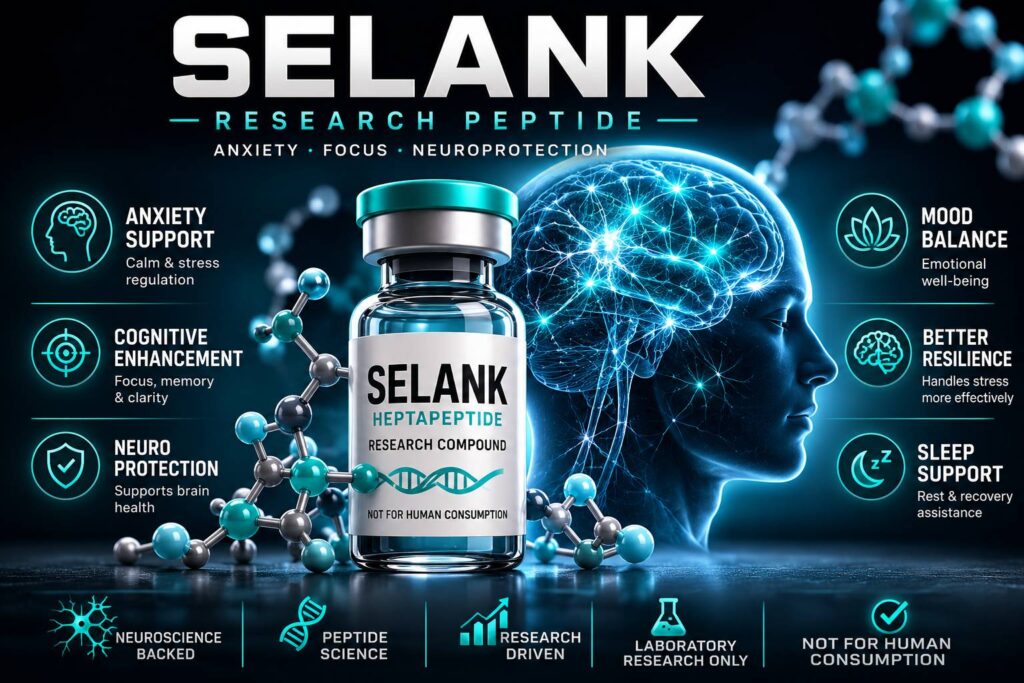
Selank consists of seven amino acids and was developed primarily for research into anxiety, stress regulation, cognition, and neuroimmune signaling.
Much of its clinical development and use has occurred in Russia and surrounding regions. Although Selank is frequently discussed internationally as a nootropic or anxiolytic peptide, it is not FDA-approved in the United States for treating anxiety or any other medical condition.
II. Science Behind Selank 🧬
Selank is a heptapeptide with the amino-acid sequence:
Thr-Lys-Pro-Arg-Pro-Gly-Pro
Research suggests that Selank may influence several neurological and molecular systems rather than acting through one simple receptor.
Areas being investigated include:
- GABAergic signaling
- Serotonergic signaling
- Gene expression related to neurotransmission
- BDNF and neuroplasticity
- Stress-response pathways
- Neuroimmune regulation
- Learning and memory
Experimental studies suggest interactions with the brain’s GABA system, which may help explain the compound’s reported anxiolytic properties.
However, describing Selank simply as a direct GABA-A positive allosteric modulator like a conventional benzodiazepine would overstate what has been established.
III. Primary Research Applications 💡
Selank has been investigated primarily for its potential anxiolytic and cognitive effects.
Research interests include:
- Anxiety and stress
- Emotional regulation
- Attention
- Learning
- Memory
- Cognitive performance
- Neuroplasticity
- Neuroimmune signaling
One reason Selank has attracted interest is the possibility of influencing anxiety without producing the degree of sedation associated with some conventional anxiolytic medications.
However, available evidence remains considerably more limited than that supporting established anxiety treatments.
CHAPTER 2: RESEARCH & SAFETY CHECKLIST ✅
There is currently no validated Selank-specific laboratory screening panel.
Tests such as cortisol, white-blood-cell counts, glucose, liver enzymes, or immune-cell ratios should not be presented as mandatory biomarkers for determining whether Selank is safe or effective.
I. General Health Considerations
Depending on an individual’s medical history, a healthcare professional may consider routine testing such as:
CBC: Provides information about blood cells and general health.
Comprehensive Metabolic Panel: Evaluates liver, kidney, electrolyte, and metabolic markers.
Fasting Glucose / HbA1c: May be appropriate when metabolic health is relevant.
Additional laboratory testing should be based on medical history rather than arbitrary “optimal Selank ranges.”
II. Medication & Supplement Considerations
Selank does not have a comprehensively established human drug-interaction profile.
Particular caution is reasonable when combining an experimental neuroactive peptide with medications or substances that affect the central nervous system.
These can include:
- Benzodiazepines
- Antidepressants
- Sedatives
- Sleep medications
- Alcohol
- Other experimental nootropics
There is insufficient evidence to claim that Selank routinely causes serotonin syndrome with SSRIs or MAO inhibitors.
Likewise, Selank should not automatically be characterized as a clinically meaningful anticoagulant without adequate human evidence.
People taking prescription psychiatric medication should not discontinue or modify treatment simply to use Selank.
CHAPTER 3: ADMINISTRATION & RESEARCH PROTOCOLS 🧪
Selank has no FDA-approved dosing regimen for anxiety, cognition, stress, sleep, or performance enhancement.
Therefore, protocols circulated through peptide communities should not be represented as established medical dosing standards.
I. Routes Studied
Selank is most commonly associated with intranasal administration in research and regional clinical use.
Other experimental formulations may exist, but routes should not automatically be considered interchangeable because absorption and pharmacokinetics may differ.
II. Dose & Frequency
Specific microgram protocols frequently circulated online vary substantially.
There is currently insufficient evidence to establish a universal:
- Starting dose
- Maintenance dose
- Maximum daily dose
- Frequency
- Long-term regimen
III. Timing ⏰
There is no clinically validated requirement that Selank must be taken specifically in the morning, evening, before studying, or immediately before stressful events.
Its effects may also vary considerably between individuals.
IV. Cycle Length
Commonly discussed schedules such as:
14 days on / several weeks off
or
6 weeks on / 6 weeks off
should not be treated as universally validated protocols.
There is also insufficient evidence that these schedules are required specifically to prevent receptor desensitization.
V. Storage
Storage requirements depend on the specific formulation and manufacturer.
Lyophilized peptide, reconstituted solution, and finished nasal products may have different stability requirements. Product-specific validated instructions should therefore take priority over universal online storage rules.
CHAPTER 4: EXPECTATIONS 🎯
There is no clinically validated week-by-week Selank results schedule.
Research has investigated potential effects involving:
Anxiety & Stress
Selank has primarily attracted attention for potential anxiolytic activity and modulation of stress responses.
Cognition
Experimental research has examined possible effects on:
- Attention
- Learning
- Memory
- Cognitive processing
Neuroplasticity
Research into Selank has explored changes in gene expression and signaling pathways associated with neuroplasticity and nervous-system function.
Mood
Selank may influence pathways involved in emotional regulation, but it should not be represented as an established treatment for depression or other psychiatric disorders.
Claims that users will reliably experience reduced anxiety during Week 1, enhanced cognition during Week 3, or persistent benefits for a specific number of weeks after stopping are not established clinical outcomes.
CHAPTER 5: POTENTIAL SIDE EFFECTS ⚠️
Human safety data remain limited compared with approved medications.
Potential considerations include:
Nasal Irritation
Intranasal formulations may potentially cause:
- Dryness
- Irritation
- Sneezing
- Nasal discomfort
Headache
Headache may occur, although its frequency and relationship to Selank are not fully characterized.
Fatigue or Drowsiness
Some individuals may experience changes in alertness or fatigue.
Unanticipated Mood Effects
Any neuroactive compound could potentially produce unexpected changes in:
- Mood
- Anxiety
- Sleep
- Concentration
Product-Quality Risks
Unapproved research products can introduce additional risks involving:
- Incorrect identity
- Inaccurate concentration
- Contamination
- Degradation
- Lack of sterility
These risks are separate from Selank’s intrinsic pharmacology.
CHAPTER 6: COMMON RESEARCH MISTAKES 🤦
Treating Selank as a Proven Anxiety Medication
Selank has interesting anxiolytic research behind it, but the evidence base does not match that of established, widely approved anxiety treatments.
Assuming It Works Like a Benzodiazepine
Selank may influence GABA-related pathways, but it should not simply be described as a peptide version of Xanax or another benzodiazepine.
Assuming It Cannot Cause Side Effects
Limited evidence of severe toxicity does not mean an experimental compound is risk-free.
Expecting Guaranteed Cognitive Enhancement
Potential effects on memory and cognition remain areas of research rather than guaranteed outcomes.
Assuming Cycling Is Mandatory
Claims that continuous administration inevitably causes receptor desensitization requiring a particular off-cycle are not sufficiently established.
Poor Administration Technique
Intranasal products require appropriate formulation and administration, but attempting to create nasal preparations from unverified research material can introduce concentration, contamination, and sterility risks.
CHAPTER 7: DISCONTINUATION 🏁
Selank has not been established as producing the type of physical dependence associated with benzodiazepines, opioids, or certain other psychoactive medications.
However, the available evidence is not sufficient to claim categorically that every person can discontinue every Selank regimen without any symptoms.
There is no established medical requirement for a gradual Selank taper.
There is also insufficient evidence demonstrating that anxiolytic effects reliably persist for one week or any other specific period after discontinuation.
CHAPTER 8: SELANK COMBINATIONS 🧬
Combining experimental compounds should be approached cautiously because most popular Selank “stacks” have not undergone controlled clinical testing.
Semax + Selank
This is perhaps the best-known combination discussed in nootropic communities.
Semax is investigated primarily for neuroprotective and cognitive effects, while Selank has attracted greater interest for stress and anxiety regulation.
The combination is theoretically complementary, but there is insufficient evidence establishing an optimal ratio, dosing strategy, or superior clinical efficacy.
BPC-157 + Selank
These compounds have very different research profiles.
Claims that combining them produces synergistic gut healing or systemic anti-inflammatory effects have not been demonstrated in controlled human trials.
NAD+ + Selank
NAD+ plays a fundamental role in cellular energy metabolism, while Selank is investigated for neurological signaling.
The fact that both relate broadly to brain biology does not establish clinical synergy.
Alpha-GPC / Choline + Selank
Choline-containing compounds participate in acetylcholine metabolism and may influence cognitive function.
There is no established evidence that adding them to Selank specifically enhances memory or learning beyond either intervention alone.
DSIP + Selank
DSIP is another experimental peptide associated with sleep research.
Combining it with Selank has not been established as a treatment for chronic insomnia.
CHAPTER 9: SELANK & MAJOR HEALTH CONDITIONS 🏥
Heart Disease ❤️
Chronic psychological stress can influence cardiovascular health, but this does not establish Selank as a cardiovascular therapy.
There is insufficient evidence that Selank significantly lowers cardiovascular mortality or prevents heart disease.
Stroke & Cerebrovascular Disease 🧠
Neuroprotection and cerebral ischemia are important areas of peptide research.
However, Selank has not been established as a treatment that improves recovery after stroke or prevents brain damage from vascular events.
Stroke requires immediate evidence-based medical care.
Cancer 🎗️
Immune regulation and cancer biology are extremely complex.
Selank should not be described as preventing cancer, inhibiting tumor growth, or improving cancer survival without appropriate clinical evidence.
Diabetes Mellitus 🩸
Stress pathways and metabolic health can interact, but Selank has not been established as a therapy for insulin resistance, metabolic syndrome, or diabetes.
Pneumonia & Respiratory Infections 🫁
Selank has been investigated for immunomodulatory effects, but claims of broad-spectrum antiviral activity or protection against respiratory infections should not be treated as established clinical benefits.
Kidney Disease
There is insufficient evidence demonstrating that Selank treats kidney disease, the “gut-brain-kidney axis,” or cognitive symptoms specifically associated with renal disease.
Liver Disease
Selank is not an established treatment for liver disease.
Likewise, claims about predictable elevations in ALT or AST at particular Selank doses are not supported by sufficient human evidence.
CHAPTER 10: SUMMARY 📝
Selank is a synthetic heptapeptide derived from the naturally occurring peptide tuftsin and developed primarily for research into anxiety, stress regulation, cognition, and neuroimmune signaling.
Research interest centers on potential effects involving:
- Anxiety and stress
- GABA-related signaling
- Neurotransmission
- Learning and memory
- Neuroplasticity
- BDNF-related pathways
- Gene expression
- Neuroimmune regulation
Selank is particularly interesting because experimental research suggests the possibility of anxiolytic activity without the same pharmacological profile as traditional sedative medications.
However, many modern claims surrounding Selank—including guaranteed cognitive enhancement, cardiovascular protection, antiviral effects, cancer protection, metabolic improvement, and precise cycling requirements—extend beyond established human evidence.
The most scientifically accurate description is that Selank is an experimental neuroactive peptide with intriguing anxiolytic and cognitive research, but with substantially less high-quality clinical evidence than established therapies for anxiety and other neurological conditions.
⚠️ Disclaimer: This material is provided solely for educational and informational purposes. It is not medical advice, diagnosis, dosing guidance, or a treatment recommendation. Selank is not FDA-approved in the United States for treating anxiety, cognitive impairment, or other medical conditions. Consult a qualified healthcare professional before using or combining experimental peptides, medications, or supplements.