CHAPTER 1: OVERVIEW 📋
I. History of Kisspeptin 🏛️
Kisspeptin was first identified in 1996 as the product of the KISS1 gene, initially studied for its potential role in suppressing melanoma metastasis. The name “kisspeptin” was later adopted in reference to Hershey, Pennsylvania, where the discovery took place.
Its importance in reproductive biology became much clearer in 2003, when researchers demonstrated that disruptions in the kisspeptin receptor pathway could cause hypogonadotropic hypogonadism and impaired puberty. This established kisspeptin signaling as a major regulator of the human reproductive axis.
II. Science Behind Kisspeptin 🧬
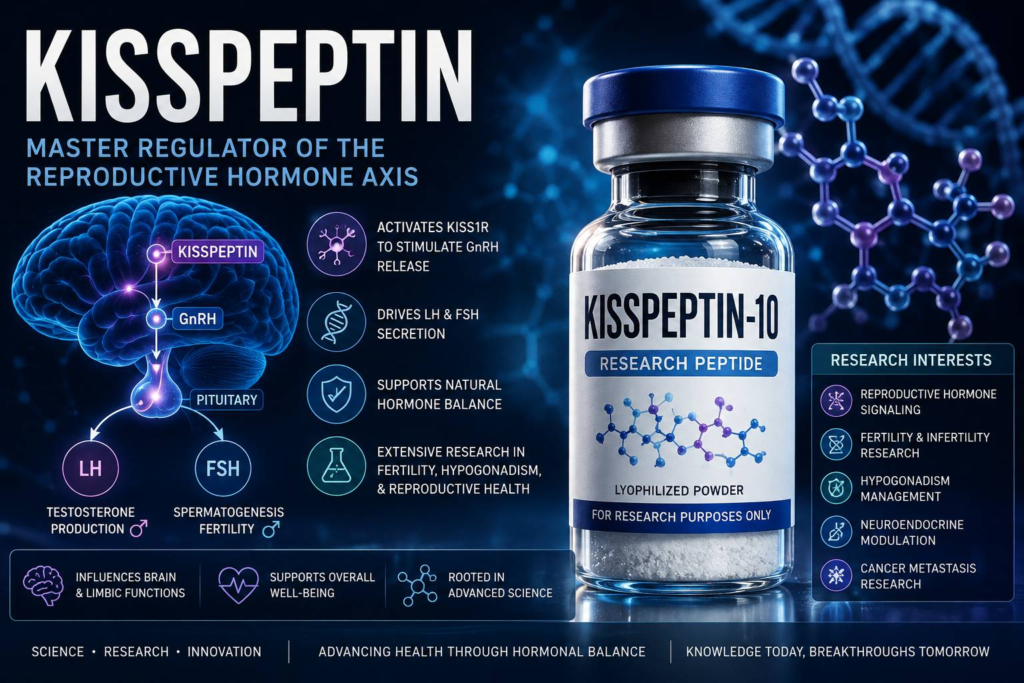
Kisspeptins are naturally occurring neuropeptides produced from the KISS1 gene. They activate the KISS1R/GPR54 receptor, particularly within hypothalamic pathways responsible for reproductive hormone signaling.
Activation of this system stimulates gonadotropin-releasing hormone (GnRH) neurons. GnRH subsequently signals the pituitary to release:
- Luteinizing hormone (LH)
- Follicle-stimulating hormone (FSH)
These hormones regulate downstream testosterone production, ovarian function, ovulation, and fertility. Rather than supplying testosterone or reproductive hormones directly, kisspeptin acts farther upstream in the body’s natural signaling cascade.
III. Early Research Applications 💡
Kisspeptin research originally centered on cancer metastasis, but reproductive endocrinology has since become one of its most extensively investigated areas.
Human studies have explored kisspeptin signaling in infertility, reproductive hormone disorders, puberty, hypogonadism, and assisted reproduction. Research has also examined its relationship with metabolism, sexual and emotional processing, although these applications remain under investigation.
CHAPTER 2: RESEARCH & SAFETY CONSIDERATIONS ✅
Because kisspeptin directly influences the hypothalamic-pituitary-gonadal (HPG) axis, research generally evaluates hormone status rather than relying on universal “optimal” values.
Commonly monitored biomarkers can include:
| Biomarker |
What Researchers Monitor |
| Total Testosterone |
Baseline and treatment-related hormonal changes |
| LH |
Pituitary response to GnRH stimulation |
| FSH |
Gonadal and reproductive-axis signaling |
| Estradiol (E2) |
Changes relative to sex, age and baseline |
| SHBG |
Interpretation of circulating sex-hormone availability |
Laboratory reference ranges should be interpreted according to the specific laboratory, biological sex, age, clinical context, and study population rather than using a single universal range.
Drug combinations affecting the reproductive axis—including hCG, SERMs, aromatase inhibitors, testosterone, or other hormonal therapies—can substantially change hormone responses. Combination protocols therefore require appropriate clinical oversight rather than assuming that multiple hormone-modulating agents will produce better results.
CHAPTER 3: KISSPEPTIN RESEARCH 🥼
I. Formulation & Administration 🔬
Kisspeptin has been investigated in several forms, including kisspeptin-10 and kisspeptin-54. Study preparation, route of administration, dose, and formulation vary substantially between clinical trials.
Because kisspeptin is an active hormone-regulating compound, there is no universal self-directed reconstitution or dosing protocol that can safely be generalized across products or research settings.
II. Hormonal Response 🚀
Human studies demonstrate that kisspeptin can produce measurable increases in LH, with downstream changes in reproductive hormones depending on the population and experimental design.
The magnitude and duration of this response can vary according to dose, formulation, sex, baseline hormone status, and frequency of exposure.
III. Timing ⏱️
Kisspeptin can trigger relatively rapid endocrine signaling, but responses are not determined simply by whether someone is fasting or fed. Reproductive hormone secretion is influenced by numerous physiological factors, including baseline endocrine status and endogenous GnRH activity.
IV. Repeated Exposure 🔄
One important research question is tachyphylaxis or desensitization. Frequent or continuous stimulation does not necessarily produce progressively greater hormonal effects.
This makes administration frequency an important experimental variable rather than supporting a universal cycle such as “4–6 weeks on.”
CHAPTER 4: WHAT RESEARCH HAS OBSERVED 🎯
Research outcomes depend heavily on the population being studied.
Acute administration: Changes in LH and other reproductive hormones can occur relatively quickly following kisspeptin stimulation.
Reproductive medicine: Kisspeptin has been investigated as a method of triggering reproductive hormone signaling and oocyte maturation during assisted reproduction.
Male reproductive research: Studies have examined its ability to stimulate the HPG axis and increase downstream testosterone signaling under certain experimental conditions.
Longer-term research: The effects of repeated administration, receptor responsiveness, fertility outcomes, and optimal treatment schedules remain active areas of investigation.
Kisspeptin should therefore be viewed primarily as an experimental regulator of reproductive signaling, rather than as a proven general-purpose testosterone booster.
CHAPTER 5: SAFETY & SIDE EFFECTS ⚠️
Human studies have generally reported kisspeptin as reasonably well tolerated under controlled research conditions, but safety depends on formulation, dose and population.
Reported or plausible considerations include headache, nausea, flushing, injection-site reactions, and hormone-related effects. Altering reproductive hormone signaling may also have consequences that cannot be predicted from short-term changes in testosterone, LH, or FSH alone.
Long-term safety data are considerably more limited than those available for established reproductive medicines.
CHAPTER 6: COMMON RESEARCH MISCONCEPTIONS 🤦
| Misconception |
Why It Matters |
| More frequent dosing is always better |
Repeated stimulation can change receptor responsiveness and endocrine signaling. |
| Kisspeptin is basically testosterone |
Kisspeptin acts upstream through GnRH rather than supplying testosterone directly. |
| Everyone needs the same hormone ranges |
Reference ranges vary by laboratory, age, sex and clinical context. |
| A larger LH spike guarantees better results |
Acute hormone changes do not automatically translate into improved long-term clinical outcomes. |
| Stacking more hormonal compounds improves results |
Combining endocrine-active compounds makes responses and adverse effects more difficult to predict. |
CHAPTER 7: DISCONTINUATION & FOLLOW-UP 🏁
There is no evidence-based universal “kisspeptin PCT” or tapering schedule applicable to all experimental use.
Because kisspeptin influences the HPG axis, discontinuation and follow-up should instead depend on the formulation used, duration of exposure, study protocol, symptoms, and follow-up measurements of relevant reproductive hormones.
CHAPTER 8: RESEARCH COMBINATIONS 🔗
Kisspeptin has scientific relevance alongside other reproductive interventions because several treatments affect different levels of the same hormonal system. However, this does not mean combinations such as kisspeptin + hCG, tamoxifen, testosterone, or aromatase inhibitors are established or universally appropriate “stacks.”
For research purposes, combining these interventions can actually make results harder to interpret because changes can occur simultaneously at the hypothalamus, pituitary, and gonadal levels.
CHAPTER 9: KISSPEPTIN & BROADER HEALTH RESEARCH 🧠
Cardiovascular Health ❤️
Kisspeptin is closely connected with reproductive and metabolic signaling, but it is not an established cardiovascular treatment. Cardiovascular effects remain an area of research.
Cerebrovascular & Neurological Research 🧠
Kisspeptin signaling occurs within brain networks involved in reproduction, behavior, and emotional processing. This is an emerging research field rather than an established therapy for stroke or neurological disease.
Cancer Research 🎗️
The KISS1 gene was originally identified for its metastasis-suppressing properties, which remains an important part of kisspeptin’s scientific history. That does not establish kisspeptin administration as a cancer treatment.
Diabetes & Metabolism 🩸
Research suggests meaningful interactions between metabolic status and reproductive signaling. Kisspeptin is being investigated in this context, but it is not an established diabetes therapy.
Kidney & Liver Health
Current evidence does not support using kisspeptin to treat kidney or liver disease. Individuals with significant organ impairment require additional caution because pharmacokinetics and safety may differ from healthy research populations.
CHAPTER 10: SUMMARY 📝
Kisspeptin is a naturally occurring neuropeptide and one of the key upstream regulators of human reproductive hormone signaling. By activating KISS1R and stimulating GnRH neurons, it can initiate the hormonal cascade responsible for LH, FSH, testosterone production, ovarian function, and fertility.
Its scientific importance extends from its original discovery in metastasis research to modern investigations involving fertility, reproductive endocrinology, hypogonadism, assisted reproduction, metabolism, and neuroendocrine signaling.
Kisspeptin is particularly interesting because it works differently from direct hormone replacement: instead of simply supplying a downstream hormone, it activates an upstream physiological signaling pathway. However, optimal dosing schedules, long-term safety, repeated-use effects, and appropriate patient populations remain areas of ongoing investigation.
⚠️ Disclaimer: This content is for educational and research-information purposes only. Kisspeptin products marketed for research use are not automatically established treatments for infertility, low testosterone, or other medical conditions. Dosing, combining, starting, or discontinuing hormone-active compounds should be discussed with an appropriately qualified healthcare professional.