CHAPTER 1: PEPTIDE OVERVIEW 📋
I. History
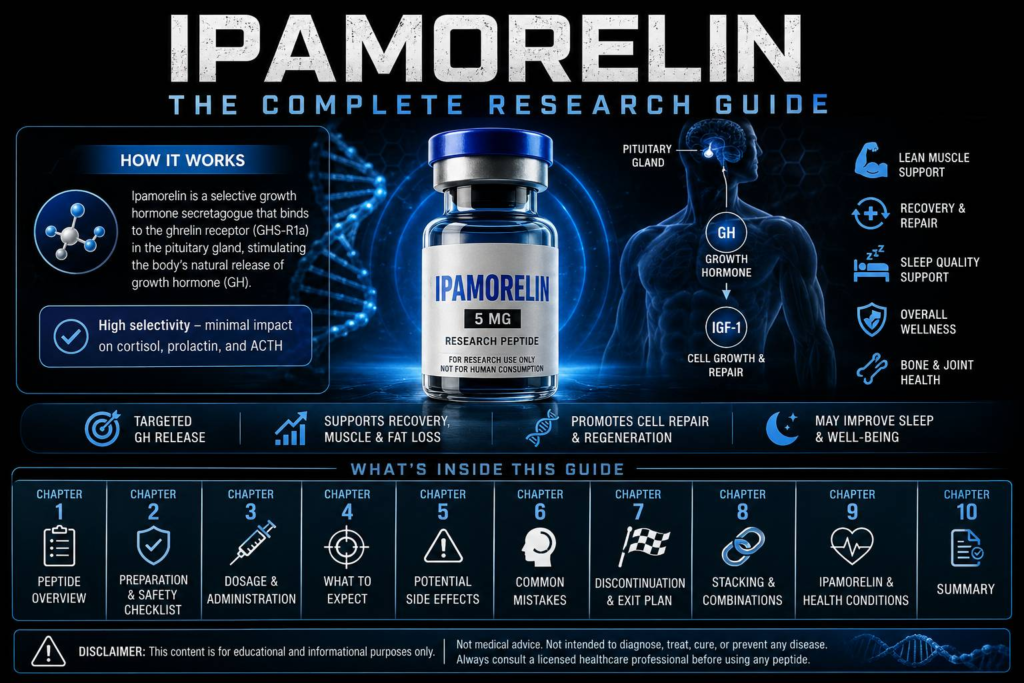
Ipamorelin is a synthetic pentapeptide developed during research into compounds capable of stimulating growth hormone (GH) release with greater selectivity than earlier growth hormone secretagogues.
It belongs to the growth hormone secretagogue (GHS) family and acts primarily through the growth hormone secretagogue receptor (GHS-R1a), also known as the ghrelin receptor.
Ipamorelin became scientifically interesting because preclinical research suggested that it could stimulate GH release while producing less activity involving cortisol and ACTH than some earlier secretagogues.
II. Science Behind the Peptide
Ipamorelin contains five amino acids and functions as a ghrelin-receptor agonist.
Activation of GHS-R1a can stimulate the pituitary gland to release growth hormone. GH subsequently influences numerous tissues directly and indirectly, including through insulin-like growth factor-1 (IGF-1).
Research involving GH signaling is relevant to:
- Body composition
- Protein metabolism
- Bone biology
- Connective tissue
- Recovery physiology
- Glucose metabolism
- Sleep and circadian physiology
Ipamorelin should not be described as simply “optimizing” GH without consequences. Growth hormone and IGF-1 signaling influence numerous biological systems, and increasing their activity may carry risks as well as potential research applications.
III. Early Research Applications
Ipamorelin was investigated clinically for conditions involving gastrointestinal motility, including postoperative ileus.
Although research demonstrated biological activity, Ipamorelin did not become an FDA-approved therapy for this indication.
Today, much of the interest surrounding Ipamorelin involves experimental research into GH secretion, metabolism, recovery, body composition, and endocrine physiology.
CHAPTER 2: PREPARATION & SAFETY CHECKLIST ✅
There is no universally validated laboratory checklist that determines whether Ipamorelin is safe for a particular person.
Because Ipamorelin affects the GH/IGF-1 axis, medical evaluation may be especially important for individuals with metabolic, endocrine, cardiovascular, or cancer-related concerns.
I. Potential Laboratory Considerations
Depending on the clinical situation, a healthcare professional may consider:
IGF-1: Can provide information about activity within the GH/IGF-1 axis. Results should be interpreted using age- and sex-adjusted laboratory reference ranges rather than a universal target.
Fasting Glucose: Useful for evaluating glucose regulation.
HbA1c: Provides information about longer-term blood-glucose control.
Comprehensive Metabolic Panel: May help evaluate general metabolic, liver, kidney, and electrolyte status.
Thyroid Testing: TSH and, when indicated, free thyroid hormones may be evaluated because thyroid and GH physiology can interact.
Lipid Panel: May be appropriate as part of broader metabolic assessment.
Other testing should be based on the individual’s age, medical history, symptoms, and risk factors.
II. Medication & Supplement Considerations
There is insufficient human evidence to define a complete Ipamorelin interaction profile.
Food intake and metabolic state can influence normal GH physiology, but claims that particular foods completely “kill” an Ipamorelin pulse should not be treated as established clinical rules.
Combining Ipamorelin with:
- Exogenous growth hormone
- Other GH secretagogues
- GHRH analogues
- Glucose-lowering medications
- Hormonal therapies
may alter endocrine or metabolic effects and should not be approached as automatically safe.
Prescription medications should never be discontinued simply to accommodate an experimental peptide protocol.
CHAPTER 3: DOSAGE & ADMINISTRATION 💉
There is currently no FDA-approved dosing regimen for Ipamorelin for anti-aging, bodybuilding, fat loss, recovery, sleep enhancement, or general wellness.
Specific protocols commonly promoted online—such as 100–300 mcg daily, bedtime dosing, twice-daily injections, or 12–16-week cycles—should not be presented as established medical standards.
Timing
Growth hormone secretion naturally follows a pulsatile pattern and is influenced by sleep, nutrition, exercise, age, sex, and metabolic status.
However, there is insufficient clinical evidence to establish that Ipamorelin must always be administered:
- Before bed
- While fasting
- A specific number of hours after eating
- At a particular interval before the next meal
Cycle Length
There is no validated clinical requirement for a 12–16-week cycle followed by exactly 30 days off.
Likewise, claims that such cycling is necessary to prevent GHS-R desensitization require stronger human evidence.
Total Amount Per Cycle
Because a standardized therapeutic dose and cycle have not been established for common wellness or performance uses, calculating a universal number of milligrams or vials required for a cycle would create a level of certainty unsupported by current evidence.
CHAPTER 4: WHAT TO EXPECT 🎯
There is no clinically validated week-by-week Ipamorelin transformation schedule.
Research involving GH secretagogues is relevant to physiological areas including:
- Growth hormone secretion
- IGF-1 signaling
- Body composition
- Protein metabolism
- Sleep physiology
- Bone metabolism
- Connective-tissue biology
- Glucose regulation
Claims that Ipamorelin reliably improves sleep within two weeks, accelerates workout recovery by Week 4, reduces visceral fat by Week 8, or improves hair, skin, and joints by Week 12 have not been established through robust controlled trials for these uses.
Responses may also differ substantially depending on age, baseline GH status, metabolic health, nutrition, sleep, exercise, and other variables.
CHAPTER 5: POTENTIAL SIDE EFFECTS ⚠️
Because Ipamorelin influences growth-hormone signaling, potential adverse effects may overlap with effects associated with increased GH/IGF-1 activity.
Possible concerns may include:
Injection-Site Reactions
Injectable preparations may potentially cause:
- Redness
- Swelling
- Irritation
- Bruising
- Pain
- Infection
Fluid Retention
GH-related signaling can contribute to fluid retention or edema in some circumstances.
Headache or Dizziness
These symptoms may occur, although reliable incidence data for non-approved Ipamorelin use are limited.
Tingling or Numbness
Changes in fluid balance associated with GH activity can potentially contribute to symptoms resembling paresthesia or carpal-tunnel-type discomfort.
Glucose Regulation
Growth hormone can oppose some actions of insulin. Increasing GH activity may therefore affect insulin sensitivity and glucose regulation, particularly in susceptible individuals.
Unknown Long-Term Effects
Long-term human safety data for repeated Ipamorelin use outside investigated clinical settings remain limited.
CHAPTER 6: COMMON RESEARCH MISTAKES 🤦
Treating Internet Protocols as Medical Standards
A frequently repeated dose, schedule, or cycle does not become clinically validated simply because it is popular online.
Assuming Fasting Is Mandatory
Nutrition affects normal GH physiology, but there is insufficient evidence supporting rigid universal fasting rules for every Ipamorelin protocol.
Expecting Immediate Body-Composition Changes
Changes involving muscle, fat, connective tissue, or metabolic physiology depend on numerous variables and cannot be assigned a guaranteed timeline.
Ignoring Metabolic Health
GH signaling can influence glucose metabolism. Individuals with impaired glucose regulation require particular caution.
Treating Ipamorelin as a Substitute for Sleep or Nutrition
Experimental GH secretagogues cannot replace:
- Adequate sleep
- Appropriate nutrition
- Resistance training
- Cardiovascular exercise
- Recovery
- Medical management of endocrine disorders
Poor Product Handling
Unapproved peptide products may introduce risks involving identity, concentration, sterility, contamination, degradation, and storage.
CHAPTER 7: DISCONTINUATION 🏁
Ipamorelin stimulates endogenous GH secretion rather than functioning identically to direct administration of exogenous growth hormone.
However, this does not establish that every user can discontinue any regimen without physiological consequences or monitoring.
There is no universally validated Ipamorelin tapering or “exit” protocol.
Likewise, a mandatory 30-day receptor reset has not been established as a clinical requirement.
When Ipamorelin is used in a medically supervised context, discontinuation should follow the supervising healthcare professional’s recommendations.
CHAPTER 8: IPAMORELIN & PEPTIDE COMBINATIONS 🧬
Combination protocols involving Ipamorelin are frequently discussed in peptide communities, but combination-specific clinical evidence varies considerably.
CJC-1295 / GHRH Analogues + Ipamorelin
The rationale is based on targeting complementary components of GH secretion: a GHRH pathway and the ghrelin/GHS-R pathway.
This biological rationale does not automatically establish the safety, optimal ratio, or effectiveness of any particular combination.
BPC-157 / TB-500 + Ipamorelin
BPC-157 and TB-500-related compounds are discussed in experimental tissue-repair research, while Ipamorelin influences GH signaling.
Claims that combining them produces dramatically accelerated systemic healing remain unproven in controlled human trials.
GLP-1–Based Drugs + Ipamorelin
GLP-1–based therapies can significantly affect appetite, glucose regulation, and body weight.
Combining them with a GH secretagogue introduces additional metabolic variables and should not be described simply as a method for maximizing fat loss while preserving muscle.
Testosterone Therapy + Ipamorelin
Testosterone and GH/IGF-1 signaling influence overlapping aspects of body composition and metabolism.
Their combination may produce additive physiological effects but also introduces additional risks and monitoring requirements. It should not be considered a universally appropriate “anabolic foundation.”
CHAPTER 9: IPAMORELIN & MAJOR HEALTH CONDITIONS 🏥
Heart Disease
GH and IGF-1 participate in cardiovascular physiology, and researchers have investigated their relationship with cardiac structure, vascular function, and metabolism.
However, Ipamorelin has not been established as a therapy that makes the heart “younger,” reverses cardiac remodeling, or improves heart disease outcomes.
Vascular Disease & Stroke
Growth hormone and IGF-1 influence endothelial biology, but this does not establish Ipamorelin as a treatment for hypertension, vascular disease, or stroke prevention.
Cancer
This area requires particular caution.
Ipamorelin is not established as causing cancer, but GH and IGF-1 are involved in cellular growth and proliferation.
The relationship between the GH/IGF-1 axis and malignancy is complex. Individuals with active or previous cancer should discuss any GH-modulating compound with their oncology or endocrine team.
Diabetes & Insulin Resistance
Growth hormone can reduce insulin sensitivity under certain circumstances.
For this reason, people with prediabetes, diabetes, or significant insulin resistance may require additional caution and medical monitoring when considering compounds that increase GH activity.
Ipamorelin is not an established treatment for diabetes.
Respiratory Disease & Infection
There is insufficient clinical evidence that Ipamorelin activates the thymus in a manner that creates an “immune firewall” or meaningfully improves the body’s ability to eliminate respiratory infections.
Ipamorelin should not be presented as a treatment for pneumonia or other infectious diseases.
CHAPTER 10: SUMMARY 📝
Ipamorelin is an experimental five-amino-acid growth hormone secretagogue that acts primarily through the ghrelin/GHS-R1a receptor to stimulate endogenous growth hormone release.
Its selectivity and endocrine pharmacology have made it an interesting research compound for investigating the GH/IGF-1 axis and related physiological processes.
Areas of scientific interest include:
- Growth hormone secretion
- IGF-1 physiology
- Metabolism
- Body composition
- Recovery biology
- Bone and connective tissue
- Sleep physiology
- Gastrointestinal motility
However, many popular claims surrounding Ipamorelin—including guaranteed fat loss, muscle gain, anti-aging effects, improved immunity, cardiovascular rejuvenation, and precise week-by-week results—extend beyond the available clinical evidence.
There is also no universally established human protocol for wellness or performance use involving a specific dose, fasting schedule, cycle length, maintenance phase, or mandatory receptor-reset period.
Ipamorelin is therefore best described as an experimental GH secretagogue with interesting biological activity but limited evidence supporting many of its widely promoted off-label applications.
⚠️ Disclaimer: This content is provided for educational and informational purposes only. Ipamorelin is an experimental peptide and this article does not provide medical advice, diagnosis, dosing instructions, or treatment recommendations. Potential effects on growth hormone, IGF-1, glucose metabolism, and other physiological systems require appropriate consideration. Consult a licensed healthcare professional before starting, stopping, combining, or changing medications, supplements, hormones, or peptide protocols.