CHAPTER 1: OVERVIEW 📋
I. History of Epitalon 🏛️
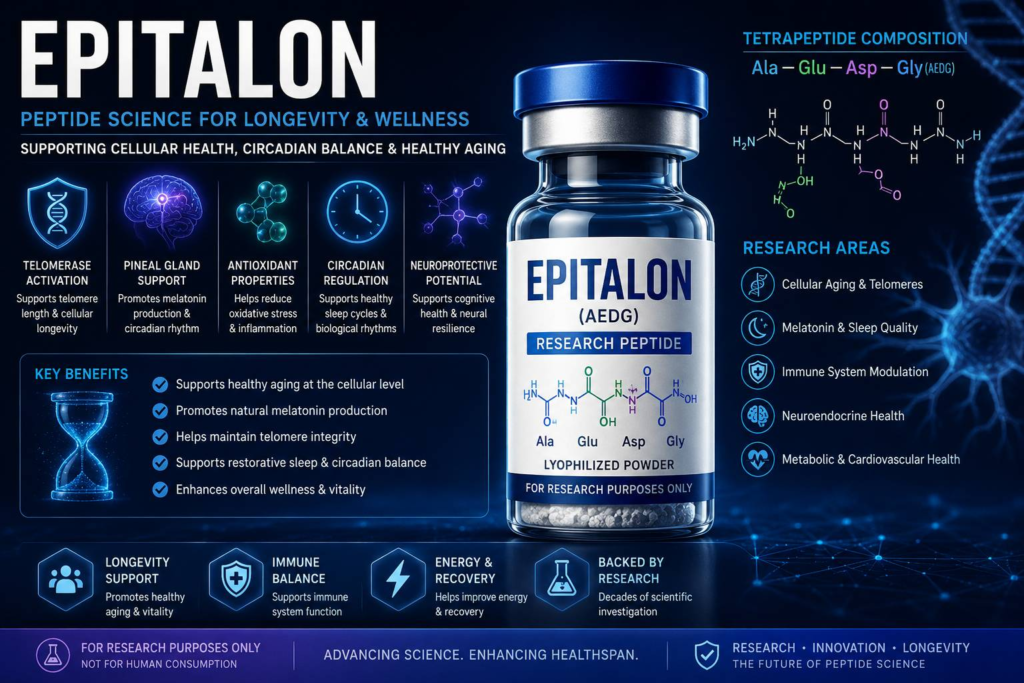
Epitalon—also spelled Epithalon—is a synthetic tetrapeptide associated with research led by Russian scientist Vladimir Khavinson and colleagues. It was developed from work on peptide preparations derived from the pineal gland and was designed as a short, defined peptide sequence composed of Ala-Glu-Asp-Gly (AEDG).
Much of the early literature surrounding Epitalon originated in Russia and focused on aging, pineal function, circadian biology, and longevity. Although the compound has attracted significant interest in longevity research communities, much of the evidence comes from preclinical studies, small clinical investigations, and older research that has not been independently replicated at the scale expected for an approved therapeutic.
II. Science Behind Epitalon 🧬
Epitalon is a four-amino-acid peptide investigated for possible effects on cellular aging and gene regulation.
One of its most widely discussed research areas is telomere biology. Telomeres are protective DNA-protein structures located at the ends of chromosomes that generally shorten as cells divide. Laboratory research has investigated whether Epitalon can influence telomerase activity, the enzyme involved in maintaining telomere length.
Epitalon has also been studied in connection with:
- Circadian rhythm and pineal signaling
- Melatonin regulation
- Oxidative stress
- Gene expression
- Cellular senescence
- Immune and neuroendocrine function
These mechanisms remain areas of investigation and should not be interpreted as proof that Epitalon reverses human aging or extends human lifespan.
III. Early Research Applications 💡
Early Epitalon research primarily focused on age-associated physiological decline. Researchers investigated whether peptide-based regulation could influence sleep, circadian rhythms, immune function, metabolism, and other biological processes that change with age.
This work eventually helped make Epitalon one of the better-known experimental compounds within the broader field of peptide gerontology and longevity research.
CHAPTER 2: RESEARCH & SAFETY CONSIDERATIONS ✅
There is currently no standardized clinical biomarker panel specifically validated for Epitalon use. Studies investigating aging and metabolic health may monitor general biomarkers depending on the research question.
| Research Area |
Potential Measurements |
| Metabolic Health |
Fasting glucose, insulin, HbA1c |
| Inflammation |
CRP and other inflammatory markers |
| Cardiovascular Health |
Lipid profile and blood pressure |
| Liver Function |
ALT, AST and other liver markers |
| Kidney Function |
Creatinine and eGFR |
| Circadian Biology |
Sleep timing and melatonin-related measurements |
Values should be interpreted using the reference ranges of the laboratory performing the testing, rather than applying arbitrary universal “optimal” ranges.
Medication & Health Considerations 💊
Evidence regarding Epitalon’s interactions with medications is limited. Extra caution is appropriate for individuals receiving cancer treatment, immunosuppressive therapy, hormone-active medications, or other treatments that could interact with experimental biological pathways.
Claims that specific medications are universally prohibited with Epitalon are not currently supported by strong clinical evidence.
CHAPTER 3: EPITALON RESEARCH 🥼
I. Research Formulations 🔬
Experimental Epitalon has been investigated using different formulations and administration methods. This makes it difficult to establish a single standardized protocol from the available literature.
Product quality is another major variable. Materials sold online as “research peptides” may not necessarily have the same identity, purity, potency, sterility, or formulation as material used in published research.
II. Dose & Frequency Research 🚀
Published studies have used differing exposure schedules, making it inappropriate to describe one particular dose or cycle as the established Epitalon protocol.
Questions involving optimal dose, frequency, treatment duration, and repeated exposure remain unresolved because large, modern randomized clinical trials are lacking.
III. Circadian Research ⏰
The connection between Epitalon and the pineal/circadian system is one of its most interesting research areas.
Some studies have investigated changes involving melatonin secretion and age-related circadian disruption. However, evidence does not establish that Epitalon reliably “resets” the biological clock in healthy people.
IV. Cycling 🔄
Short treatment periods appear frequently in historical peptide research, but there is currently no universally accepted evidence-based schedule specifying how often Epitalon should be cycled.
Likewise, claims that continuous administration necessarily causes pineal desensitization have not been firmly established in human clinical research.
CHAPTER 4: WHAT RESEARCH HAS OBSERVED 🎯
Rather than expecting predictable week-by-week results, Epitalon research is better understood by biological domain.
Sleep & Circadian Function 🌙
Studies have explored whether pineal peptides can influence melatonin rhythms, sleep patterns, and age-associated circadian changes.
Cellular Aging 🧬
Laboratory experiments have investigated telomerase activity, telomere dynamics, cellular senescence, and gene-expression changes.
Oxidative Stress 🛡️
Preclinical research suggests potential effects involving antioxidant defense and oxidative damage.
Immune Function 🔬
Some research has examined age-associated immune changes, although strong modern clinical evidence remains limited.
Longevity ⏳
Animal experiments and older observational work have generated interest in possible lifespan effects. This should not be translated into a claim that Epitalon has been proven to extend human lifespan.
CHAPTER 5: SAFETY & SIDE EFFECTS ⚠️
Reliable large-scale human safety data for Epitalon remain limited.
Small studies and reports have generally not identified a clearly defined pattern of severe toxicity, but this does not establish long-term safety. Possible concerns surrounding experimental peptide products include local injection reactions, headache, dizziness, hypersensitivity, contamination, inaccurate concentration, and unknown long-term biological effects.
Importantly, symptoms such as vivid dreams should not automatically be interpreted as proof that melatonin production or REM sleep has improved.
CHAPTER 6: COMMON RESEARCH MISCONCEPTIONS 🤦
| Misconception |
Why It Matters |
| Epitalon reverses aging |
No clinical evidence establishes reversal of human biological aging. |
| Telomerase activation guarantees longevity |
Telomere biology is considerably more complex than simply maximizing telomerase activity. |
| Animal lifespan results apply directly to humans |
Longevity findings frequently fail to translate between species. |
| A specific cycle is scientifically proven |
Published protocols vary and no universally accepted clinical regimen exists. |
| Research-grade automatically means pharmaceutical-grade |
Purity, identity and sterility can vary considerably between unregulated products. |
CHAPTER 7: DISCONTINUATION & LONG-TERM RESEARCH 🏁
Epitalon is not known to produce classical physical dependence, and there is no established evidence-based tapering protocol.
However, that should not be interpreted as proof that repeated or long-term exposure is risk-free. The long-term consequences of manipulating pathways associated with telomeres, gene expression, circadian biology, and cellular proliferation require considerably more research.
CHAPTER 8: COMBINATION RESEARCH 🔗
Epitalon is frequently discussed alongside compounds such as Thymalin, GHK-Cu, MOTS-c, and SS-31 because they are investigated in different areas of aging biology.
These combinations are better viewed as research concepts than validated therapeutic “stacks.” There is insufficient high-quality clinical evidence to establish that combining them produces superior longevity outcomes or that such combinations are safe for routine human use.
CHAPTER 9: EPITALON & MAJOR RESEARCH AREAS 🧪
Cardiovascular Health ❤️
Some research involving pineal peptides has explored cardiovascular and metabolic markers. Evidence is not strong enough to conclude that Epitalon prevents cardiovascular disease or reduces cardiovascular mortality by a specific percentage.
Neurological & Circadian Health 🧠
Epitalon’s relationship with pineal function makes sleep, circadian regulation, and neuroendocrine aging important research areas. Claims of proven protection against stroke remain premature.
Cancer Biology 🎗️
This area requires particular caution. Telomerase and cellular proliferation are deeply connected with cancer biology. Although some experimental studies report potentially favorable effects, Epitalon should not be characterized as preventing cancer or reducing cancer risk by a proven amount in humans.
Metabolic Health 🩸
Researchers have explored age-related glucose and metabolic regulation, but Epitalon is not an established treatment for diabetes.
Immune Function 🦠
Age-related immune regulation is another area of interest. Current evidence does not establish Epitalon as a treatment or preventive therapy for respiratory infections.
Kidney & Liver Health
There is insufficient clinical evidence to claim that Epitalon restores kidney function or significantly reduces liver enzymes in a predictable proportion of users.
CHAPTER 10: SUMMARY 📝
Epitalon is an experimental synthetic tetrapeptide best known for research involving aging, telomere biology, pineal function, circadian rhythms, and cellular regulation.
Its exceptionally small AEDG sequence and decades of research have made it an interesting candidate within longevity science. Laboratory studies involving telomerase, gene expression, oxidative stress, melatonin regulation, and cellular aging provide plausible avenues for continued investigation.
At the same time, the evidence base is much less definitive than many online descriptions suggest. Claims that Epitalon reverses aging, dramatically reduces mortality, prevents cancer, restores organs, or extends human lifespan go beyond what current high-quality evidence can establish.
The strongest scientific framing is therefore not that Epitalon is a proven “anti-aging peptide,” but that it is an interesting experimental compound for studying several biological mechanisms associated with aging and longevity.
⚠️ Disclaimer: This article is for educational and research-information purposes only and is not medical advice, diagnosis, or a treatment protocol. Epitalon is not an FDA-approved anti-aging or longevity therapy. Experimental peptide products may carry purity, sterility, dosing, interaction, and long-term safety risks.