CHAPTER 1: PEPTIDE OVERVIEW 📋
I. History
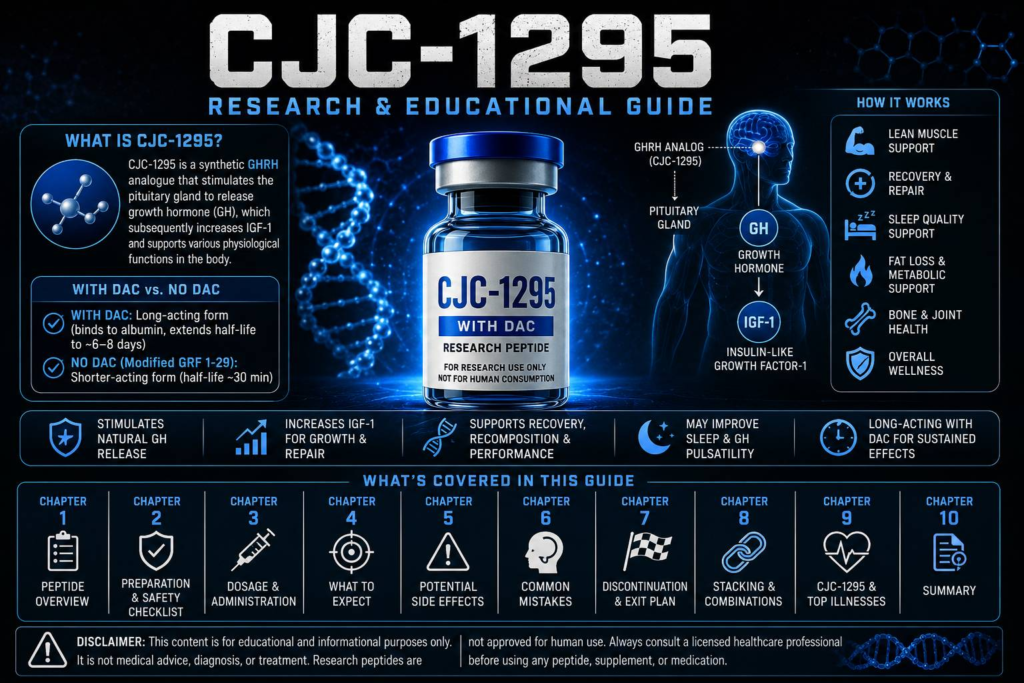
CJC-1295 is a synthetic analogue of growth hormone-releasing hormone (GHRH) developed by ConjuChem Biotechnologies. It was designed to stimulate the pituitary gland’s natural release of growth hormone while improving upon the very short duration of naturally occurring GHRH.
An important distinction is that the name CJC-1295 is often used inconsistently. The original CJC-1295 contains a Drug Affinity Complex (DAC) that extends its circulation time. Products marketed as “CJC-1295 No DAC” are generally associated with modified GRF (1-29), a shorter-acting GHRH analogue. These should not automatically be treated as pharmacologically identical.
II. Science Behind the Peptide
CJC-1295 acts primarily through the GHRH receptor on pituitary somatotroph cells. Activation of this receptor stimulates endogenous growth hormone secretion, which can subsequently influence IGF-1 production.
The GH/IGF-1 axis is involved in numerous physiological processes, including:
- Protein metabolism
- Body composition
- Bone metabolism
- Connective-tissue biology
- Glucose regulation
- Lipid metabolism
- Cellular growth and repair
The DAC modification was developed to prolong exposure by allowing the molecule to bind circulating proteins such as albumin. This creates a substantially different pharmacokinetic profile from shorter-acting GHRH analogues.
III. Clinical Research
CJC-1295 has undergone early human clinical investigation examining its ability to increase growth hormone and IGF-1 concentrations.
These studies demonstrated biological activity and prolonged endocrine effects, but CJC-1295 did not become an FDA-approved treatment for anti-aging, bodybuilding, fat loss, athletic recovery, or general wellness.
CHAPTER 2: PREPARATION & SAFETY CHECKLIST ✅
Because CJC-1295 modifies the GH/IGF-1 axis, medical evaluation may be important for people with endocrine, metabolic, cardiovascular, or cancer-related risk factors.
There is no single laboratory panel that has been validated as a universal CJC-1295 safety checklist.
I. Potential Laboratory Considerations
IGF-1: Can help evaluate activity of the GH/IGF-1 axis. Results should be interpreted using appropriate age- and sex-adjusted laboratory reference ranges.
Fasting Glucose: May help identify impaired glucose regulation.
HbA1c: Provides information about longer-term blood-glucose control.
Comprehensive Metabolic Panel: May be appropriate for evaluating general metabolic, kidney, liver, and electrolyte status.
Lipid Panel: Can provide information about cardiovascular and metabolic health.
Additional testing should be selected according to the individual’s medical history rather than using arbitrary universal “optimal” peptide ranges.
II. Medication & Supplement Considerations
There is insufficient clinical evidence to establish a comprehensive CJC-1295 interaction list.
Combining CJC-1295 with compounds that also modify the GH/IGF-1 axis—such as:
- Exogenous growth hormone
- Ipamorelin
- Other GH secretagogues
- Other GHRH analogues
may increase endocrine exposure and potentially alter the risk of adverse effects.
Nutrition, insulin, sleep, and exercise can influence normal GH physiology, but claims that a particular food or meal completely “blocks” CJC-1295 should not be treated as established clinical rules.
Prescription medications should not be stopped or altered simply to accommodate an experimental peptide.
CHAPTER 3: DOSAGE & ADMINISTRATION 💉
There is currently no FDA-approved dosing protocol for CJC-1295 for anti-aging, body composition, athletic performance, sleep, or recovery.
Specific protocols commonly circulated online should therefore not be presented as established medical dosing standards.
CJC-1295 With DAC vs. No DAC
This distinction is particularly important.
CJC-1295 with DAC was specifically engineered for prolonged activity.
Products described as CJC-1295 without DAC or Modified GRF (1-29) are shorter acting and should not be assumed to use the same dosing frequency, timing, or pharmacokinetic profile.
Timing
GH secretion is naturally pulsatile and influenced by factors including:
- Sleep
- Nutrition
- Exercise
- Age
- Metabolic health
There is not sufficient evidence to establish a universal rule that CJC-1295 must always be administered at bedtime, while fasting, or a precise number of hours after eating.
Cycle Length
Commonly promoted schedules involving 5 days on/2 days off, 8–12 week cycles, or mandatory 30-day breaks are not established clinical standards.
Likewise, there is insufficient evidence to claim that everyone requires periodic cycling to prevent pituitary or receptor desensitization.
Total Amount Per Cycle
Because there is no universally established therapeutic cycle for these off-label purposes—and because DAC and non-DAC formulations have substantially different pharmacology—a universal “total milligrams per cycle” calculation would be misleading.
CHAPTER 4: WHAT TO EXPECT 🎯
There is no clinically validated week-by-week transformation schedule for CJC-1295.
Research involving GHRH analogues and the GH/IGF-1 axis has examined areas such as:
- Growth hormone secretion
- IGF-1 concentrations
- Protein metabolism
- Body composition
- Fat metabolism
- Connective-tissue physiology
- Sleep and endocrine rhythms
- Metabolic health
Claims that users should experience deeper sleep by Weeks 1–2, enhanced recovery by Week 4, improved skin by Week 8, or visible fat loss by Week 12 have not been established as predictable CJC-1295 outcomes in controlled clinical trials.
Changes in GH or IGF-1 biomarkers also do not guarantee a particular physical or cosmetic result.
CHAPTER 5: POTENTIAL SIDE EFFECTS ⚠️
Potential effects associated with CJC-1295 may include consequences related to increased GH/IGF-1 activity.
Injection-Site Reactions
Injectable preparations can potentially cause:
- Redness
- Swelling
- Itching
- Irritation
- Bruising
- Pain
- Infection
Flushing
Transient flushing has been reported with some GHRH-related compounds.
Headache or Dizziness
Headache, dizziness, or other nonspecific symptoms may occur.
Fluid Retention
Increased GH activity can contribute to fluid retention or edema in susceptible individuals.
Tingling or Numbness
Changes associated with GH activity and fluid retention may contribute to paresthesia or carpal-tunnel-type symptoms.
Glucose Regulation
Growth hormone can oppose certain effects of insulin. Increased GH exposure can therefore potentially affect insulin sensitivity and glucose tolerance.
Unknown Long-Term Effects
Long-term safety data for repeated non-approved CJC-1295 use remain limited.
CHAPTER 6: COMMON RESEARCH MISTAKES 🤦
Confusing DAC and No-DAC Formulations
This is one of the biggest sources of misinformation surrounding CJC-1295.
The long-acting DAC compound and shorter-acting modified GRF formulations have different pharmacokinetic characteristics.
Treating Internet Protocols as Medical Guidelines
Frequently repeated dosing schedules are not necessarily supported by controlled clinical evidence.
Assuming More GH Is Always Better
Growth hormone has complex effects throughout the body. Excessive GH/IGF-1 signaling can produce unwanted metabolic and physiological consequences.
Expecting Immediate Body-Composition Changes
Changes in fat mass, muscle, connective tissue, or appearance depend on many factors and cannot be assigned a guaranteed timeline.
Ignoring Glucose Regulation
Because GH can affect insulin sensitivity, metabolic health remains an important consideration.
Ignoring Product Quality
Research products may introduce risks involving incorrect identity, inaccurate concentration, contamination, degradation, or lack of sterility.
CHAPTER 7: DISCONTINUATION 🏁
CJC-1295 stimulates endogenous GH secretion rather than functioning identically to direct replacement with exogenous growth hormone.
However, this does not establish that GH and IGF-1 will always return to baseline within exactly two days, nor does it establish that levels remain improved after discontinuation.
There is currently no universally validated CJC-1295 tapering or “exit” protocol.
Similarly, mandatory cycling or a specific 30-day receptor reset has not been established as a clinical requirement.
When used in a medically supervised research or treatment setting, discontinuation should follow the supervising healthcare professional’s guidance.
CHAPTER 8: CJC-1295 & PEPTIDE COMBINATIONS 🧬
Combination protocols are popular in peptide communities, but biological plausibility should not be confused with proven clinical synergy.
Ipamorelin + CJC-1295
This is one of the most commonly discussed combinations.
The theoretical rationale involves stimulating complementary pathways: CJC-1295 targets GHRH signaling, while Ipamorelin acts through the ghrelin/GHS-R1a receptor.
Although the mechanisms are complementary, there is insufficient evidence establishing an optimal ratio, dosing protocol, or long-term safety profile for the combination.
BPC-157 / TB-500 + CJC-1295
BPC-157 and TB-500-related compounds are discussed in experimental tissue-repair research, while CJC-1295 modifies GH signaling.
Claims that this combination substantially accelerates injury healing in humans have not been established in controlled clinical trials.
Retatrutide / Tirzepatide + CJC-1295
Incretin-based drugs can substantially affect appetite, glucose regulation, and body weight.
Combining these agents with GH-modulating compounds introduces additional metabolic variables. It should not be presented as a proven method for preventing muscle loss during weight reduction.
CHAPTER 9: CJC-1295 & MAJOR HEALTH CONDITIONS 🏥
Heart Disease
GH and IGF-1 participate in cardiovascular physiology and influence cardiac and vascular tissues.
However, CJC-1295 has not been established as a treatment that reverses cardiac aging, improves cardiovascular disease, or prevents heart failure.
Vascular Disease & Stroke
GH/IGF-1 signaling interacts with endothelial and vascular biology, but there is insufficient evidence that CJC-1295 prevents stroke or clinically reverses vascular disease.
Cancer
This area deserves particular caution.
CJC-1295 is not established as causing cancer, but GH and IGF-1 participate in cellular growth, survival, and proliferation. The relationship between this signaling axis and cancer biology is complex.
Individuals with active or previous malignancy should discuss GH-modulating compounds with their oncology or endocrine team.
Diabetes & Metabolic Health
Growth hormone has complex metabolic effects and can reduce insulin sensitivity under certain circumstances.
CJC-1295 should therefore not be described as an established treatment for insulin resistance, metabolic syndrome, or diabetes.
Individuals with impaired glucose regulation may require additional medical monitoring when exposed to GH-modulating compounds.
Respiratory Disease & Infection
There is insufficient clinical evidence that CJC-1295 restores thymic function or significantly improves immune defense against pneumonia, viral infections, or bacterial respiratory disease.
It should not be represented as an immune-enhancing treatment for respiratory infections.
CHAPTER 10: SUMMARY 📝
CJC-1295 is a synthetic GHRH analogue developed to stimulate endogenous growth hormone secretion and influence the GH/IGF-1 axis.
Its biology makes it an interesting research compound for studying:
- Growth hormone secretion
- IGF-1 signaling
- Metabolism
- Body composition
- Protein metabolism
- Connective-tissue physiology
- Endocrine function
- GH-related aging research
One of the most important considerations is distinguishing CJC-1295 with DAC from shorter-acting products marketed as CJC-1295 No DAC or Modified GRF (1-29).
CJC-1295 has demonstrated the ability to alter GH and IGF-1 levels in human research, but many popular claims surrounding fat loss, muscle preservation, anti-aging, sleep enhancement, immune function, cardiovascular protection, and accelerated injury recovery extend beyond established clinical evidence.
CJC-1295 is therefore best described as an experimental GHRH analogue with demonstrated endocrine activity but without established approval for the majority of wellness, performance, and longevity applications for which it is currently promoted.
⚠️ Disclaimer: This content is provided for educational and informational purposes only. CJC-1295 is an experimental peptide and this article does not provide medical advice, diagnosis, dosing instructions, or treatment recommendations. GH/IGF-1 modulation may affect glucose metabolism and other physiological systems. Consult a licensed healthcare professional before starting, stopping, combining, or changing medications, hormones, supplements, or peptide protocols.