CHAPTER 1: PEPTIDE OVERVIEW 📋
I. History
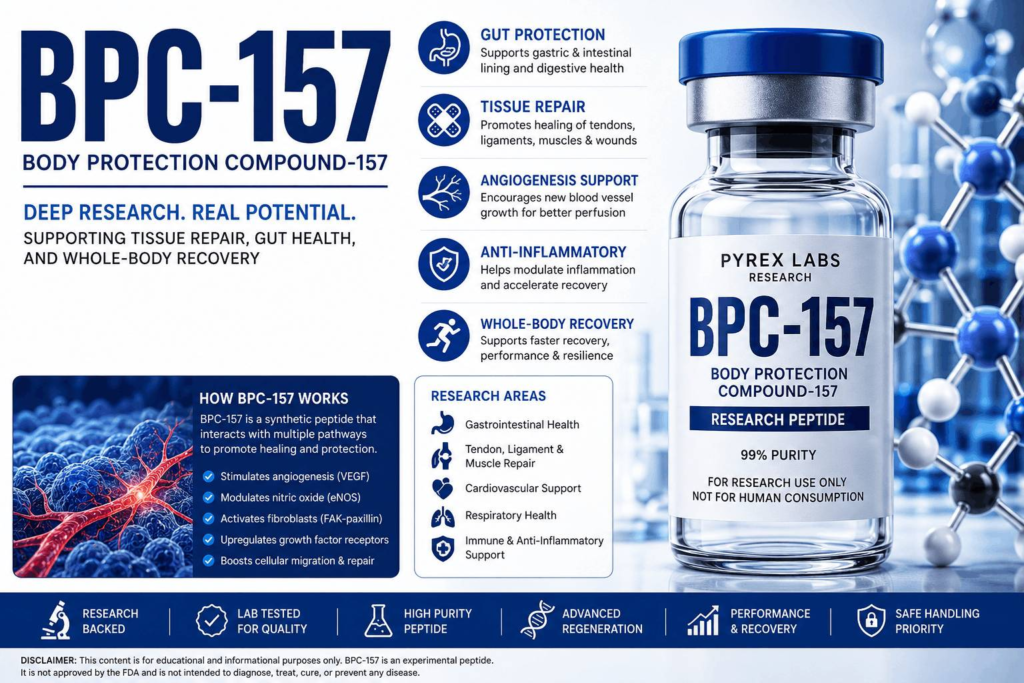
BPC-157 (Body Protection Compound-157) is a synthetic 15-amino-acid peptide derived from a sequence associated with a protective protein found in gastric juice.
Research into BPC-157 originated largely from investigators in Croatia and has focused heavily on gastrointestinal protection, wound healing, tissue injury, inflammatory processes, and vascular responses.
Despite widespread discussion of BPC-157 in peptide and fitness communities, it remains an experimental compound and is not an FDA-approved medication.
II. Science Behind the Peptide
BPC-157 is a pentadecapeptide, meaning it contains 15 amino acids.
Preclinical research suggests that BPC-157 may influence several biological systems involved in injury and repair rather than acting through one established receptor.
Areas under investigation include:
- Angiogenesis: Experimental research suggests effects on pathways involved in blood-vessel formation and vascular repair.
- Nitric Oxide Signaling: BPC-157 has been studied for interactions with nitric-oxide pathways involved in vascular function.
- Fibroblast Activity: Laboratory research has investigated effects on fibroblast migration and signaling involved in tissue repair.
- Growth-Factor Signaling: Experimental findings suggest interactions with pathways involving growth factors and cellular repair.
- Inflammatory Signaling: BPC-157 has been investigated in models involving inflammatory responses and tissue injury.
These mechanisms remain primarily supported by laboratory and animal research rather than large controlled human trials.
III. Early Research Applications
One of the most extensively investigated areas of BPC-157 research is gastrointestinal protection.
Animal studies have explored potential effects involving:
- Gastric ulcers
- Intestinal injury
- NSAID-associated gastrointestinal damage
- Inflammatory gastrointestinal conditions
- Fistulas and tissue injury
Research later expanded into tendon, ligament, muscle, nerve, vascular, and other tissue-repair models.
CHAPTER 2: PREPARATION & SAFETY CHECKLIST ✅
There is currently no standardized clinical screening protocol specifically validated for BPC-157.
Anyone considering exposure to an experimental peptide should discuss individual health conditions, medications, and appropriate monitoring with a qualified healthcare professional.
I. Potential Health Monitoring
Depending on the clinical situation, general testing might include:
CBC: Provides information about blood-cell health.
Comprehensive Metabolic Panel: Can provide information about liver, kidney, electrolyte, and metabolic status.
Liver Function: ALT, AST, alkaline phosphatase, and bilirubin may be considered when clinically appropriate.
Kidney Function: Creatinine and eGFR can help evaluate renal function.
Inflammatory Markers: CRP or hs-CRP can provide information about systemic inflammation but are nonspecific.
Metabolic Testing: Fasting glucose, HbA1c, or other tests may be appropriate when metabolic health is relevant.
Specific numerical targets for hs-CRP, fasting insulin, or HbA1c should not be represented as mandatory BPC-157 safety thresholds.
II. Medication & Supplement Considerations
A comprehensive human drug-interaction profile for BPC-157 has not been established.
Claims that everyone using BPC-157 must avoid NSAIDs, anticoagulants, progesterone, or other specific medications are not adequately supported by controlled human research.
However, medications affecting blood clotting, cardiovascular function, inflammation, or wound healing may be particularly relevant when discussing experimental compounds with a healthcare professional.
Do not stop prescribed medications simply to use BPC-157.
CHAPTER 3: DOSAGE & ADMINISTRATION 💉
There is currently no FDA-approved or universally established human dose for BPC-157.
Online protocols frequently describe microgram-level daily doses, injection schedules, oral formulations, and multi-week cycles. These should not be confused with validated medical dosing guidelines.
Route of Administration
Experimental discussions commonly involve:
- Subcutaneous administration
- Oral formulations
However, comparative human evidence establishing the optimal route, bioavailability, or clinical effectiveness is limited.
Timing
Claims that BPC-157 must be administered:
- At night
- On an empty stomach
- Before meals
- Twice daily because of a specific plasma half-life
have not been sufficiently validated through controlled human pharmacokinetic research.
Cycle Length
Frequently promoted 4-, 8-, or 12-week cycles are not established clinical standards.
There is also insufficient evidence that users need a mandatory off-cycle period to “resensitize” to BPC-157.
Total Peptide Per Cycle
Because there is no established therapeutic human dose or standardized cycle, calculating a universal amount required for a complete BPC-157 cycle would create a level of dosing certainty that current evidence does not support.
CHAPTER 4: WHAT TO EXPECT 🎯
There is no clinically established 12-week response timeline for BPC-157.
Preclinical research has instead focused on biological processes such as:
- Gastrointestinal tissue protection
- Tendon and ligament healing
- Muscle injury
- Fibroblast migration
- Angiogenesis
- Vascular signaling
- Nerve injury
- Inflammatory responses
Claims that users should experience a particular percentage reduction in pain by Week 4, visible tendon remodeling by Week 6, or complete athletic recovery by Weeks 10–12 have not been demonstrated in controlled human trials.
Recovery from an injury depends on the tissue involved, injury severity, rehabilitation, nutrition, sleep, medical treatment, and many other factors.
CHAPTER 5: POTENTIAL SIDE EFFECTS ⚠️
One of the major limitations surrounding BPC-157 is the lack of extensive controlled human safety data.
Potential concerns include:
Injection-Site Reactions
Experimental injectable preparations may potentially cause:
- Redness
- Burning
- Itching
- Swelling
- Bruising
- Pain
- Infection
General Symptoms
Anecdotal reports sometimes describe:
- Nausea
- Headache
- Fatigue
- Dizziness
However, reliable incidence rates and direct causality have not been established.
Unknown Long-Term Effects
The long-term consequences of repeated BPC-157 exposure in humans remain uncertain.
Product Quality
Unapproved research products may introduce risks involving incorrect identity, inaccurate concentration, impurities, contamination, degradation, or lack of sterility.
CHAPTER 6: COMMON RESEARCH MISTAKES 🤦
Treating Animal Research as Human Clinical Proof
BPC-157 has produced interesting results in numerous experimental models, but animal findings cannot automatically predict human outcomes.
Expecting Rapid Injury Repair
Tendons, ligaments, cartilage, and other connective tissues can heal slowly because of their biological characteristics and blood supply.
BPC-157 should not be viewed as a replacement for appropriate rehabilitation.
Neglecting the Foundation
Recovery still depends heavily on:
- Adequate nutrition
- Appropriate protein intake
- Sleep
- Progressive rehabilitation
- Proper diagnosis
- Injury-specific treatment
Poor Storage or Handling
Experimental peptide formulations can be affected by temperature, light, contamination, and handling conditions.
Storage requirements should come from the dispensing pharmacy, manufacturer, or validated formulation instructions rather than a universal internet rule.
Ignoring Product Quality
Purity claims alone do not establish sterility, potency, identity, or clinical safety.
CHAPTER 7: DISCONTINUATION 🏁
BPC-157 is not a conventional anabolic steroid or replacement hormone.
There is currently no established evidence demonstrating that it suppresses endogenous testosterone, growth hormone, or another major hormonal axis in the same manner as exogenous hormone therapy.
There is also no validated BPC-157 tapering protocol.
Claims that treatment must continue until an injury is “95–100% healed” or that users require a specific multi-week off-cycle are not established clinical guidelines.
When used under professional supervision, decisions about discontinuation should be made with the supervising healthcare professional.
CHAPTER 8: BPC-157 & PEPTIDE COMBINATIONS 🧬
Combining experimental compounds can introduce additional uncertainty because combination-specific safety and efficacy studies are limited.
TB-500 + BPC-157
This combination is frequently called the “Wolverine Stack” in peptide communities.
BPC-157 and Tβ4-related compounds have been investigated in different tissue-repair pathways, but there is insufficient controlled human evidence demonstrating that combining them produces superior healing.
CJC-1295 / Ipamorelin + BPC-157
Growth-hormone secretagogues influence endocrine signaling, while BPC-157 is being investigated through different repair pathways.
Claims that BPC-157 increases growth-hormone receptor density sufficiently to create a proven synergistic stack remain unestablished.
NAD+ + BPC-157
NAD+ is essential to cellular energy metabolism.
However, describing NAD+ supplementation as providing the specific “ATP fuel” necessary for BPC-157 to repair tissues oversimplifies cellular metabolism and has not been established as a clinical combination protocol.
KPV + BPC-157
KPV has been investigated for anti-inflammatory properties, particularly in experimental gastrointestinal models.
A clinically validated KPV/BPC-157 combination protocol does not currently exist.
GHK-Cu + BPC-157
Both compounds have generated interest in tissue and wound-healing research, but evidence demonstrating superior outcomes when they are combined remains insufficient.
CHAPTER 9: BPC-157 & MAJOR HEALTH CONDITIONS 🏥
Cardiovascular Disease
BPC-157 has been investigated in experimental models involving vascular signaling, nitric oxide, endothelial function, and cardiovascular injury.
These findings do not establish that BPC-157 lowers blood pressure, reverses atherosclerosis, or protects humans from heart attacks.
It should not replace established cardiovascular prevention or treatment.
Diabetes & Metabolic Health
Inflammation, vascular health, and tissue repair are relevant to diabetes research.
However, BPC-157 has not been established as a treatment for insulin resistance or diabetes, and claims of predictable reductions in fasting glucose or HOMA-IR require substantially stronger human evidence.
Cancer
BPC-157 research involving angiogenesis and cellular signaling creates important unanswered questions regarding abnormal cell growth.
Preclinical findings are complex and do not establish that BPC-157 either causes cancer or treats cancer.
People with active or previous malignancies should discuss experimental peptide exposure with their oncology team.
Respiratory & Lung Disease
Experimental research has investigated BPC-157 in models of tissue injury, including some pulmonary conditions.
There is currently insufficient human evidence to claim that BPC-157 reverses pulmonary fibrosis, improves COPD by a specific percentage, or treats respiratory infections.
Kidney Disease
Preclinical studies have explored BPC-157 in several organ-injury models.
These findings do not establish BPC-157 as a treatment capable of reversing chronic kidney disease or renal fibrosis in humans.
CHAPTER 10: SUMMARY 📝
BPC-157 is an experimental 15-amino-acid peptide that has attracted significant research interest for its potential involvement in gastrointestinal protection, vascular signaling, inflammatory regulation, and tissue-repair processes.
Preclinical research has explored BPC-157 in models involving:
- Gastrointestinal protection
- Tendon and ligament repair
- Muscle injury
- Wound healing
- Angiogenesis
- Nitric-oxide signaling
- Nerve injury
- Inflammatory responses
Its unusually broad preclinical research profile explains why BPC-157 has become one of the most discussed experimental peptides in regenerative research.
However, the distinction between promising preclinical findings and established human medicine is critical.
BPC-157 does not currently have the level of controlled human clinical evidence required to support claims that it reliably heals injuries, reverses chronic diseases, treats cancer, restores kidney function, or prevents cardiovascular disease.
The most scientifically accurate description is that BPC-157 is a promising but experimental research peptide whose potential therapeutic applications, optimal dosing, long-term safety, and clinical effectiveness require considerably more human research.
⚠️ Disclaimer: This material is provided solely for educational and informational purposes. BPC-157 is an experimental peptide, and this article does not provide medical advice, diagnosis, dosing instructions, or treatment recommendations. Preclinical findings do not necessarily demonstrate safety or effectiveness in humans. Consult a licensed healthcare professional before starting, stopping, combining, or changing medications, supplements, peptides, or other therapies.