CHAPTER 1: PEPTIDE OVERVIEW 📋
I. History of AOD-9604
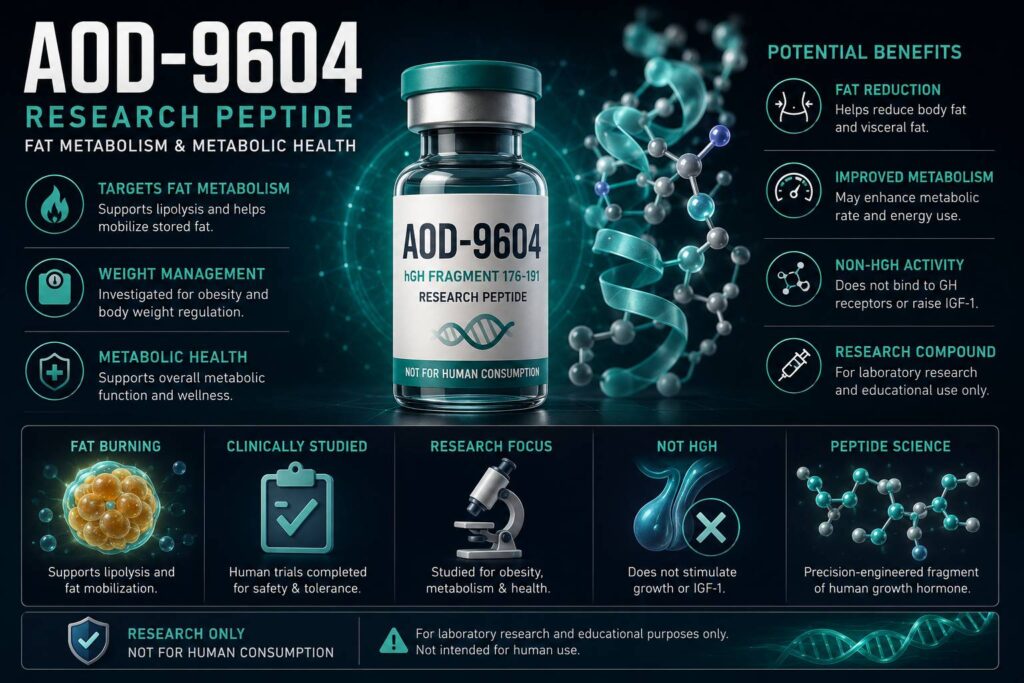
AOD-9604 is a synthetic peptide fragment derived from the C-terminal region of human growth hormone (hGH). It was developed as researchers investigated whether some of growth hormone’s metabolic effects could be separated from its broader growth-promoting activity.
The compound was studied primarily as a potential treatment for obesity and metabolic disease, with the goal of influencing fat metabolism without reproducing the full biological activity of intact growth hormone.
AOD-9604 eventually progressed into human clinical development. Although early research established that it could be administered to humans, clinical studies did not demonstrate sufficiently consistent or clinically meaningful weight-loss efficacy to establish it as an approved obesity medication.
II. Science Behind AOD-9604
AOD-9604 corresponds to a modified fragment of the growth hormone molecule, commonly described as hGH fragment 176–191.
Research has focused largely on its potential effects on adipose-tissue and lipid metabolism rather than conventional growth hormone activity.
Preclinical studies have investigated possible effects involving:
- Lipolysis — mobilization of stored triglycerides
- Lipogenesis — formation and storage of new fat
- Adipose-tissue metabolism
- Energy balance
- Body-weight regulation
Importantly, AOD-9604 should not simply be treated as a smaller version of injectable HGH. Its biological activity and clinical evidence are different from full-length growth hormone.
III. First Research Applications
The principal clinical-development target for AOD-9604 was obesity.
Researchers hoped that isolating a metabolic region of growth hormone might provide some influence on fat metabolism without producing the broader endocrine effects associated with full-length HGH.
Human studies were conducted, but the overall weight-loss results were not strong enough to establish AOD-9604 as an effective obesity therapy.
This history is important because AOD-9604 is often marketed today with claims that go considerably beyond what human trials have demonstrated.
CHAPTER 2: RESEARCH & SAFETY CHECKLIST ✅
There is no clinically validated AOD-9604 laboratory checklist and no specific biomarker panel proven to predict whether someone will respond to the compound.
For medically supervised research, general health evaluation may still be appropriate.
I. Potential Laboratory Considerations
Comprehensive Metabolic Panel (CMP): Provides general information about kidney function, liver function, electrolytes, and metabolic health.
Fasting Glucose: Helps assess baseline glucose regulation.
HbA1c: Provides a longer-term measure of blood-glucose control.
Lipid Panel: Measures cholesterol and triglycerides and may be useful when evaluating overall cardiometabolic health.
Thyroid Testing: May be appropriate when unexplained weight changes or metabolic symptoms suggest possible thyroid dysfunction.
These tests represent general metabolic evaluation rather than mandatory AOD-9604-specific requirements.
II. Medication & Supplement Considerations
A comprehensive human interaction profile for AOD-9604 has not been established.
There is insufficient evidence to claim that specific foods, carbohydrates, supplements, or medications universally “switch off” AOD-9604.
Likewise, established medications should not be discontinued simply to accommodate an experimental peptide.
Combining AOD-9604 with other investigational compounds also introduces additional uncertainty because many popular combinations have not undergone controlled human testing.
CHAPTER 3: ADMINISTRATION & RESEARCH PROTOCOLS 🧪
AOD-9604 does not have an FDA-approved dosing regimen for weight loss, fat reduction, joint repair, or athletic performance.
Consequently, commonly circulated protocols should not be presented as established medical dosing standards.
I. Reconstitution
If AOD-9604 is supplied as a lyophilized research product, preparation requirements depend on the specific formulation and manufacturer.
Claims that AOD-9604 universally requires a particular concentration of acetic acid instead of bacteriostatic water should not be generalized across products without validated formulation-specific instructions.
Sterility, stability, concentration, and compatibility are especially important for injectable preparations.
II. Dose & Frequency
Online protocols frequently specify daily microgram doses. However, there is currently no universally accepted therapeutic dose for routine weight management.
Historical clinical trials used defined experimental regimens under controlled conditions, which should not automatically be converted into self-administration protocols.
III. Timing
There is insufficient clinical evidence establishing that AOD-9604 must always be administered:
- While fasting
- First thing in the morning
- Immediately before exercise
- A specific number of hours before or after eating
The claim that insulin completely switches off AOD-9604’s effects in humans has not been established as a clinical dosing rule.
IV. Cycle Length
Commonly promoted 8–12 week cycles, six-month protocols, and mandatory off-periods are not established clinical requirements.
There is also insufficient evidence that periodic breaks are required specifically to prevent AOD-9604 receptor desensitization.
V. Total Amount Per Cycle
Because no universally accepted therapeutic cycle exists, calculating a standard amount required for an 8-, 12-, or 16-week AOD-9604 protocol would imply a level of clinical certainty that current evidence does not support.
CHAPTER 4: EXPECTATIONS 🎯
AOD-9604 should not be described as a guaranteed fat-loss peptide.
Its human clinical history is particularly important here.
Although preclinical research provided a rationale for investigating AOD-9604 for obesity, controlled human development ultimately produced inconsistent weight-loss results.
There is therefore no scientifically validated timeline such as:
Weeks 1–4: fat mobilization begins
Weeks 5–8: visible fat loss
Weeks 9–12: significant body-composition transformation
These timelines should not be presented as predictable outcomes.
What Has Actually Been Studied?
Research has investigated AOD-9604 in areas involving:
- Obesity
- Body-weight regulation
- Fat metabolism
- Adipose-tissue biology
- Metabolic health
Researchers have also explored possible applications outside weight management, but evidence for many of these uses remains preliminary.
Nutrition, physical activity, sleep, medications, genetics, and baseline metabolic health remain major determinants of body composition.
CHAPTER 5: POTENTIAL SIDE EFFECTS ⚠️
Available clinical research has provided some human safety information, but this does not establish long-term safety for every formulation, dose, or route currently marketed.
Potential considerations include:
Injection-Site Reactions
Injectable preparations can potentially produce:
- Redness
- Swelling
- Itching
- Soreness
- Bruising
- Infection
Headache
Headache may occur, although it should not automatically be attributed to dehydration or electrolyte deficiency.
Gastrointestinal Symptoms
Nausea or gastrointestinal discomfort may occur in some individuals.
Fatigue
Fatigue is nonspecific and can have numerous causes. It should not automatically be interpreted as evidence that AOD-9604 is “mobilizing fat.”
Product-Quality Risks
With unapproved research products, additional risks may include:
- Incorrect concentration
- Contamination
- Degradation
- Mislabeling
- Lack of sterility
These risks can be separate from the pharmacology of AOD-9604 itself.
CHAPTER 6: COMMON RESEARCH MISTAKES 🤦
Treating AOD-9604 as Proven Weight-Loss Therapy
AOD-9604 was investigated for obesity, but its clinical program did not establish the degree of weight-loss efficacy required for an approved obesity treatment.
Assuming “Fat Mobilization” Equals Fat Loss
Even if a compound influences lipid metabolism, long-term fat loss depends on whole-body energy balance and numerous metabolic processes.
Treating Fasting as Mandatory
Claims that eating immediately shuts down AOD-9604’s activity are not established human clinical rules.
Treating It Like HGH
AOD-9604 is derived from a portion of growth hormone but should not be assumed to reproduce the systemic endocrine effects of full-length HGH.
Shaking or Mishandling Injectable Products
Any injectable preparation should be handled according to validated product-specific instructions. Universal claims about peptide degradation from ordinary movement should be avoided unless supported for the particular formulation.
Expecting Spot Reduction
There is no convincing evidence that AOD-9604 allows users to selectively choose where body fat is lost.
CHAPTER 7: DISCONTINUATION 🏁
There is no established evidence that AOD-9604 requires a hormonal-style taper.
However, statements that everyone can simply stop treatment without any considerations are broader than available evidence supports.
There is also no validated requirement for a specific 2–4 week washout period to restore receptor sensitivity.
Because AOD-9604 has not been established as a long-term obesity medication, standardized discontinuation and maintenance protocols have not been developed.
CHAPTER 8: AOD-9604 COMBINATIONS 🧬
Combination strategies are frequently discussed online, but most have not been evaluated in controlled clinical trials.
GLP-1–Based Therapies + AOD-9604
Drugs such as tirzepatide and semaglutide have substantial human clinical evidence demonstrating effects on appetite, glucose regulation, and body weight.
Adding AOD-9604 should not automatically be described as producing synergistic fat loss because controlled evidence demonstrating an additional benefit is lacking.
CJC-1295 / Ipamorelin + AOD-9604
CJC-1295 and Ipamorelin influence the GH/IGF-1 axis through different receptor systems.
There is insufficient evidence establishing that combining these compounds with AOD-9604 improves muscle preservation or fat loss in humans.
MOTS-c + AOD-9604
MOTS-c is an experimental mitochondrial-derived peptide studied in metabolic research.
Theoretical complementary mechanisms do not establish clinical synergy.
BPC-157 + AOD-9604
Both compounds have been discussed in experimental tissue and repair research.
However, controlled human evidence demonstrating improved cartilage regeneration from this combination is lacking.
CHAPTER 9: AOD-9604 & MAJOR HEALTH CONDITIONS 🏥
Heart Disease ❤️
Reducing obesity can improve cardiovascular risk, but this does not establish that AOD-9604 directly prevents cardiovascular disease.
Claims that AOD-9604 breaks down arterial plaque are not supported by sufficient clinical evidence.
Stroke & Cerebrovascular Disease 🧠
Metabolic health is strongly associated with stroke risk.
However, AOD-9604 has not been established as a treatment for hyperlipidemia, stroke prevention, or cerebrovascular disease.
Cancer 🎗️
AOD-9604 differs pharmacologically from full-length growth hormone, but this should not be translated into a blanket claim that it is “safe for cancer.”
Cancer biology is complex, and individuals with active or previous malignancy should discuss experimental compounds with their medical team.
Diabetes Mellitus 🩸
AOD-9604 was partly developed in an effort to separate metabolic effects from some of the broader effects of HGH.
However, it should not be described as a treatment that improves insulin sensitivity or reverses diabetes without adequate human evidence.
Respiratory Infections 🫁
There is insufficient evidence that AOD-9604 prevents or treats pneumonia, viral respiratory infections, or other infectious diseases.
General metabolic health can influence overall health, but that does not establish AOD-9604 as an immune therapy.
Kidney Disease
Available evidence does not establish AOD-9604 as a kidney-protective therapy.
Claims of “no renal toxicity” should also be interpreted cautiously because absence of a signal in limited studies does not prove safety across all populations and long-term exposures.
Liver Disease
Fat metabolism and liver health are closely related, particularly in metabolic dysfunction-associated steatotic liver disease.
However, AOD-9604 has not been established as a treatment for fatty liver disease or other hepatic disorders.
CHAPTER 10: SUMMARY 📝
AOD-9604 is a synthetic peptide derived from the C-terminal region of human growth hormone that was developed primarily to investigate whether metabolic effects associated with GH could be separated from its broader endocrine activity.
Research interest has centered on:
- Fat metabolism
- Adipose-tissue biology
- Obesity research
- Body-weight regulation
- Metabolic health
AOD-9604 is particularly notable because it progressed beyond laboratory research into human clinical development for obesity.
However, that history also provides an important reality check: despite encouraging biological rationale and preclinical findings, human trials did not establish sufficiently convincing weight-loss efficacy for AOD-9604 to become an approved obesity treatment.
Claims involving guaranteed fat loss, spot reduction, arterial-plaque removal, improved insulin sensitivity, cartilage regeneration, precise fasting windows, or dramatic synergy with other peptides therefore extend beyond established evidence.
AOD-9604 remains scientifically interesting as an example of attempts to isolate specific metabolic properties of the growth hormone molecule, but it is best characterized as an investigational peptide with historical human obesity research and limited evidence supporting many of the modern claims surrounding its use.
⚠️ Disclaimer: This material is provided solely for educational and informational purposes. It is not medical advice, diagnosis, dosing guidance, or a treatment recommendation. AOD-9604 is not an FDA-approved weight-loss treatment. Research products may have additional quality, purity, sterility, and regulatory risks. Consult a qualified healthcare professional before using or combining experimental compounds, medications, or supplements.