CHAPTER 1: COMPOUND OVERVIEW 📋
I. History
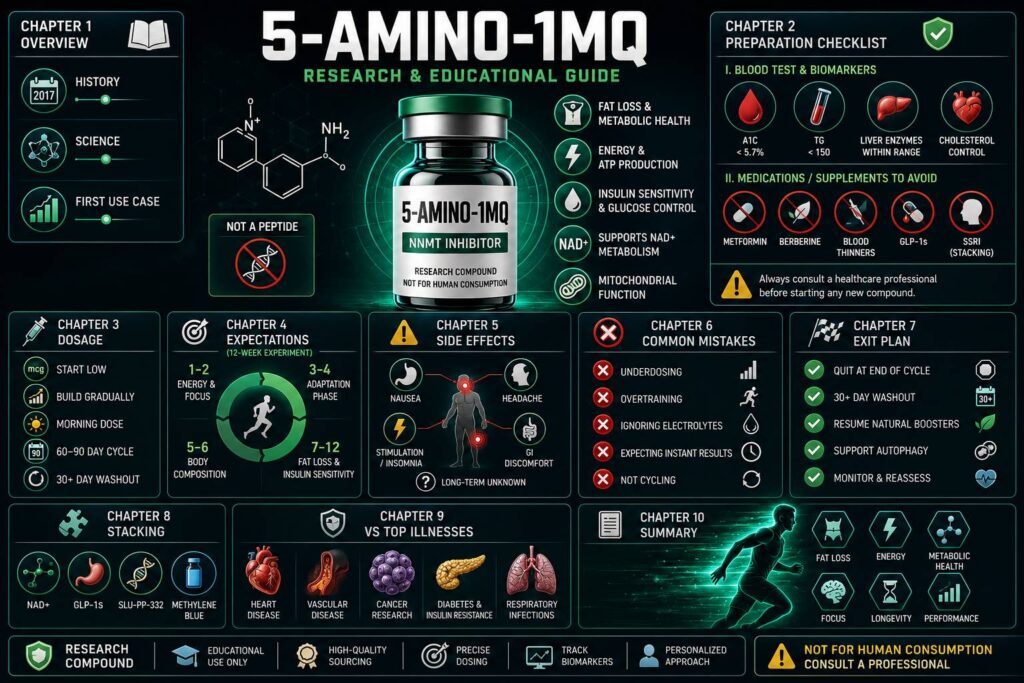
5-Amino-1MQ (5-amino-1-methylquinolinium) is an experimental small molecule developed through research into nicotinamide N-methyltransferase (NNMT), an enzyme involved in nicotinamide and methyl-group metabolism.
Interest in NNMT increased after researchers found associations between elevated NNMT activity and adipose-tissue metabolism, obesity, insulin resistance, and metabolic dysfunction.
5-Amino-1MQ was developed as an NNMT inhibitor and became particularly interesting after preclinical experiments suggested that inhibiting NNMT could influence energy expenditure, adipose-tissue metabolism, and body weight.
Despite sometimes being marketed alongside research peptides, 5-Amino-1MQ is not a peptide.
II. Science Behind 5-Amino-1MQ
NNMT transfers a methyl group from S-adenosylmethionine (SAM) to nicotinamide, producing 1-methylnicotinamide (1-MNA).
Because nicotinamide participates in NAD+ salvage metabolism, altering NNMT activity can affect several interconnected metabolic pathways.
Preclinical research into NNMT inhibition has investigated potential effects on:
- NAD+ metabolism
- Cellular energy regulation
- Adipose-tissue metabolism
- Glucose homeostasis
- Insulin sensitivity
- Methyl-donor metabolism
- Energy expenditure
It is important not to oversimplify this mechanism as simply “preventing NAD+ breakdown.” NNMT participates in a broader network involving nicotinamide, methylation, and NAD+ metabolism.
III. Early Research Applications
Much of the early interest in 5-Amino-1MQ involved metabolic dysfunction and obesity models.
Animal studies of NNMT inhibition have reported changes involving:
- Body weight
- Adipose tissue
- Energy expenditure
- Glucose metabolism
- Insulin sensitivity
These findings have generated considerable interest in 5-Amino-1MQ as a metabolic research compound.
However, promising animal results should not be interpreted as established weight-loss efficacy in humans.
CHAPTER 2: PREPARATION & SAFETY CHECKLIST ✅
There is currently no clinically validated 5-Amino-1MQ screening protocol and no established laboratory range that determines whether someone is an appropriate candidate for the compound.
Because human safety and efficacy data remain limited, any clinical monitoring would need to be individualized.
I. Potential Laboratory Considerations
Depending on the research or medical context, general metabolic testing might include:
Fasting Glucose: Provides information about current glucose regulation.
HbA1c: Reflects longer-term glucose control.
Lipid Panel: Measures cholesterol and triglycerides and provides broader information about metabolic and cardiovascular health.
Liver Function: ALT, AST, bilirubin, and related markers may be appropriate when evaluating hepatic health.
Kidney Function: Creatinine and eGFR may be useful for evaluating renal status.
There are currently no validated 5-Amino-1MQ-specific “optimal” biomarker targets.
II. Medication & Supplement Considerations
A comprehensive human drug-interaction profile for 5-Amino-1MQ has not been established.
Particular caution may be warranted when combining an experimental metabolic compound with medications or supplements that substantially affect:
- Blood glucose
- Insulin sensitivity
- Appetite
- Body weight
- Liver metabolism
- Cardiovascular physiology
This may include glucose-lowering medications and incretin-based drugs.
There is also insufficient evidence to recommend avoiding or combining metformin, berberine, anticoagulants, NAD+ products, or other metabolic compounds solely on the basis of a standardized 5-Amino-1MQ protocol.
CHAPTER 3: DOSAGE & ADMINISTRATION 🧪
There is currently no FDA-approved human dose for 5-Amino-1MQ.
Specific oral or injectable protocols circulated online should therefore not be represented as established clinical dosing recommendations.
Oral Administration
5-Amino-1MQ is commonly discussed online as an oral research compound.
However, standardized human pharmacokinetic and dose-ranging evidence remains insufficient to establish a universally accepted:
- Starting dose
- Maintenance dose
- Maximum dose
- Administration frequency
Injectable Administration
Claims involving routine injectable doses of 5-Amino-1MQ are even less established.
An injectable protocol should not be extrapolated simply from oral dosing or animal research.
Timing
There is insufficient evidence demonstrating that 5-Amino-1MQ must be administered:
- First thing in the morning
- On an empty stomach
- According to cortisol rhythms
- At a specific interval from food
Likewise, insomnia or stimulation should not be presented as a guaranteed consequence of later administration without adequate evidence.
Cycle Length
Commonly promoted 60- or 90-day cycles and mandatory 30-day washout periods are not established clinical requirements.
Total Amount Per Cycle
Because there is no validated human therapeutic dose or standardized cycle, calculating a universal amount required for a complete 5-Amino-1MQ cycle would imply a level of dosing certainty that current evidence does not support.
CHAPTER 4: WHAT TO EXPECT 🎯
There is currently no clinically validated 12-week results timeline for 5-Amino-1MQ.
Preclinical NNMT-inhibition research has generated interest in:
- Adipose-tissue metabolism
- Energy expenditure
- NAD+ metabolism
- Glucose regulation
- Insulin sensitivity
- Metabolic flexibility
- Body-weight regulation
However, claims that users should experience an immediate energy surge during Week 1, appetite suppression during Weeks 2–3, visible fat loss by Week 6, or a particular number of pounds lost within 30 days are not supported by robust controlled human evidence.
5-Amino-1MQ should also not be presented as producing simultaneous fat loss and muscle gain independent of nutrition, exercise, and other metabolic factors.
CHAPTER 5: POTENTIAL SIDE EFFECTS ⚠️
One of the largest uncertainties surrounding 5-Amino-1MQ is the limited amount of controlled human safety data.
A reliable incidence profile for adverse effects has not been established.
Potentially reported or theoretically relevant concerns may include:
Gastrointestinal Symptoms
Nausea or gastrointestinal discomfort may occur with experimental metabolic compounds, but frequency and causality for 5-Amino-1MQ are not well characterized.
Headache
Headache has been discussed anecdotally, but reliable incidence data are lacking.
Sleep or Stimulation Effects
Reports of increased energy or difficulty sleeping are largely anecdotal and should not be treated as predictable pharmacological effects.
Metabolic Effects
Because NNMT participates in metabolic pathways, unexpected effects on glucose regulation, methyl metabolism, or other metabolic processes remain areas requiring further research.
Unknown Long-Term Effects
The safety of prolonged NNMT inhibition in humans remains uncertain.
CHAPTER 6: COMMON RESEARCH MISTAKES 🤦
Calling 5-Amino-1MQ a Peptide
5-Amino-1MQ is a small-molecule NNMT inhibitor, not a peptide.
Treating Animal Weight Loss as Human Proof
Preclinical findings can identify promising mechanisms but cannot establish how much weight humans will lose—or whether clinically meaningful weight loss will occur at all.
Assuming There Is a Proven “Fat-Loss Threshold”
Claims that microgram dosing falls below a known human IC50 threshold for fat loss confuse laboratory enzyme inhibition measurements with clinical dosing.
Assuming More ATP Means More Energy
5-Amino-1MQ does not simply cause cells to manufacture unlimited ATP. Cellular energy metabolism is substantially more complex.
Ignoring Diet and Exercise
Even if NNMT inhibition ultimately proves useful for metabolic applications, it would not eliminate the importance of:
- Nutrition
- Physical activity
- Sleep
- Energy balance
- Metabolic health
Assuming Electrolyte Depletion
Claims that 5-Amino-1MQ inherently causes sodium, potassium, and magnesium depletion because it increases ATP production are not established.
CHAPTER 7: DISCONTINUATION 🏁
There is currently no established evidence that 5-Amino-1MQ requires a gradual taper.
However, there is also insufficient evidence to prescribe a universal 30-day washout period or claim that a washout is necessary to restore autophagy or metabolic signaling.
Long-term human data examining repeated cycles of NNMT inhibition remain limited.
For medically supervised experimental use, decisions regarding discontinuation should be based on individual circumstances and professional guidance.
CHAPTER 8: 5-AMINO-1MQ COMBINATIONS 🧬
Combining experimental metabolic compounds can introduce additional uncertainty.
A plausible biochemical rationale does not establish that a combination is safe or more effective.
NAD+ + 5-Amino-1MQ
NNMT and NAD+ metabolism are biologically connected through nicotinamide metabolism.
However, describing 5-Amino-1MQ as preventing NAD+ breakdown while supplemental NAD+ provides an external “boost” oversimplifies the pathway.
There is no established clinical protocol demonstrating superior cognitive, metabolic, or energy outcomes from this combination.
GLP-1–Based Therapies + 5-Amino-1MQ
GLP-1 and related incretin therapies have established effects on appetite, glucose regulation, and body weight.
5-Amino-1MQ works through a substantially different experimental mechanism.
Combining the two should not be described as a proven “top-down and bottom-up” fat-loss strategy without clinical evidence evaluating the combination.
SLU-PP-332 + 5-Amino-1MQ
SLU-PP-332 is itself an experimental research compound investigated primarily in preclinical metabolic research.
There is insufficient evidence establishing the safety or efficacy of combining it with 5-Amino-1MQ in humans.
Methylene Blue + 5-Amino-1MQ
Methylene blue has complex pharmacological actions, including effects on mitochondrial electron transport at certain concentrations.
Combining it with 5-Amino-1MQ has not been established as a clinically validated method for increasing cellular energy.
Methylene blue also has important drug-interaction considerations, particularly with serotonergic medications.
CHAPTER 9: 5-AMINO-1MQ & MAJOR HEALTH CONDITIONS 🏥
Heart Disease
Metabolic dysfunction, insulin resistance, obesity, and lipid abnormalities are important cardiovascular risk factors.
NNMT biology may therefore be relevant to cardiovascular research.
However, 5-Amino-1MQ has not been established as a treatment for high cholesterol, atherosclerosis, or heart disease in humans.
Specific percentage reductions in cholesterol or triglycerides observed in preclinical models should not be presented as expected human outcomes.
Vascular Disease & Stroke
Metabolic health and vascular function are closely connected, but there is insufficient evidence that 5-Amino-1MQ improves human circulation, prevents stroke, or treats vascular disease.
Cancer
NNMT expression has been investigated in several cancers, and altered cellular metabolism is an important feature of cancer biology.
However, this does not establish that inhibiting NNMT with 5-Amino-1MQ prevents or treats cancer.
The relationship between NNMT and tumor biology is complex and may differ between cancer types.
Diabetes & Insulin Resistance
This is one of the more scientifically interesting areas of NNMT research.
Preclinical studies suggest that altering NNMT activity can affect glucose metabolism and insulin sensitivity.
However, 5-Amino-1MQ has not been established as a treatment capable of reducing HbA1c by a predictable amount or reversing Type 2 diabetes in humans.
Respiratory Disease & Infection
NAD+ metabolism and mitochondrial function participate in immune-cell biology.
That does not establish that 5-Amino-1MQ strengthens immunity sufficiently to prevent or treat pneumonia, COVID-19, or other respiratory infections.
CHAPTER 10: SUMMARY 📝
5-Amino-1MQ is an experimental small-molecule inhibitor of nicotinamide N-methyltransferase (NNMT), an enzyme involved in nicotinamide, methyl-group, and metabolic regulation.
It is not a peptide, despite frequently appearing in peptide research catalogs.
Research into NNMT inhibition has generated interest because of potential effects involving:
- NAD+ metabolism
- Adipose-tissue biology
- Energy expenditure
- Glucose regulation
- Insulin sensitivity
- Metabolic health
- Methyl-group metabolism
Animal and laboratory findings have made 5-Amino-1MQ an intriguing compound for obesity and metabolic research. However, there remains a substantial difference between preclinical metabolic effects and demonstrated human weight-loss therapy.
Claims involving guaranteed rapid fat loss, specific HbA1c reductions, cholesterol improvements, muscle preservation, anti-aging effects, precise dosing cycles, or disease treatment currently extend beyond established human evidence.
The most scientifically accurate description is that 5-Amino-1MQ is a promising experimental NNMT inhibitor whose human efficacy, optimal dosing, long-term safety, and therapeutic applications remain under investigation.
⚠️ Disclaimer: This material is provided solely for educational and informational purposes. 5-Amino-1MQ is an experimental compound, and this article does not provide medical advice, dosing instructions, diagnosis, or treatment recommendations. Long-term human safety and efficacy have not been established. Consult a qualified healthcare professional before using or combining experimental compounds, medications, or supplements.