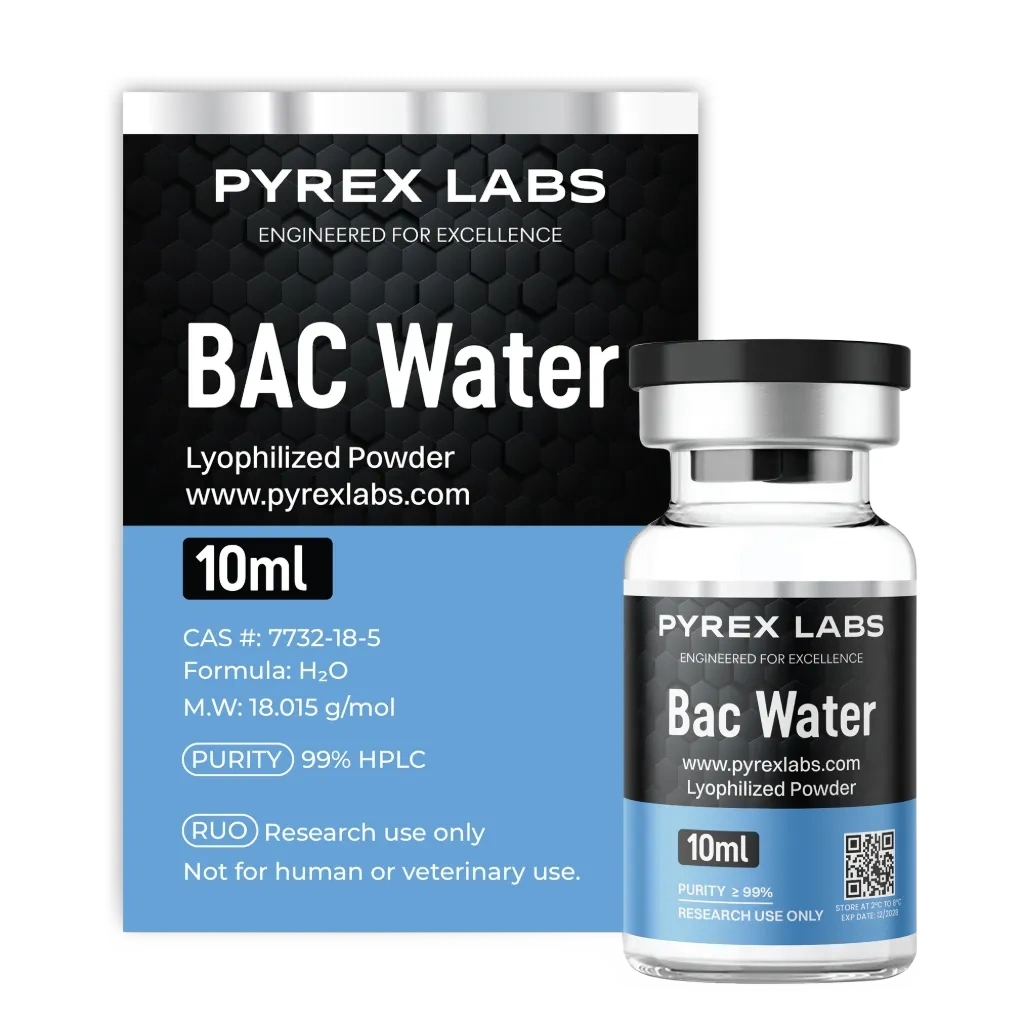
Bacteriostatic Water
$14.95
- Buy 5+ of each and save 5%
- Buy 10+ of each and save 8%
- Product is sold in powder form, needs reconstitution before use. Please read more on our FAQ page.
BAC Water (Bacteriostatic Water for Injection) is sterile, non-pyrogenic water containing 0.9% benzyl alcohol as a bacteriostatic preservative from Pyrex Labs. Unlike sterile water with no preservative, BAC Water is formulated for multi-dose use — the benzyl alcohol inhibits bacterial growth introduced during repeated needle punctures, allowing the vial to be used across multiple research sessions.
SHARE:
SHARE:
- Products sold on our website are designed for in vitro testing and lab experimentation exclusively.
- All the products you see on the website are being sold in a lyophilized powder state (freeze-dried), in a sealed sterile vial; and should be reconstituted.
- The product’s label clearly states the amount of product a vial contains; some products are offered in different variations.
- The products we are selling come in a sealed vial but require additional lab equipment for proper testing.
AVAILABILITY:
- Ships today if you order and pay by 12 PM CST
- Some product may take up to 72 hours to ship
- Backordered items will ship in 3-5 days
BAC Water (Bacteriostatic Water for Injection) is sterile, non-pyrogenic water containing 0.9% benzyl alcohol as a bacteriostatic preservative . Unlike sterile water for injection (which contains no preservative), BAC Water is specifically formulated for multi-dose use. The 0.9% benzyl alcohol concentration is the standard established by the USP (United States Pharmacopeia) for multi-dose vials .
The benzyl alcohol preservative inhibits the growth of most common bacteria that may inadvertently be introduced during repeated needle punctures of the stopper . This property makes BAC Water the preferred reconstitution medium for lyophilized (freeze-dried) peptides that researchers plan to store for more than a few hours or use across multiple experimental sessions.
Each vial is filled, sealed, and terminally sterilized. Ready to use as a sterile diluent for reconstituting lyophilized research peptides.
Best for: Reconstituting lyophilized peptides for multi-dose research use.
Why BAC Water for Peptide Research?
| Feature | BAC Water (0.9% BA) | Sterile Water (No Preservative) |
|---|---|---|
| Preservative | Yes (0.9% benzyl alcohol) | None |
| Multi-Dose Use | ✅ Yes (up to 28 days) | ❌ No (single-use only) |
| Bacterial Inhibition | ✅ Suppresses bacterial growth | ❌ None |
| Microbial Contamination Risk | Low | High after first puncture |
| Shelf Life (after opening) | 28 days (USP standard) | Hours (discard immediately) |
| Best For | Multi-dose peptide vials | One-time use, immediate consumption |
Mechanism of Action
Benzyl Alcohol as a Preservative: Benzyl alcohol acts as a local bacteriostatic agent by denaturing bacterial proteins and disrupting microbial cell membranes . At 0.9% concentration, it is effective against a broad spectrum of common bacteria, including Staphylococcus aureus, Pseudomonas aeruginosa, and Escherichia coli .
Not a Sterilant: BAC Water does not sterilize contaminated solutions. The preservative merely suppresses the growth of small numbers of bacteria that may be introduced through routine use. If a solution becomes heavily contaminated (cloudy, turbid, discolored), the bacteriostatic agent may be overwhelmed .
Multi-Dose Vial Standard: The USP standards for multi-dose vials require the inclusion of a bacteriostatic preservative “to inhibit the growth of microorganisms that may be introduced from withdrawing individual doses” . BAC Water containing 0.9% benzyl alcohol meets this specification.
Specifications
| Specification | Detail |
|---|---|
| Product | BAC Water (Bacteriostatic Water for Injection) |
| Composition | 99.1% Sterile Water + 0.9% Benzyl Alcohol (v/v) |
| Volume (Standard) | 10mL, 30mL (custom sizes available) |
| Preservative | Benzyl Alcohol, USP grade |
| Water Quality | Sterile, non-pyrogenic, distilled, USP grade |
| Sterilization Method | Terminal sterilization (autoclaving) |
| pH | 5.0 – 7.0 (typical) |
| Osmolality | ~0 mOsmol/kg (isotonic when used as diluent) |
| Container | Sealed sterile glass vial with rubber stopper & flip-off cap |
| Storage (unopened) | Room temperature (15-30°C), protected from light |
| Storage (opened) | Room temperature; discard after 28 days |
| Intended use | Laboratory and in-vitro research only |
Recommended Reconstitution Guidelines
Standard Reconstitution Volumes: Researchers typically reconstitute lyophilized peptide vials with 0.5–3 mL of BAC Water depending on desired final concentration and experimental protocol.
Example Calculations:
| Peptide Mass | BAC Water Volume | Final Concentration |
|---|---|---|
| 5 mg | 1.0 mL | 5 mg/mL |
| 5 mg | 2.0 mL | 2.5 mg/mL |
| 10 mg | 1.0 mL | 10 mg/mL |
| 10 mg | 2.0 mL | 5 mg/mL |
Proper Reconstitution Technique:
-
Wipe the rubber stopper of both BAC Water vial and peptide vial with a sterile alcohol swab
-
Draw the desired volume of BAC Water into a sterile syringe
-
Insert needle through the peptide vial stopper
-
Direct diluent gently down the inside glass wall — not directly onto the lyophilized cake
-
Swirl gently until fully dissolved. Do NOT shake (shaking can denature peptides)
-
Refrigerate reconstituted peptide at 2-8°C
Storage & Stability
Unopened Vials:
-
Store at room temperature (15-30°C / 59-86°F)
-
Protect from light and excessive heat
-
Do not freeze
-
Stable until expiration date printed on vial label
Opened Vials (Multi-Dose Use):
-
USP standards recommend discarding 28 days after first puncture
-
Store at room temperature (refrigeration not required but acceptable)
-
Always use sterile technique when withdrawing doses
-
Inspect before each use: discard if solution appears cloudy, turbid, or contains particulate matter
Stability of Reconstituted Peptides in BAC Water:
| Peptide Type | Typical Stability at 2-8°C |
|---|---|
| GHRH Analogue (CJC-1295, Sermorelin) | 14-30 days |
| GH Secretagogue (Ipamorelin, GHRP) | 14-30 days |
| Repair Peptide (BPC-157, TB-500) | 7-14 days |
| Copper Peptide (GHK-Cu) | 7-14 days |
| Fragments / Short Peptides | 7-30 days (sequence dependent) |
*Note: When in doubt, aliquot reconstituted peptide into single-use tubes and freeze at -20°C for long-term storage.*
Important Research Notes
Benzyl Alcohol Toxicity Considerations:
-
Benzyl alcohol has been associated with serious adverse events in neonates (gasping syndrome) and should not be used in research involving human infants
-
High concentrations of benzyl alcohol (1.8% and above) have demonstrated cytotoxic effects in certain cell culture systems
-
For cell culture applications sensitive to preservatives, researchers should use sterile water without preservative
Not for Use with Certain Peptides: Some peptides may precipitate or degrade in the presence of benzyl alcohol. If turbidity or precipitation occurs upon reconstitution, the peptide may be incompatible with BAC Water. In such cases, use sterile water for injection (preservative-free) and use immediately.
Do Not Freeze BAC Water: Freezing BAC Water is not recommended. The freezing process can cause differential freezing of water vs. benzyl alcohol, potentially altering the preservative concentration. Store at room temperature.
Contraindications in Research:
-
Do not use in cell culture without confirming cell line compatibility
-
Do not use for intrathecal or epidural administration in animal models (neurotoxicity risk)
-
Do not use if solution is not clear and colorless
Quality Assurance
Every lot of BAC Water undergoes rigorous quality control, including:
-
Sterility testing (USP <71>)
-
Endotoxin testing (LAL assay, USP <85>)
-
Benzyl alcohol concentration verification (USP <611>)
-
pH and osmolality testing
-
Visual inspection for particulates and container integrity
Each vial is coded with a lot number that links directly to quality control documentation. A lot-specific Certificate of Analysis (COA) is available upon request.
Comparison: BAC Water vs. Sterile Water vs. Normal Saline
| Feature | BAC Water (0.9% BA) | Sterile Water | Normal Saline (0.9% NaCl) |
|---|---|---|---|
| Preservative | ✅ 0.9% Benzyl Alcohol | ❌ None | ❌ None |
| Multi-Dose | ✅ Yes (28 days) | ❌ No | ❌ No |
| Bacteriostatic | ✅ Yes | ❌ No | ❌ No |
| Osmolality | ~0 mOsmol/kg | ~0 mOsmol/kg | ~308 mOsmol/kg |
| Peptide Solubility | Excellent | Excellent | Variable (salt may interfere) |
| Best Use | Multi-dose peptide storage | Single-use, preservative-sensitive | Not recommended (salt precipitation risk) |
Frequently Asked Questions
What is BAC Water? BAC Water (Bacteriostatic Water for Injection) is sterile water containing 0.9% benzyl alcohol as a bacteriostatic preservative. It is used as a diluent for reconstituting lyophilized peptides intended for multi-dose research use.
Why can’t I use regular sterile water? Sterile water contains no preservative. Once a vial is punctured, any bacteria introduced will grow unchecked. BAC Water contains 0.9% benzyl alcohol, which suppresses bacterial growth, allowing the vial to be used multiple times over 28 days.
How long can I use an opened BAC Water vial? USP standards recommend discarding opened BAC Water vials 28 days after first puncture. Always mark the opening date on the vial label.
Do I need to refrigerate BAC Water? No. BAC Water should be stored at room temperature (15-30°C). Refrigeration is not required but is acceptable. Do not freeze.
Can I freeze BAC Water? No. Freezing can alter the preservative concentration as water and benzyl alcohol freeze at different temperatures. Store at room temperature.
What should I do if the BAC Water becomes cloudy? Discard immediately. Cloudiness, turbidity, or particulate matter indicates microbial contamination.
Is BAC Water safe for cell culture? Not for all applications. Benzyl alcohol is cytotoxic to some cell lines at concentrations above 0.1-0.2%. For cell culture applications, use preservative-free sterile water and prepare single-use aliquots.
Do you provide a Certificate of Analysis? Yes. A lot-specific COA is available upon request for every case shipped.
Related Products from Pyrex Labs
Researchers who order BAC Water from Pyrex Labs frequently also purchase:
-
Empty Sterile Vials – For aliquot preparation
-
Pre-Sterilized Syringes (1mL, 3mL, 5mL) – For peptide reconstitution
-
Alcohol Prep Pads – For stopper sterilization
-
Peptide Storage Cases – For organized -20°C storage
-
Individual Peptides – Ipamorelin, TB-500, BPC-157, GLOW, etc.
Disclaimer
⚠️ FOR RESEARCH PURPOSES ONLY. NOT FOR HUMAN USE.
Not approved by the FDA. Not intended for diagnostic, therapeutic, or medical applications in humans or animals. For in-vitro laboratory research exclusively. Not for use in human injection, cell therapy, or any clinical application. Pyrex Labs products are intended solely for scientific investigation and research purposes by qualified professionals.
This product description is ready to copy and paste as plain text. Would you like me to create a shorter version or adjust the format for a specific platform?